
Author: Site Editor Publish Time: 2026-05-22 Origin: Site


Hebei Linchuan Safety Protective Equipment Co., LTD operates at the forefront of this manufacturing sector. This article provides a comprehensive overview of the technical infrastructure, quality assurance protocols, and material science that define a professional chainmail production facility.
The efficacy of a chainmail glove is fundamentally determined by the quality of the raw material. A professional factory must implement strict metallurgical controls at the point of entry.
AISI 304: The Standard Barrier: Most industrial safety applications utilize AISI 304 stainless steel. This austenitic alloy contains approximately 18% chromium and 8% nickel. It provides the necessary balance of tensile strength and oxidation resistance required for standard food processing and textile cutting environments.
AISI 316L: The Marine and Acid-Resistant Grade: For specialized environments, such as seafood processing or high-acid chemical cleaning, the factory must utilize AISI 316L. The addition of 2-3% molybdenum significantly enhances the material's resistance to pitting and crevice corrosion. Hebei Linchuan ensures that premium orders are manufactured with 316L to maximize the operational lifespan of the equipment in corrosive conditions.
A modern factory is categorized by its level of automation. High-precision machinery is required to maintain consistency across thousands of individual rings.
Precision Wire Drawing: The process begins with drawing stainless steel wire to a standardized diameter, typically 0.5mm. Tolerances are held within +/- 0.01mm to ensure that the final weight and flexibility of the glove are predictable.
Automated Ring Forming: Specialized machines form the wire into circular rings. In a professional factory setting, these machines operate at high speeds while maintaining a perfect circular geometry, which is essential for the subsequent welding phase.
Plasma and Laser Welding Stations: The most critical stage is the welding of each ring. Older manufacturing methods relied on butted rings (unwelded), which can open under minimal pressure. Hebei Linchuan utilizes advanced plasma welding technology, where every ring is fused shut. This creates a bond that is physically stronger than the wire itself.
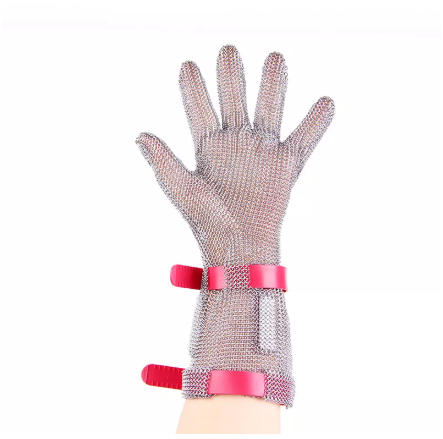
The structural integrity of chainmail is derived from the 4-in-1 weaving pattern. In this configuration, every single ring passes through four adjacent rings.
Flexibility vs. Protection: This weaving pattern allows the mesh to flow like fabric, conforming to the contours of the human hand. It ensures that the worker maintains the dexterity required for high-yield operations without compromising safety.
Structural Redundancy: The 4-in-1 matrix provides mechanical redundancy. If a single ring were to fail under extreme stress, the surrounding rings continue to maintain the barrier, preventing the blade tip from reaching the wearer's skin.
A reputable factory must align its production with international safety frameworks. This data allows procurement officers to make objective purchasing decisions.
EN 1082-1: The European Benchmark: This standard evaluates Protective clothing — Gloves and arm guards protecting against cuts and stabs by hand knives. Impact Energy Test: The mesh is subjected to a blade strike with a kinetic energy of 2.45 Joules. Penetration Depth: To pass the test, the penetration of the knife tip must be restricted to a specified depth (often less than 10mm). Wholesale Implication: Hebei Linchuan products are designed to meet these benchmarks, ensuring that global shipments comply with EU and North American import safety regulations.
ISO 13998 and ANSI/ISEA: For industrial environments involving powered blades or high-speed cutting, higher levels of protection are calibrated according to ISO 13998. These standards provide the data necessary for safety managers to assess the level of risk mitigation provided by the factory’s output.
Safety equipment is only effective if it is worn correctly and consistently. A professional factory must prioritize ergonomics in its design phase.
Weight Optimization: Using 0.5mm wire, a standard chainmail glove weighs approximately 150-200 grams. This minimizes hand fatigue during 8-hour shifts.
Ambidextrous Design: Most modern chainmail gloves are reversible. For a factory, this simplifies the manufacturing line; for the end-user, it reduces inventory complexity, as any glove can fit either the left or right hand.
Closure Systems: Hebei Linchuan provides various closure options, including adjustable TPU (Thermoplastic Polyurethane) straps, textile straps, and metal claw closures. TPU is often preferred in the food industry for its antimicrobial properties.
In the food processing industry, chainmail is a tool for both safety and hygiene. The factory must ensure that the finish of the rings is smooth to facilitate cleaning.
Non-Porous Surface: Stainless steel is inherently non-porous. Unlike fiber-based gloves, chainmail does not harbor bacteria within the material itself.
Sterilization Compatibility: Chainmail is resistant to high temperatures (up to 82°C / 180°F for standard cleaning) and harsh chemical sanitizers. This makes it a sustainable, long-term solution for HACCP-compliant facilities.
For wholesale buyers, the factory's price point is part of a larger economic calculation.
Durability vs. Replacement: Synthetic cut-resistant gloves often require replacement every 2-4 weeks due to fraying or odor. A single stainless steel glove from Hebei Linchuan can last for years.
Data Insight: Over a 3-year period, the cost of one chainmail glove is approximately 15% of the cost of the multiple synthetic replacements required for the same workstation.
The manufacturing of stainless steel chainmail gloves is a specialized field that requires a synthesis of metallurgy, mechanical engineering, and safety compliance. Hebei Linchuan Safety Protective Equipment Co., LTD is dedicated to providing industrial-grade solutions that protect human capital while enhancing operational efficiency. By focusing on plasma-welded rings, AISI 316L material options, and rigorous adherence to EN 1082-1 standards, we ensure that our global partners receive products that perform in the most demanding environments.