
Author: Lin Publish Time: 2026-09-18 Origin: Site


Stainless steel chainmail gloves represent a specialized category of personal protective equipment designed to protect workers from cuts and punctures caused by hand knives. While synthetic cut-resistant materials have advanced in recent years, chainmail remains the material of choice for certain applications, particularly in meat processing facilities where hygiene, cleanability, and resistance to powered cutting tools are critical requirements. For wholesale buyers, distributors, and procurement managers, understanding the supply landscape for stainless steel chainmail gloves is essential to making informed purchasing decisions. This guide provides a structured overview of supplier selection criteria, product specifications, certification requirements, and market considerations relevant to sourcing chainmail gloves from manufacturers.
Chainmail gloves are constructed from interlocking stainless steel rings that form a flexible mesh. The mesh is typically made from 304 or 316 grade stainless steel, with 316L being common for applications requiring higher corrosion resistance and food contact compliance. Each ring is individually welded to maintain structural integrity, and the finished product undergoes testing to verify cut and puncture resistance.
The primary market for stainless steel chainmail gloves is the meat and poultry processing industry. In these environments, workers use hand knives for deboning, cutting, and trimming operations. A chainmail glove is typically worn on the non-dominant hand, which holds the meat, while the dominant hand wields the knife. Beyond meat processing, chainmail gloves find application in fish processing, catering, butchery, and certain textile cutting operations where motorized blades are used.
The key advantage of chainmail over synthetic alternatives lies in its cleanability and durability. Stainless steel mesh can be immersed in hot water and cleaned repeatedly without degrading, which is essential for food safety compliance. The service life of a chainmail glove substantially exceeds that of synthetic cut-resistant gloves, making the total cost of ownership favorable despite a higher initial purchase price.
When sourcing stainless steel chainmail gloves, buyers should evaluate several technical parameters. Ring diameter and wire thickness are fundamental specifications. Common configurations include an outer ring diameter of 4mm with a wire thickness of 0.5mm to 0.55mm. Some suppliers offer larger ring sizes for applications requiring greater flexibility, while smaller rings provide enhanced protection density.
The steel grade is another critical factor. Grade 304 stainless steel offers adequate corrosion resistance for most applications, while grade 316L provides superior resistance to chlorides and is often specified for food contact applications that involve frequent cleaning with sanitizing agents. Suppliers may offer both grades, and buyers should verify that the steel grade matches their end-user requirements.
Cuff length and closure mechanism also vary. Short cuffs provide wrist protection only, while extended cuffs offer additional forearm coverage. Closure systems include textile straps with snap buttons, self-adjusting stainless steel springs, and elastic bands. The self-adjusting spring design eliminates the need for external fasteners and promotes consistent wear.
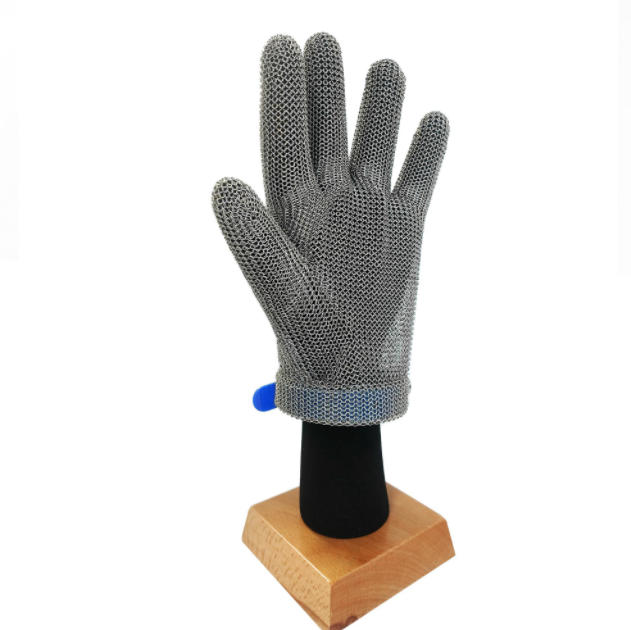
The production of stainless steel chainmail gloves involves multiple manufacturing stages. The process begins with steel wire drawing, followed by ring formation and welding. The welded rings are then assembled into mesh panels and attached to cuffs and closure mechanisms.
Quality control at the supplier level should encompass incoming material inspection, in-process checks during welding and assembly, and final product testing. Welded construction adds approximately ten to twenty percent to product cost compared to non-welded alternatives but provides measurably higher ring joint strength. Electrolytic polishing, which removes surface imperfections and enhances corrosion resistance, adds an additional ten to fifteen percent to material costs.
Buyers evaluating potential suppliers should request samples from production batches and test for weld consistency, ring closure integrity, and surface finish. Multiple samples from the same batch help assess production consistency, which is a leading indicator of the supplier's quality management capabilities.
Stainless steel chainmail gloves for professional use are regulated as personal protective equipment in most markets. For European distribution, compliance with Regulation (EU) 2016/425 is mandatory, and products must carry CE marking. Chainmail gloves fall under Category 2, requiring type examination by a notified body.
The harmonized standard EN 1082-1:1997 specifies requirements for design, penetration resistance, ergonomic characteristics, and marking of chainmail gloves and arm guards for protection against hand knives. For gloves used with powered knives, the applicable standard is EN 14328:2005, which includes an impact cut resistance test. Suppliers should be able to provide test reports from independent laboratories such as SATRA, SGS, or BV.
For North American markets, ANSI/ISEA 105 provides the framework for cut resistance classification, though chainmail gloves are often evaluated against ASTM F2878 or similar puncture resistance standards. Some suppliers also obtain USDA acceptance for food processing applications.
China remains a significant manufacturing base for stainless steel chainmail gloves, with numerous suppliers operating in Hebei, Shandong, and other industrial provinces. When evaluating potential suppliers, buyers should verify manufacturing experience and production capacity.
Suppliers with five or more years of dedicated chainmail glove production generally demonstrate established manufacturing processes and quality control systems. Production capacity varies widely: medium-scale facilities produce approximately 10,000 to 30,000 pairs monthly, while larger factories with automated ring welding and assembly capabilities can produce 100,000 or more pairs per month. For wholesale buyers placing recurring orders, confirming that supplier capacity aligns with volume requirements is essential to avoid supply disruptions.
Hebei Linchuan Safety Protective Equipment Co., LTD specializes in manufacturing safety protective steel gloves for industrial applications, including metal mesh gloves constructed from high-grade stainless steel. The company maintains quality control processes including material inspection, precision welding, and performance testing against relevant safety standards.
The wholesale pricing of stainless steel chainmail gloves reflects material costs, labor, finishing processes, and certification expenses. Grade 316 stainless steel adds fifteen to twenty-five percent to base material cost compared to grade 304. Welded construction, as noted, adds ten to twenty percent, and electrolytic polishing contributes an additional ten to fifteen percent.
While the per-pair cost of chainmail gloves substantially exceeds that of synthetic cut-resistant gloves, the extended service life changes the economic calculation. A chainmail glove priced at eighty dollars wholesale with a twelve-month service life costs approximately twenty-two cents per working day. A synthetic level-five glove priced at fifteen dollars with a three-week service life costs approximately one dollar per working day. For high-volume meat processing operations, this total cost of ownership differential is significant.
Buyers should also factor in repair and maintenance costs. Chainmail gloves can be repaired if individual rings are damaged, extending service life further. Suppliers that offer repair services or replacement ring kits provide added value to wholesale customers.
Wholesale distributors serving meat processing facilities should maintain appropriate size distribution in inventory. Sales data indicates that medium, large, and extra-large sizes account for approximately seventy percent of unit sales. Small and extra-small represent twenty percent, while double extra-large and triple extra-large account for the remaining ten percent.
Handedness is another inventory consideration. In right-handed workforces, the left-hand glove is the primary seller because it is worn on the non-dominant hand. Wholesale buyers serving predominantly right-handed populations should stock left-hand gloves at three to four times the quantity of right-hand gloves. However, many chainmail gloves are ambidextrous and can be converted for either hand, which simplifies inventory management.
Seasonal demand patterns also affect inventory planning. Demand increases from September through December as meat processing facilities prepare for holiday production, then decreases from January through March. Distributors should place orders with suppliers three to four months before peak season to ensure inventory availability.
The food processing industry demands that all equipment and PPE maintain strict hygiene standards. Stainless steel chainmail gloves are well-suited to these requirements because the material can be cleaned and sanitized repeatedly without degradation.
Recommended cleaning procedures involve washing with hot water at approximately 50°C and detergent, followed by rinsing at a minimum of 82°C. Disinfection with approved products may follow. Some suppliers offer gloves with detectable properties, where the steel alloy is formulated to ensure detection of even small metal particles by standard metal detection equipment used in food processing lines. This feature provides an additional layer of food safety assurance.
Buyers should verify that suppliers can provide documentation confirming material compliance with food contact regulations, including migration testing where applicable. The use of 316L stainless steel and the absence of non-stainless components in the glove construction are indicators of food-safe design.
Chainmail gloves for wholesale export are typically packaged in corrugated cartons suitable for container shipping. Standard master cartons contain twelve to twenty-four pairs depending on glove size and packaging configuration. Protective dividers between gloves prevent surface scratching during transit.
Container loading capacity provides a useful reference for logistics planning. A twenty-foot container holds approximately 800 to 1,200 master cartons, which translates to 20,000 to 30,000 pairs depending on carton configuration. A forty-foot container holds approximately 40,000 to 60,000 pairs.
Lead times vary by supplier and order complexity. Sample production typically requires seven to fourteen days from specification confirmation. Mass production lead times depend on order volume and factory scheduling, with peak season orders requiring longer lead times. Chinese manufacturing facilities often experience extended lead times during the September-to-December peak period.
Hebei Linchuan Safety Protective Equipment Co., LTD manufactures stainless steel chainmail gloves and related metal mesh protective products for industrial and food processing applications. The company's product range includes chainmail gloves constructed from 304 and 316 stainless steel, available in various mesh sizes, cuff lengths, and closure configurations.
The company's manufacturing processes include precision welding of steel rings, multiple inspection points during production, and final performance testing against EN 1082 and related standards. Customization options include various cuff lengths, sizing requirements, and private labeling for wholesale distributors.
Hebei Linchuan maintains a focus on quality materials, proper fit, and compliance with applicable safety standards. For wholesale buyers and distributors seeking a manufacturing partner for stainless steel chainmail gloves, the company provides responsive customer service and reliable delivery schedules.
Sourcing stainless steel chainmail gloves requires careful evaluation of product specifications, supplier capabilities, certification compliance, and total cost of ownership. The wholesale market offers multiple suppliers with varying production capacities, quality systems, and geographic focuses. Buyers who understand the technical requirements of their end-user applications, whether in meat processing, food service, or industrial cutting operations, can make more informed decisions about which suppliers to partner with.
The key criteria for supplier selection include verified manufacturing experience, production capacity adequate for order volumes, relevant certifications for target markets, and demonstrable quality control processes. By focusing on these factors, wholesale buyers can establish reliable supply chains for this specialized category of protective equipment.