
Author: Site Editor Publish Time: 2026-06-16 Origin: Site


Chain mail aprons serve as protective garments in various industrial and commercial settings. These aprons are constructed from interlocked metal rings, forming a flexible yet durable barrier against cuts, punctures, and thermal hazards. The global market for protective apparel has seen consistent growth, driven by occupational safety regulations and increased awareness of workplace injuries. Within this sector, chain mail aprons occupy a specialized niche, particularly in food processing, meatpacking, glass handling, and woodworking industries. Suppliers of these aprons must meet stringent quality standards while balancing cost, durability, and user comfort. Hebei Linchuan Safety Protective Equipment Co., LTD has positioned itself as a notable manufacturer in this field, offering products that align with international safety norms. This article examines the key aspects of chain mail apron supply, including material specifications, manufacturing processes, industry applications, and procurement considerations for businesses seeking reliable protective solutions.
The fundamental component of any chain mail apron is the metal wire used in its construction. Stainless steel remains the predominant material choice due to its corrosion resistance, strength-to-weight ratio, and hygienic properties. Common grades include 304 and 316 stainless steel, with the latter offering enhanced resistance to chlorides and acidic environments, making it suitable for food processing applications. Wire diameters typically range from 0.8 millimeters to 1.2 millimeters, depending on the required protection level and flexibility. Rings are formed through a coiling process, then cut and interlocked using specialized machinery. The most common weaves are the 4-in-1 and 6-in-1 patterns, where each ring passes through four or six adjacent rings respectively. The 4-in-1 weave offers a balance of protection and mobility, while the 6-in-1 weave provides denser coverage for higher-risk environments. Manufacturing standards for chain mail aprons are governed by several international norms. In Europe, EN 1082-1 specifies requirements for protective clothing against mechanical impacts, including cut resistance. In the United States, ANSI/ISEA 105 addresses cut resistance levels, with chain mail aprons typically achieving Level 4 or 5 protection. These standards involve testing with standardized blades under controlled conditions, measuring the force required to cut through the material. Suppliers must conduct regular quality assurance tests, including ring tensile strength assessments and burst resistance evaluations. Hebei Linchuan Safety Protective Equipment Co., LTD follows these protocols, ensuring each batch meets documented performance criteria. The manufacturing process also includes finishing steps such as passivation to remove surface contaminants, which is particularly important for aprons used in direct food contact scenarios.
Suppliers typically offer several variants of chain mail aprons to accommodate different operational needs. The most common distinction is based on coverage area, ranging from waist aprons that protect the lower torso to full-length versions covering the chest and upper legs. Waist aprons weigh between 2.5 and 3.5 kilograms, while full-length models can weigh up to 5.5 kilograms depending on ring gauge and weave density. Some suppliers provide adjustable shoulder straps and waist belts to distribute weight evenly, reducing user fatigue during extended wear. For specialized applications, aprons may include additional features such as reinforced neckbands, padded shoulder rests, or integrated pockets for small tools. Another important classification concerns the ring material and finish. Standard stainless steel aprons offer reliable protection for most applications, but suppliers also produce aluminum alloy versions for lighter-weight requirements. Aluminum aprons reduce total weight by approximately 30 percent but offer lower cut resistance, making them suitable for lower-risk tasks such as fruit processing or light assembly work. High-grade aprons incorporate titanium plating or tungsten carbide coatings on critical ring sections, enhancing wear resistance in abrasive environments. Some suppliers offer customizable options, allowing clients to specify ring diameter, weave pattern, and apron dimensions. This flexibility is particularly valuable for businesses with unique workflow requirements or employees with specific ergonomic needs. Hebei Linchuan Safety Protective Equipment Co., LTD provides a range of standard and custom configurations, supported by technical documentation detailing performance specifications.
Chain mail aprons find application across diverse industries, each with distinct hazard profiles and performance requirements. The food processing sector represents the largest consumer segment, accounting for over 40 percent of global demand. In meat and poultry processing plants, workers face constant exposure to sharp blades, bone fragments, and cutting equipment. Chain mail aprons provide essential cut protection while allowing freedom of movement necessary for rapid, repetitive tasks. These aprons also facilitate cleaning and sanitization, as stainless steel withstands high-temperature washdowns and chemical disinfectants without degradation. Regulatory bodies such as the USDA and EFSA mandate appropriate protective gear in these environments, driving consistent replacement cycles. The glass manufacturing industry presents another significant application area. Workers handling raw glass sheets or finished products risk severe lacerations from sharp edges. Chain mail aprons offer reliable protection against these hazards while remaining unaffected by heat exposure up to 200 degrees Celsius. Similarly, in metal fabrication and stamping operations, aprons shield workers from metal burrs and flying debris. The woodworking sector utilizes chain mail aprons during chainsaw operation and log splitting, where cut resistance is critical. Beyond industrial settings, these aprons appear in specialized roles such as archaeological excavation, where they protect against sharp stone tools, and in wildlife management during handling of large animals. Each application demands specific apron configurations, and suppliers must maintain comprehensive product portfolios to address these varied needs. Hebei Linchuan Safety Protective Equipment Co., LTD serves clients across these sectors, providing application-specific recommendations based on hazard assessments.
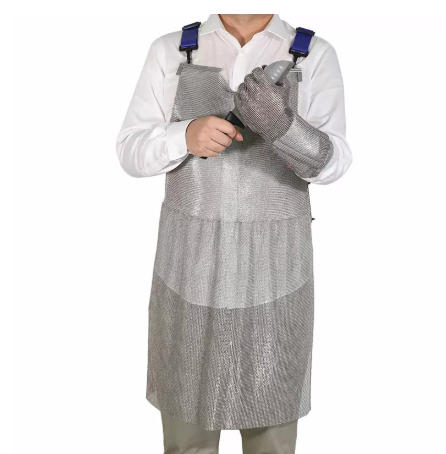
Quality assurance constitutes a fundamental aspect of chain mail apron supply, as product failure can result in serious injuries. Reputable suppliers implement multi-stage inspection processes covering raw materials, in-process production, and finished goods. Raw wire is tested for tensile strength and chemical composition using spectrometry, ensuring compliance with specified grades. During ring formation, suppliers monitor coil diameter consistency and cut edge quality to prevent sharp burrs that could damage adjacent rings. The assembly phase involves visual inspection of weave integrity, with random samples subjected to pull tests measuring ring separation force. Finished aprons undergo dimensional verification and weight checks, alongside functional tests for strap strength and buckle security. Certification processes require third-party laboratory testing according to relevant standards. For cut resistance, the ISO 13997 standard defines a method using a straight blade moving across the material under controlled load. Results are expressed in newtons of force required to achieve a specified cut depth. Chain mail aprons typically achieve cut resistance values exceeding 20 newtons, placing them in the highest performance categories. Additional tests may include puncture resistance per EN 388, abrasion resistance per ISO 12947, and flammability tests per EN ISO 14116. Suppliers must maintain traceability records linking each production batch to test results, enabling recall management if issues arise. Hebei Linchuan Safety Protective Equipment Co., LTD maintains ISO 9001 certification for its quality management system, with documented procedures covering all aspects of production and testing. The company regularly submits products to accredited laboratories for independent verification, providing customers with reliable performance data.
The chain mail apron supply market includes both regional manufacturers and global distributors, each with distinct competitive advantages. Large-scale producers benefit from economies of scale, enabling competitive pricing for standard products. These suppliers typically maintain high-volume production lines with automated ring-forming and weaving equipment, achieving output rates of several hundred aprons per day. However, such operations often have minimum order quantities that may deter smaller buyers. Conversely, specialized suppliers offer greater customization flexibility and shorter lead times for non-standard configurations. They may employ semi-automated processes allowing rapid design adjustments, albeit at higher per-unit costs. Geographic factors also influence supplier selection. Proximity to key industrial regions reduces shipping costs and delivery times, which is particularly relevant for bulky chain mail aprons. Suppliers located near major ports can offer more favorable logistics for international shipments. Additionally, regional suppliers often have better understanding of local safety regulations and industry practices, providing value-added advisory services. On the technical front, suppliers vary in their engineering capabilities, with some offering computer-aided design for custom apron shapes and others relying on traditional patterns. Hebei Linchuan Safety Protective Equipment Co., LTD combines automated production capacity with design flexibility, maintaining inventories of standard sizes while supporting custom orders. The company's location in Hebei province provides access to transportation infrastructure serving both domestic and export markets.
Understanding the cost structure of chain mail aprons helps buyers make informed procurement decisions. Material costs represent the largest component, typically accounting for 50 to 60 percent of total production expense. Stainless steel prices fluctuate with global commodity markets, and suppliers often adjust pricing accordingly. Ring forming and weaving processes contribute 20 to 25 percent of costs, with labor being the primary factor in regions with higher wage rates. Finishing operations such as passivation and polishing add approximately 10 percent, while packaging and shipping comprise the remainder. For custom orders, design and tooling charges may apply, particularly for non-standard dimensions or novel weave patterns. Economies of scale significantly affect per-unit pricing. A typical chain mail apron might cost between 80 and 180 dollars for standard models, with full-length and heavy-duty variants at the upper end of this range. Bulk orders of 500 units or more often receive discounts of 15 to 25 percent compared to small-batch purchases. Buyers should also consider total cost of ownership, including maintenance and replacement frequency. High-quality aprons with proper care can last 3 to 5 years in moderate-use environments, while lower-grade alternatives may require annual replacement. Additionally, some suppliers offer leasing or rental programs, which can be advantageous for seasonal operations or trial implementations. Hebei Linchuan Safety Protective Equipment Co., LTD provides transparent pricing structures with volume-based discounts, along with lifecycle cost analyses to assist clients in budget planning.
Businesses seeking chain mail apron suppliers should follow a structured procurement process to ensure optimal outcomes. The initial step involves conducting a comprehensive hazard assessment, identifying specific risks present in the work environment. This assessment should consider not only cut hazards but also potential exposure to chemicals, heat, and electrical risks, as chain mail aprons do not provide protection against all threats. Based on this analysis, buyers can define required protection levels, coverage dimensions, and ancillary features. Engaging with multiple suppliers allows comparison of technical specifications, pricing, and delivery terms. Requesting product samples for field testing is advisable, as worker comfort and mobility can only be properly evaluated through actual use. When evaluating supplier proposals, buyers should scrutinize certification documentation and ask for evidence of third-party testing. Suppliers should provide clear guidance on product care and maintenance, as improper cleaning can compromise ring integrity. Important questions include the supplier's return policy for defective items, warranty coverage duration, and availability of replacement parts such as straps and buckles. For international procurement, buyers must consider import duties, customs clearance procedures, and Incoterms. Establishing a long-term relationship with a reliable supplier offers benefits such as priority production slots and early access to product innovations. Hebei Linchuan Safety Protective Equipment Co., LTD assists clients throughout the procurement process, offering technical consultations, sample arrangements, and after-sales support.
Proper maintenance significantly extends the service life of chain mail aprons while maintaining their protective performance. Daily cleaning removes organic residues and abrasive particles that can accelerate ring wear. In food processing environments, aprons should undergo sanitization after each shift using approved cleaning agents compatible with stainless steel. Automated washing systems using mild detergents at temperatures below 60 degrees Celsius are generally recommended, as excessive heat or aggressive chemicals may damage ring surfaces. Manual cleaning with soft brushes and warm water is suitable for lighter soiling. After washing, aprons must be thoroughly dried to prevent moisture entrapment between rings, which could lead to corrosion over time. Periodic inspection forms another critical maintenance component. Users should check for signs of ring deformation, broken rings, or strap deterioration before each use. Any damaged rings should be repaired promptly using manufacturer-supplied replacement rings and specialized pliers. Suppliers typically provide repair kits and instructions for field maintenance. More comprehensive inspections should be conducted monthly, involving ring tension tests and overall structural assessment. Record-keeping of maintenance activities helps track apron condition and predict replacement needs. Environmental factors such as exposure to salt water or acidic substances may shorten service intervals, requiring more frequent inspections. Hebei Linchuan Safety Protective Equipment Co., LTD includes maintenance manuals with all shipments, detailing recommended care procedures and offering repair services for clients preferring professional maintenance.
The chain mail apron industry continues to evolve in response to technological developments and changing market demands. Material science advances are yielding lighter-weight alloys with equal or superior cut resistance, potentially reducing user fatigue and improving ergonomics. Some suppliers are experimenting with composite rings incorporating ceramic or polymer inserts for enhanced protection against specific hazards. Digital manufacturing technologies, including 3D printing of ring components, may enable greater customization while reducing material waste. However, these innovations remain in early stages and have not yet achieved widespread commercial adoption. Another trend involves integration of smart features such as RFID tags for asset tracking and condition monitoring. Embedded sensors could potentially detect ring stress or corrosion, providing early warnings of potential failure points. While these technologies add cost, they may offer value in high-reliability applications such as aerospace or defense. Sustainability concerns are also influencing supply chains, with increased emphasis on recyclable materials and energy-efficient production processes. Some suppliers now offer take-back programs for end-of-life aprons, recovering metal content for reuse. Regulatory developments continue to shape product requirements, with anticipated updates to cut resistance standards likely to introduce new testing methodologies. Hebei Linchuan Safety Protective Equipment Co., LTD monitors these trends closely, investing in research and development to maintain product relevance. The company's engineering team evaluates emerging materials and processes, ensuring that future product lines incorporate practical innovations without sacrificing reliability.
Selecting a chain mail apron supplier involves careful consideration of multiple factors including product quality, technical capability, cost, and service support. The ideal supplier demonstrates consistent adherence to international standards, transparent quality processes, and responsiveness to client needs. Buyers should prioritize suppliers with documented testing protocols and certification maintenance, as these indicate commitment to safety. While price remains important, it should not overshadow considerations of durability and performance, as inferior products may require more frequent replacement and expose workers to unnecessary risk. Establishing clear communication channels with the supplier facilitates timely resolution of any issues that arise during the procurement or usage phases. Hebei Linchuan Safety Protective Equipment Co., LTD exemplifies many characteristics of a dependable supplier, combining manufacturing expertise with customer-oriented service. The company's product range covers standard and custom chain mail aprons, supported by thorough quality assurance and technical documentation. With a focus on practical solutions rather than exaggerated claims, the company provides buyers with realistic performance expectations and maintenance guidance. As the protective apparel market continues to grow, suppliers that prioritize quality, transparency, and innovation will likely achieve sustained success. Businesses making informed supplier choices can enhance workplace safety while optimizing their protective equipment expenditures.