
Author: Lin Publish Time: 2026-10-08 Origin: Site


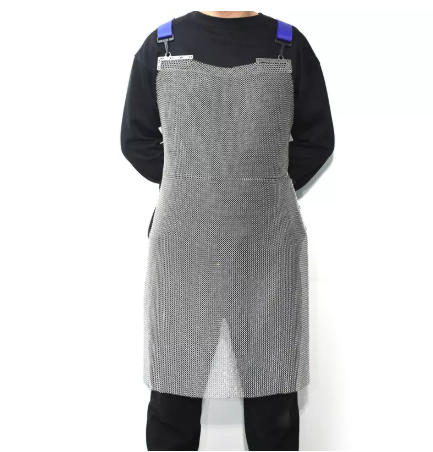
A chainmail apron is a piece of personal protective equipment made from interlocking stainless steel rings, designed to protect the torso, abdomen, and upper legs from cuts and punctures caused by hand knives and blades. It is used mainly in meat processing, poultry processing, seafood handling, butchery, and certain industrial cutting operations where the body is exposed to blade contact. Unlike gloves, which protect the hands, aprons cover a larger area and are often worn together with chainmail gloves and arm guards to create a complete protective set. Choosing the right chainmail apron involves more than selecting a size. Buyers need to consider coverage area, ring specification, steel grade, closure system, weight, and certification. This guide explains the key factors that should guide the selection process for distributors, processors, and procurement teams.
A chainmail apron protects the front of the torso, the abdomen, and part of the upper legs. In meat processing, the most common injury scenario involves a knife slipping during cutting or deboning and contacting the body rather than the product. An apron places a layer of welded stainless steel rings between the blade and the body, reducing the risk of a cut.
The protection mechanism is mechanical rather than fiber-based. Each ring is individually welded, and the interlocking structure distributes the force of a blade across multiple rings. The EN 1082-2 standard, which covers chainmail aprons and related body protection, requires that individual rings withstand a defined tensile force without breaking or opening, similar to the requirement for chainmail gloves.
Aprons are typically worn over work clothing and are adjusted with straps or buckles at the waist and neck. Some designs include shoulder straps for weight distribution, while others rely on a waist belt. The choice of closure and support system affects comfort, fit, and user acceptance over a full shift.
Chainmail aprons are available in several coverage configurations. Full aprons cover the chest, abdomen, and upper legs, providing the broadest protection. Half aprons cover the abdomen and upper legs only, leaving the chest uncovered. Some designs extend to the knees for additional leg protection, while others stop at the hip.
The choice of coverage depends on the task and the working posture. In deboning operations where the knife is used close to the body, a full apron may be appropriate. In cutting operations where the risk is concentrated at the waist and thigh level, a half apron may be sufficient and lighter to wear.
Some aprons are designed as a single panel, while others use segmented panels to improve flexibility. Segmented designs allow the apron to bend with the body during movement, which can improve comfort in tasks that involve bending, lifting, and twisting. Buyers should match the coverage area and panel design to the actual working conditions rather than selecting the largest option available.
Ring diameter and wire thickness are core specifications for chainmail aprons. Common configurations include an outer ring diameter of 3.81 millimeters to 4 millimeters with a wire thickness of 0.5 millimeters to 0.55 millimeters. Smaller rings increase the number of rings per unit area, raising protection density. Larger rings reduce weight and improve flexibility but provide lower protection density.
Mesh density affects both protection and weight. A denser mesh provides more contact points per unit area, which can improve resistance to blade penetration. However, denser mesh also increases the weight of the apron. Since aprons cover a larger area than gloves, weight is a more significant consideration. A heavier apron may provide higher protection but can cause fatigue over a full shift.
Buyers should balance protection density against weight and flexibility. For most meat processing applications, a standard mesh specification provides adequate protection. Higher-density mesh may be specified for tasks involving higher cutting forces or repeated blade contact.
Chainmail aprons are typically made from grade 304 or grade 316L stainless steel. Grade 304 offers adequate corrosion resistance for most food processing applications. Grade 316L provides higher resistance to chlorides and acidic environments and is often specified for facilities that use aggressive sanitizing agents.
The molybdenum content in 316L, typically between 2 and 3 percent, is the main reason for its higher corrosion resistance. This also makes 316L approximately 15 to 25 percent more expensive than 304 at the base material level. Buyers should match the steel grade to the cleaning and sanitizing practices of the facility rather than defaulting to the higher grade.
For food processing facilities that use chlorinated sanitizers or acidic cleaning agents, 316L is a practical choice because it resists pitting and crevice corrosion more effectively. For facilities with milder cleaning practices, 304 provides adequate performance at a lower cost.
The closure system affects fit, comfort, and safety. Common closure types include textile straps with snap buttons, buckles, and hook-and-loop fasteners. The closure must hold the apron securely in place during movement while allowing quick removal if needed.
Adjustability is important because aprons must fit a range of body sizes. An apron that is too loose can shift during work and expose unprotected areas. An apron that is too tight can restrict movement and cause discomfort. Adjustable straps at the waist and neck allow the wearer to achieve a secure fit.
Some aprons use shoulder straps to distribute weight across the shoulders rather than concentrating it at the waist. This design can improve comfort for longer shifts. Buyers should consider the weight distribution of the apron and the preferences of end users when selecting closure and support systems.
Weight is a significant factor in apron selection because aprons cover a large area and are worn for extended periods. A heavier apron may provide higher protection density but can cause fatigue, particularly in tasks that involve bending and lifting.
The weight of an apron depends on the mesh specification, coverage area, and steel grade. A full apron with dense mesh and 316L steel will weigh more than a half apron with standard mesh and 304 steel. Buyers should match weight to the duration and physical demands of the task.
Comfort features such as padded straps, breathable backing, and segmented panels can improve user acceptance. Workers are more likely to wear protective equipment consistently if it is comfortable and does not restrict movement. Buyers should consider comfort features as part of the overall specification rather than as optional extras.
Chainmail aprons for professional use are regulated as personal protective equipment in most markets. For European distribution, compliance with Regulation (EU) 2016/425 is mandatory, and products must carry CE marking. Chainmail aprons fall under Category 2, requiring type examination by a notified body.
The harmonized standard EN 1082-2 specifies requirements for chainmail aprons and related body protection for hand knife users. The standard covers design, penetration resistance, ergonomic characteristics, straps, weight, materials, and marking. Suppliers should provide test reports from recognized laboratories.
For North American markets, ANSI/ISEA 105 provides a cut resistance classification framework, though chainmail aprons are often evaluated against puncture resistance standards such as ASTM F2878. Food contact compliance may also be required where the apron comes into contact with food products. Suppliers should provide migration test reports and declarations where applicable.
Chainmail apron production involves wire drawing, ring formation, welding, mesh assembly, panel joining, and closure attachment. Quality control should cover incoming material inspection, weld strength testing, mesh inspection, and final penetration testing.
Buyers should request samples from production batches and evaluate weld consistency, ring closure integrity, panel joining strength, and closure function. Multiple samples from the same batch help assess production consistency.
Electrolytic polishing is an optional finishing process that removes surface defects and improves corrosion resistance. It adds approximately 10 to 15 percent to material cost. For aprons used in high-hygiene environments, polishing can improve cleanability and extend service life.
The wholesale price of chainmail aprons reflects material costs, welding, assembly labor, finishing, and certification. Grade 316L stainless steel adds approximately 15 to 25 percent to base material cost compared with 304. Welded construction adds 10 to 20 percent, and electrolytic polishing adds another 10 to 15 percent. Larger coverage areas and denser mesh increase material usage and cost.
Total cost of ownership should be evaluated alongside unit price. A chainmail apron that lasts 12 months or longer may cost less per working day than a lower-priced alternative that requires frequent replacement. Buyers should compare aprons on a cost-per-use basis and consider repair options, as chainmail aprons can be repaired when individual rings are damaged.
Hebei Linchuan Safety Protective Equipment Co., LTD manufactures chainmail aprons and related metal mesh protective products for food processing and industrial applications. The product range includes aprons made from 304 and 316 stainless steel, available in various mesh sizes, coverage configurations, and closure designs.
The company's manufacturing processes include precision welding of steel rings, multiple inspection points during production, and final performance testing in accordance with EN 1082 and related standards. Customization options cover coverage area, sizing, closure design, and private labeling for wholesale distributors.
Hebei Linchuan focuses on material quality, wearing comfort, and compliance with applicable safety standards. For wholesale buyers and processors seeking a manufacturing partner for chainmail aprons, the company provides responsive customer service and reliable delivery schedules.
Choosing a chainmail apron requires balancing coverage area, ring specification, steel grade, closure design, and weight against the specific requirements of the working environment. Buyers should match the apron to the actual cutting risk and working posture rather than defaulting to the heaviest or largest option. Certification and food contact compliance are essential for food processing applications, and suppliers should provide valid test reports and documentation.
Key criteria for selection include verified manufacturing quality, appropriate mesh specification, suitable steel grade, comfortable weight distribution, and relevant certifications. By focusing on these factors, buyers can select chainmail aprons that provide effective protection, meet regulatory requirements, and support consistent use by workers in meat, poultry, and seafood processing operations.