
Author: Site Editor Publish Time: 2026-02-02 Origin: Site


Introduction
Chainmail aprons constitute a specialized class of personal protective equipment (PPE) designed to safeguard the torso and upper legs from laceration and puncture hazards in static or semi-static work environments. Manufactured by Hebei Linchuan Safety Protective Equipment Co., LTD, these aprons are engineered to provide targeted protection while allowing a degree of mobility for tasks where full upper-body armor is unnecessary or impractical. This article provides a technical analysis of their design, material properties, performance data, and appropriate industrial applications.
1. Material Composition and Construction Specifications
The protective efficacy of a chainmail apron originates from its metallic mesh construction, with precise specifications determining its performance characteristics.
Primary Alloy: Standard aprons are fabricated from AISI 304 or 316 stainless steel, selected for its strength and corrosion resistance in various industrial environments. For applications requiring enhanced chemical resistance (e.g., food processing with acidic cleaners), 316L stainless steel is standard.
Mesh Parameters:
Wire Diameter: Typically ranges from 0.7 mm to 1.0 mm. A 0.8 mm diameter offers a balance between protection, weight, and flexibility.
Inner Ring Diameter (IRD): Commonly 4 mm to 6 mm. A 5 mm IRD provides a proven density for defense against most knife and blade threats.
Fabrication and Assembly: Rings are electrically resistance-welded for a secure, smooth join. The apron panel is typically a single sheet of maille, bound along the edges with a leather or synthetic polymer strip to prevent unraveling and to provide attachment points for straps.
2. Design Features and Ergonomic Integration
Effective apron design prioritizes wearability, coverage, and compatibility with other PPE.
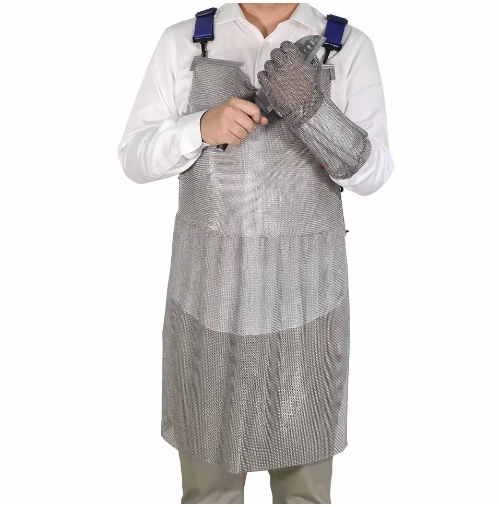
Coverage Area: A standard apron covers from the upper chest (below the sternum) to mid-thigh, providing primary protection to the abdomen, groin, and upper legs—areas containing vital organs and major blood vessels.
Suspension System: Adjustable neck and waist straps, often made from heavy-duty nylon webbing with quick-release buckles, allow for a secure and customized fit over work clothing. Proper strap design distributes the apron's weight (approximately 3.5 to 6.5 kg depending on size and material) to minimize shoulder and back strain during prolonged use.
Lining and Compatibility: Many models include a removable, breathable liner (e.g., cotton or polyester) to improve comfort, absorb sweat, and prevent the metal from contacting the skin directly. The design allows for unhindered use of arm and leg protective equipment.
3. Performance Testing and Data
Performance is evaluated against international standards for mechanical risks.
Cut Resistance (EN ISO 13997:1999): Chainmail aprons consistently achieve performance exceeding the highest levels in cut resistance scales. Testing of standard 316 stainless steel mesh (0.8 mm wire, 5 mm IRD) typically yields a cut resistance value (CPS or Newton force) above 40 N, classifying it as Level F per EN 388:2016. This provides a high degree of protection against accidental slashes and intentional cutting motions.
Puncture Resistance (EN 388:2016): Against the standard puncture test (4.5 N stylus), the mesh achieves the maximum Level 5 resistance. It also offers significant protection against hypodermic needle punctures as per related ISO standards.
Limitation on Impact Force: It is critical to note that the apron is designed as a cut and puncture barrier. It offers negligible protection against high-velocity projectiles, heavy crushing forces, or extreme temperatures.
4. Primary Applications and Selection Guidelines
Chainmail aprons are specified for industries where workers are stationary or have limited upper-body movement while handling sharp objects.
Meat and Poultry Processing: A primary application is in deboning, trimming, and butchering operations, protecting workers from knife slips. Data from industry safety boards indicate a measurable reduction in laceration incidents to the torso when chainmail aprons are mandated for specific stations.
Metalworking and Stamping: Operators handling sharp-edged sheet metal, stamped parts, or castings use aprons for protection against lacerations during handling and quality inspection.
Glass and Ceramics Manufacturing: Workers handling large sheets of glass or freshly cut ceramic tiles utilize aprons as a secondary defense against sharp fragments.
Culinary (Specialized): Used in high-volume professional kitchens for butchery tasks and certain fish preparation techniques.
Selection should follow a task-based risk assessment, considering the sharpness and force of potential contact, duration of wear, and need for hygiene (e.g., easy cleaning).
5. Maintenance, Hygiene, and Product Lifespan
Durability and hygiene are key operational considerations.
Cleaning and Sanitization: The stainless-steel construction allows for thorough cleaning with industrial detergents, steam, or autoclaving (for specific models), which is essential in food processing environments. Regular sanitization protocols are required to prevent bacterial growth in the mesh.
Inspection Regime: A pre-use visual and tactile inspection is recommended to identify any broken, stretched, or corroded links. A single failed link can create a localized weak point.
Expected Service Life: With proper care—including prompt cleaning, drying, and storage—a stainless-steel chainmail apron from Hebei Linchuan can have an operational lifespan exceeding 8 years. Straps and liners may require replacement more frequently due to wear.
Conclusion
The chainmail apron from Hebei Linchuan Safety Protective Equipment Co., LTD is a technically validated solution for mitigating laceration and puncture risks to the torso in controlled industrial settings. Its protective capability is grounded in the measurable mechanical properties of its welded stainless-steel mesh. Optimal safety outcomes are achieved when the apron is integrated into a comprehensive PPE program that includes proper worker training on its use, limitations, and maintenance, alongside other necessary controls for identified workplace hazards.
References
European Committee for Standardization (CEN). (2016). *EN 388:2016 - Protective gloves against mechanical risks*.
International Organization for Standardization (ISO). (1999). *ISO 13997:1999 - Protective clothing - Mechanical properties - Determination of resistance to cutting by sharp objects*.
Occupational Safety and Health Administration (OSHA). (2008). *29 CFR 1910.132 - General requirements for Personal Protective Equipment*.
Hebei Linchuan Safety Protective Equipment Co., LTD. (2023). Product Specification and Maintenance Manual: AP-Series Chainmail Aprons.
National Institute for Occupational Safety and Health (NIOSH). (2019). Preventing Cuts and Lacerations in the Food Processing Industry. NIOSH Publication No. 2019-165.
American National Standards Institute/International Safety Equipment Association (ANSI/ISEA). (2016). *ANSI/ISEA 105-2016 - American National Standard for Hand Protection Selection Criteria*. (Provides a framework for cut resistance classification applicable to apparel materials).