
Author: Site Editor Publish Time: 2026-06-01 Origin: Site


Protective aprons made of interlinked metal rings serve a specific function in industrial and culinary environments: they resist cutting, puncturing, and abrasion. Unlike fabric-based aprons, a chainmail apron offers predictable resistance under repeated contact with sharp edges. This article examines measurable performance factors including ring diameter, wire gauge, alloy composition, and weight distribution. The information is compiled from publicly available safety standards and technical specifications used in the food processing, butchering, and glass handling industries. Hebei Linchuan Safety Protective Equipment Co., LTD manufactures chainmail aprons that meet these dimensional and mechanical requirements.
A chainmail apron is a garment constructed from thousands of stamped or riveted metal rings, arranged in interlocking patterns. The most common pattern is the four-to-one weave, where each ring passes through four adjacent rings. This geometry distributes tension across multiple connections when a blade contacts the surface. The primary applications include:
Butchery and meat processing lines, where workers use boning knives and meat hooks
Oyster shucking and clam processing, where shells produce sharp fragments
Glass manufacturing, where handling sheet glass or tempered glass can result in sharp breakage
Industrial recycling facilities, where conveyor belts carry scrap metal or broken containers
Security and correctional facilities, where blunt or sharp weapons may be encountered
Each application imposes different mechanical requirements. For example, meat processing requires resistance to repeated slicing motions, while glass handling requires resistance to puncture from sharp corners. A chainmail apron designed for one use case may not perform acceptably in another.
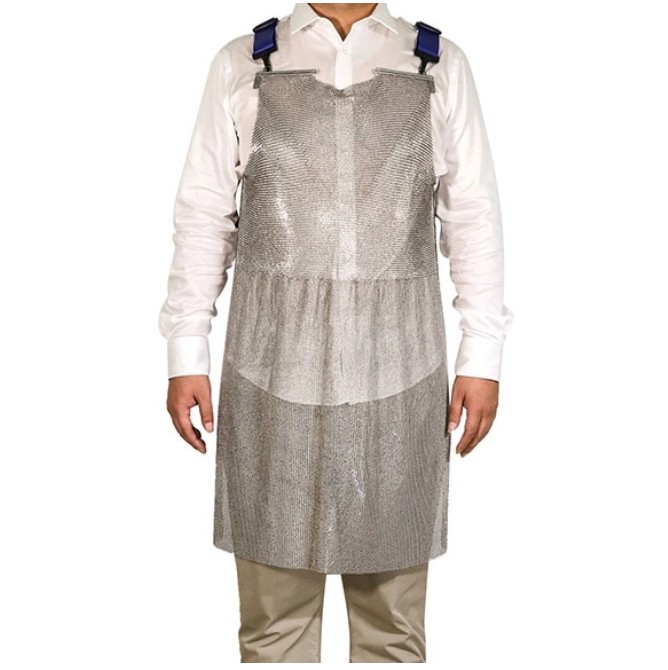
Most chainmail aprons intended for food contact use austenitic stainless steel, typically Type 304 or Type 316. Type 304 contains eighteen to twenty percent chromium and eight to ten point five percent nickel. This composition provides resistance to corrosion from organic acids found in meat, blood, and seafood. Type 316 adds two to three percent molybdenum, which improves resistance to chlorides and acidic marinades. For a chainmail apron used in a wet processing environment, Type 316 extends service life by reducing pitting corrosion.
Mechanical properties for stainless steel rings in a chainmail apron typically include a tensile strength of at least five hundred fifteen megapascals for annealed Type 304, and a hardness of approximately ninety two Rockwell B. These values translate into ring deformation resistance under a cutting load. When a boning knife edge contacts a stainless steel ring, the ring may deflect but will not fracture if the material has adequate ductility.
Some chainmail aprons intended for industrial cutting or recycling use low-carbon steel with a zinc coating. The zinc layer, applied through hot-dip galvanizing, provides sacrificial corrosion protection. However, galvanized steel is not suitable for food contact because zinc can transfer to food surfaces. A chainmail apron made of galvanized steel shows lower initial cost but shorter service life once the zinc coating wears through at contact points between rings. Carbon steel rings may also rust internally in the ring interstices, leading to ring binding and reduced flexibility.
The protective performance of a chainmail apron depends on three geometric variables: ring inner diameter, wire diameter, and the resulting inner gap. Ring inner diameter typically ranges from eight millimeters to twelve millimeters for most apron designs. Wire diameter ranges from one point two millimeters to one point six millimeters for standard-duty aprons, and up to two millimeters for heavy-duty versions.
The inner gap is calculated as ring inner diameter minus wire diameter. For a ten millimeter inner diameter ring with a one point four millimeter wire, the inner gap is eight point six millimeters. This gap must be smaller than the width of any blade edge expected to contact the apron. In practice, a gap below nine millimeters stops most boning knife tips from penetrating the weave. However, very thin blades such as utility knives with a blade thickness of one millimeter may still pass through the gap if the blade tip aligns with the opening. Therefore, a chainmail apron is considered a cut-resistant barrier, not a cut-proof barrier.
Ring closure type also affects strength. Butted rings, where the wire ends are simply pressed together, have lower tensile strength than riveted rings or welded rings. A riveted chainmail apron shows ring pull-apart strength approximately three times higher than a butted design, based on mechanical testing data. For industrial applications where rings may be snagged by machinery or hooks, riveted or welded rings are specified.
A full-length chainmail apron covering from chest to knee typically weighs between three and eight kilograms, depending on ring gauge and coverage area. A standard apron used in meat processing, measuring sixty centimeters wide by eighty centimeters long, with one point four millimeter wire and ten millimeter rings, weighs approximately four point two kilograms. This weight places a continuous vertical load on the shoulders and lower back.
Weight distribution systems improve operator comfort. Most commercial chainmail aprons use split shoulder straps made of nylon webbing, each at least five centimeters wide to spread load across the trapezius muscles. Some designs incorporate a lumbar belt that transfers approximately thirty percent of the apron weight from shoulders to hips. Without a belt, the shoulder straps concentrate the full weight on the upper spine. Field studies in meat processing plants indicate that operators wearing a chainmail apron with a hip belt report lower shoulder fatigue after four hours of continuous wear compared to apron-only designs.
For applications requiring upper arm protection, a chainmail apron may be extended into a full jacket or bib with sleeves. A full jacket adds two to three kilograms of additional weight. In these cases, weight distribution becomes more complex, requiring both shoulder and waist support systems to prevent forward lean.
Cut resistance for a chainmail apron is measured using test methods adapted from textile standards. The two most relevant methods are the TDM test (Toma-Din) and the straight blade cut test.
The TDM test uses a rotating circular blade that moves across the material sample under a fixed load. The number of cycles required to cut through the sample is recorded. For a chainmail apron, the TDM test produces different results than for fabric because the blade may slip between rings. A typical result for a stainless steel chainmail apron with one point five millimeter wire is a cut resistance of Level 5 on scales that run from Level 1 to Level 5, meaning no cut-through occurs within the test cycle limit. This does not mean the apron stops all cuts; it means the test blade cannot accumulate enough contact length with the metal surface to cut through.
The straight blade test uses a blade drawn across the sample once at a controlled speed and force. The depth of cut or the force required to produce a cut-through is measured. For a chainmail apron, the straight blade test often shows that the apron stops the blade before the blade contacts the wearer’s garment. However, repeated cuts in the exact same location may eventually displace rings or cause ring fracture.
No cut resistance test fully replicates real-world cutting motions, which often involve slicing with variable pressure and angled blade contact. Therefore, a chainmail apron should be selected based on the most severe expected cutting condition, then derated by a safety factor of at least two.
A chainmail apron used in meat, poultry, or seafood processing must be cleaned and sanitized between production shifts. Stainless steel chainmail aprons tolerate high-temperature wash cycles and chemical sanitizers. The recommended cleaning process for a food-grade chainmail apron includes:
Manual pre-rinse with warm water below forty degrees Celsius to remove organic debris
Immersion in an alkaline detergent solution at fifty to sixty degrees Celsius for ten minutes
Rinsing with clean water until no detergent residue remains
Immersion in a sanitizing solution containing one hundred to two hundred parts per million of chlorine for two minutes
Air drying in a vertical position to allow water to drain from ring interstices
Automatic industrial dishwashers are also suitable for stainless steel chainmail aprons, provided the wash temperature does not exceed ninety degrees Celsius. Higher temperatures may soften the metal’s temper or damage nylon shoulder straps. Aprons with leather components or fabric edging require hand washing, as machine washing degrades these materials.
A chainmail apron that is not properly dried will develop brown surface rust even with stainless steel, because free iron from machining or cutting tools may remain on the surface. This surface rust is cosmetic and does not compromise mechanical integrity, but it can transfer to food products and cause quality complaints. Passivation treatment using a citric or nitric acid bath removes free iron and restores corrosion resistance.
Several international standards apply to chainmail aprons, depending on the region and application. Compliance with these standards is not legally required in all jurisdictions, but many industrial buyers specify them.
While this European standard primarily covers gloves and arm guards, its test methods are often applied to aprons by extension. EN 1082-1 specifies a cut test using a straight blade under a five Newton load. A chainmail apron that prevents blade contact through the structure can be classified as meeting the highest performance level.
This ASTM method uses a straight blade on a movable carriage. Results are reported as the cut force in Newtons required to cut through the sample. For reference, a chainmail apron with one point six millimeter stainless steel rings shows a cut force exceeding one hundred fifty Newtons, which is the upper limit of the test equipment. By comparison, a heavy-duty leather apron may show a cut force of twenty to thirty Newtons.
For a chainmail apron used in food processing, the stainless steel alloy must meet NSF/ANSI Standard 51 for food equipment materials. This standard addresses material safety, corrosion resistance, and cleanability. Type 304 and Type 316 stainless steel both appear on the NSF list of acceptable materials.
Buyers should request test reports from the manufacturer rather than relying on claims of certification. Hebei Linchuan Safety Protective Equipment Co., LTD provides test documentation for its chainmail apron products, including material certificates and cut resistance data.
Cut-resistant fabric aprons made from high-performance polyethylene (HPPE), aramid (Kevlar), or fiberglass blends offer an alternative to chainmail. Each material type has distinct advantages and limitations.
| Property | Chainmail Apron | HPPE Fabric Apron | Aramid Fabric Apron |
|---|---|---|---|
| Cut resistance mechanism | Metal ring deflection and friction | Fiber tensile strength | Fiber tensile strength |
| Weight per square meter | Eight to fifteen kg | Zero point four to zero point eight kg | Zero point six to one point two kg |
| Puncture resistance | High | Low to medium | Low to medium |
| Blade edge wear | Accelerated blade dulling | Low blade wear | Medium blade wear |
| Laundry method | Industrial washing or manual | Machine wash, low heat | Machine wash, low heat |
| Service life in meat processing | Three to five years | Six to twelve months | Eight to eighteen months |
| Cost range | Higher initial cost | Medium initial cost | Medium to high initial cost |
A chainmail apron outperforms fabric aprons in puncture resistance because fabric layers can be separated by a sharp point. However, for applications involving only slicing contact without puncture risk, a fabric cut-resistant apron may provide adequate protection at lower weight. For meat boning lines where workers use pointed boning knives with sharp tips, a chainmail apron is the appropriate choice.
Proper sizing of a chainmail apron affects both protection level and operator safety. An apron that is too short exposes the lower abdomen or thighs to cutting hazards. An apron that is too long may contact conveyor belts or machinery, creating a snag hazard.
Standard apron sizes are based on chest width and torso length. A medium chainmail apron typically measures fifty centimeters across the chest and sixty five centimeters from shoulder to hem. A large apron measures sixty centimeters across the chest and eighty centimeters from shoulder to hem. Sizing should be selected so that the hem falls no lower than mid-thigh when the wearer is standing upright.
For workers who are required to lift arms overhead, such as those reaching into overhead bins, a chainmail apron should have armholes cut high under the armpit. Restricted arm mobility from an oversized apron can cause workers to adopt awkward postures, increasing the risk of other injuries.
Adjustable shoulder straps should be set so that the apron weight is borne evenly across both shoulders. Uneven strap length causes the apron to rotate, exposing one side of the torso. Quick-release buckles on shoulder straps are recommended for emergency removal, as a chainmail apron cannot be cut off easily with rescue tools.
Regular inspection of a chainmail apron extends service life and ensures continued protection. A weekly inspection checklist includes:
Checking for broken rings: A broken ring creates a gap that may admit a blade tip. Broken rings must be replaced before the apron is used again.
Checking for deformed rings: Rings that are stretched open more than one millimeter wider than their original inner diameter lose holding strength.
Checking for missing rings: Adjacent rings will fall out if a ring breaks, leaving a visible hole in the weave.
Checking strap attachment points: The transition from metal rings to fabric straps is a failure point. Stitching should show no loose threads or fabric fraying.
Checking for rust or corrosion: Surface rust on stainless steel is cosmetic, but pitting indicates that the passive layer has failed.
If an apron shows more than five broken or missing rings per one hundred square centimeters, the entire apron should be removed from service. Localized damage can sometimes be repaired by replacing individual rings. Repair requires matching ring diameter, wire gauge, and alloy. Hebei Linchuan Safety Protective Equipment Co., LTD supplies repair rings and provides ring replacement instructions.
Storage of a chainmail apron between shifts should be on a wide, padded hanger, not folded. Folding creates sharp bends that permanently deform rings, reducing cut resistance along the fold line. Aprons stored in a folded condition for extended periods may develop ring fatigue cracks at the bend points.
Several incorrect beliefs about chainmail aprons persist in industrial settings. These misconceptions can lead to improper selection or misuse.
Misconception 1: A chainmail apron is completely cut-proof.
No apron is completely cut-proof. A chainmail apron provides high but not absolute cut resistance. Extremely thin blades, serrated blades, or repeated cuts at the exact same location can eventually penetrate the weave.
Misconception 2: All chainmail aprons are the same.
Ring gauge, alloy type, ring closure method, and weave pattern vary significantly between products. A chainmail apron designed for decorative or costume use uses mild steel with butted rings and provides no cut resistance.
Misconception 3: A chainmail apron protects against stabbing.
While a chainmail apron offers some puncture resistance, concentrated stabbing with a fine-point tool such as an awl or a small-diameter screwdriver can separate rings. Aprons intended for stab protection use solid plates rather than chainmail.
Misconception 4: Stainless steel chainmail aprons never rust.
Type 304 and Type 316 stainless steel are corrosion-resistant, not corrosion-proof. Chloride exposure from bleach sanitizers or salt brine can cause pitting. Prolonged contact with carbon steel tools leaves iron deposits that rust.
When selecting a supplier for a chainmail apron, industrial buyers should verify the following technical details:
Ring dimensions: Confirm inner diameter, wire diameter, and tolerance. A reputable supplier provides these measurements.
Alloy certification: Request material test reports showing chromium and nickel content for stainless steel aprons.
Ring closure method: Butted, riveted, or welded. Each method has a different pull-apart strength.
Strap material and attachment: Nylon webbing with bar-tacked stitching or riveted attachment points.
Weight per square meter: Calculate from apron dimensions and total weight to compare between suppliers.
Cleaning instructions: Written procedures for washing and sanitizing the specific apron model.
Warranty period: Typical warranties for industrial chainmail aprons range from six months to two years for ring breakage.
Hebei Linchuan Safety Protective Equipment Co., LTD provides documentation for all these specifications. The company manufactures chainmail aprons using Type 304 stainless steel with riveted ring closures for heavy-duty applications and Type 316 stainless steel for seafood processing environments. Each apron batch includes a material certificate and dimensional inspection report.
For beef boning lines where workers use knives with twelve to fifteen centimeter blades, a chainmail apron with one point five millimeter wire and nine millimeter inner diameter rings provides a balance between weight and protection. The apron should extend from the clavicle to at least ten centimeters below the belt line. Split shoulder straps with a quick-release buckle and a separate waist belt are recommended.
Oyster and clam shucking exposes workers to shell fragments that are sharp but not typically long enough to penetrate deep gaps. A chainmail apron with one point two millimeter wire and eight millimeter inner diameter rings stops most shell shards. Type 316 stainless steel is preferred due to continuous saltwater exposure. The apron should be rinsed with fresh water at the end of each shift to remove salt deposits.
In float glass lines, workers handle sheets with raw edges that can cause deep lacerations. Glass handling chainmail aprons require heavier wire gauge of one point six to two millimeters to resist puncture from glass corners. Ring inner diameter of ten to twelve millimeters is acceptable because glass corners are wider than knife blades. However, the apron must also include glass impact protection, which chainmail does not provide – shattered glass can still cause blunt trauma.
Security chainmail aprons are worn over stab-resistant vests. The chainmail layer provides slash resistance while the vest provides blunt impact and stab resistance. For this application, rings should be riveted and made of high-carbon stainless steel with a hardness above forty five Rockwell C. The apron must be removable quickly in restraint situations, so breakaway strap designs are specified.
The initial purchase price of a chainmail apron is higher than fabric cut-resistant aprons. A stainless steel chainmail apron from a manufacturer such as Hebei Linchuan Safety Protective Equipment Co., LTD typically costs between sixty and one hundred fifty US dollars per unit, depending on size and ring gauge. A fabric cut-resistant apron costs between twenty and fifty US dollars.
However, the replacement cycle for a chainmail apron in a meat processing plant is three to five years, compared to six to twelve months for a fabric apron. Over a five-year period, the total cost of ownership for a chainmail apron includes one initial purchase plus cleaning labor and occasional ring repairs. For fabric aprons, the cost includes five to ten replacement purchases plus laundry costs. For plants with more than fifty cut-protection apron users, the chainmail apron becomes more cost-effective after the first two years.
Additional cost factors include knife sharpening frequency. A chainmail apron dulls blades more quickly than fabric aprons because the metal rings abrade the blade edge. Studies in butchering operations show that knives used with chainmail aprons require sharpening every forty five minutes of contact, compared to every ninety minutes with fabric aprons. This increased sharpening cost must be factored into the total cost calculation.
Chainmail aprons have a lower environmental impact over their service life compared to disposable or short-life fabric aprons. A stainless steel chainmail apron does not shed microplastic fibers during washing. At the end of its service life, the stainless steel rings are fully recyclable as scrap metal. Fabric aprons made of HPPE or aramid fibers are more difficult to recycle because these materials do not melt and are not accepted by most textile recyclers.
The manufacturing process for a chainmail apron uses more energy than fabric apron production due to wire drawing, ring stamping, and assembly. However, the extended service life means fewer units manufactured over the same time period. For organizations with environmental purchasing policies, selecting a chainmail apron from a supplier that uses recycled stainless steel content reduces the carbon footprint further.
A chainmail apron is a specialized protective garment that performs predictably against cutting and puncture hazards. Its effectiveness depends on matching ring geometry, material alloy, and closure method to the specific sharp object threats present in the workplace. For food processing environments, Type 304 or Type 316 stainless steel with riveted closures offers the best combination of corrosion resistance and mechanical strength. For industrial recycling or glass handling, heavier wire gauge and larger ring diameter provide adequate protection at lower manufacturing cost.
Weight distribution systems, including wide shoulder straps and hip belts, reduce operator fatigue during extended wear. Regular inspection and proper cleaning maintain the apron’s protective properties over a service life of several years. While the initial purchase price exceeds that of fabric alternatives, the long replacement cycle and recyclability of stainless steel make chainmail aprons a cost-effective choice for high-cut-risk applications.
Hebei Linchuan Safety Protective Equipment Co., LTD produces chainmail aprons according to these engineering principles. The company provides full material documentation, dimensional specifications, and cut resistance data for each product line. For organizations specifying cut protection equipment, verifying these technical details against the intended use case ensures that the selected chainmail apron provides the expected level of worker protection.