
Author: Lin Publish Time: 2026-10-26 Origin: Site


Custom chainmail aprons are protective garments made from interconnected metal rings, usually stainless steel, to help protect the front of the body against cuts from hand knives during specific work operations. Unlike conventional fabric, plastic, or leather aprons, chainmail aprons use a flexible metal mesh structure to create a physical barrier between the wearer and sharp tools.
These aprons are commonly used in meat processing plants, slaughterhouses, butcher shops, poultry processing facilities, seafood operations, and other workplaces where employees handle sharp knives. Their main purpose is to provide additional torso protection when the working process exposes the chest, abdomen, or upper legs to accidental blade contact.
The word custom refers to the ability to adapt selected product features to the customer's operational requirements. Depending on the manufacturer's available designs, customization may include apron dimensions, coverage area, strap configuration, fastening system, split-leg construction, and packaging.
For example, a meat processing company may need a standard front apron for routine trimming work, while another facility may require a longer model to cover more of the abdomen and upper thighs. A distributor may also request consistent dimensions, specific packaging, and product identification for its own sales program.
Hebei Linchuan Safety Protective Equipment Co., LTD. manufactures chainmail protective products, including stainless steel aprons and chainmail gloves. For buyers considering a custom order, the first step is to define the intended application, required coverage, user measurements, and applicable safety requirements.
A custom apron should not be selected based on appearance or dimensions alone. Its protective performance depends on the complete design, including ring construction, material properties, fastening components, coverage, and conformity with the requirements relevant to the intended workplace.
Workplaces differ in their cutting procedures, body-protection requirements, cleaning processes, and employee working positions. A standard apron may be suitable for some applications, but a customized design can help buyers address specific operational needs.
Improved coverage for the intended task
The required protective area depends on the worker's posture and the direction of potential blade contact. An apron used for meat trimming may need different coverage from one used for poultry processing or seafood preparation. Custom dimensions can help align the apron with the areas identified during a workplace risk assessment.
Better fit for different users
Employees may have different body measurements, uniforms, and working habits. Apron width and length, shoulder straps, waist belts, and fastening positions influence how the garment sits on the body. A well-fitted design helps reduce excessive movement, gaps in coverage, and interference with routine tasks.
Compatibility with existing work procedures
Some processing facilities have established procedures for putting on, removing, cleaning, inspecting, and storing protective equipment. A custom apron can be designed around practical requirements such as removable straps, adjustable fasteners, or a split-leg arrangement, where those options are available.
More consistent purchasing for distributors
Importers and safety-equipment distributors may need a repeatable specification across multiple orders. Documented dimensions, approved samples, material descriptions, and agreed packaging details help reduce discrepancies between batches.
A product specification aligned with the target market
Different countries and customer industries may require different technical documents or product configurations. Before production, buyers should identify the destination market and request evidence that the selected model meets the applicable requirements.
Customization does not automatically mean higher protection. The objective is to select a configuration that matches the actual hazard, provides appropriate coverage, and remains practical for daily use.
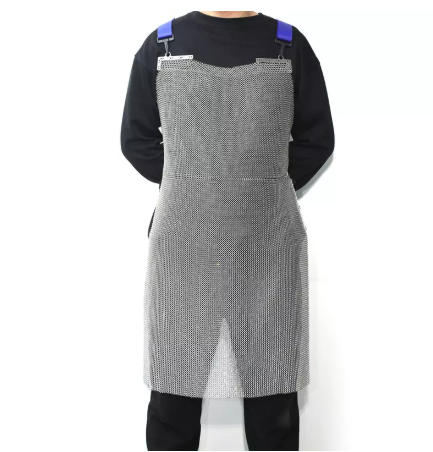
Material selection is one of the most important factors when purchasing custom chainmail aprons. Stainless steel is widely used because it combines mechanical strength with corrosion resistance and can be cleaned using suitable procedures.
However, stainless steel is a family of alloys rather than a single material. Different grades have different properties, and the appropriate grade depends on the working environment, cleaning chemicals, moisture exposure, and customer requirements.
Stainless steel grade
Buyers may encounter stainless steel grades such as 304 and 316 in protective mesh products. Grade 304 is commonly used in general-purpose stainless steel applications, while grade 316 contains molybdenum and generally offers improved resistance to certain corrosive environments, particularly those involving chlorides.
The actual suitability of either grade depends on exposure conditions and maintenance practices. Customers should confirm the material grade of the specific apron rather than assume that every stainless steel chainmail product uses the same alloy.
Ring diameter and wire thickness
Chainmail aprons are assembled from many interconnected rings. Ring diameter, wire thickness, ring geometry, and connection quality affect the mesh structure, flexibility, weight, and protective performance.
A smaller ring opening may change the coverage characteristics of the mesh, while thicker wire may influence overall weight and mechanical behavior. These features should be assessed as part of the complete product design rather than treated as independent indicators of protection.
For reference, commercially available chainmail apron models include ring dimensions around 3.8–5.3 mm, but this is an example of market variation, not a universal specification or a guarantee of protection. The exact ring size and wire diameter should be confirmed against the model being purchased.
Ring connection and manufacturing consistency
Ring connections are important because the apron relies on the integrity of the interconnected mesh. Buyers should ask how ring closure is controlled, how defects are identified, and what inspections are performed before dispatch.
Consistent construction helps the finished product maintain its intended shape and reduces the likelihood of defects going unnoticed during routine inspection.
Straps and fastening components
The strap system affects fit, stability, and ease of use. Depending on the model, components may include adjustable shoulder straps, waist belts, plastic fasteners, or other attachment systems. The suitability of each component should be assessed for the cleaning chemicals, temperature range, and working conditions in the facility.
When ordering from Hebei Linchuan Safety Protective Equipment Co., LTD., buyers should confirm the material grade, ring specifications, strap material, fastening design, and available technical documents for the selected product.
Custom sizing is a major consideration for businesses purchasing chainmail aprons for different employees or workstations. The correct dimensions should provide the intended protective coverage without creating unnecessary restrictions on movement.
Commercial chainmail aprons are available in different dimensions. For example, supplier listings may show sizes such as 55 × 60 cm, 60 × 80 cm, or other configurations. These figures are examples only; buyers must confirm whether the listed measurements refer to width and length, how the garment is measured, and which model is being quoted.
Apron width and length
Width affects the area covered across the torso, while length determines how far the apron extends toward the hips or thighs. The correct combination depends on the worker's body size, work posture, and potential blade-contact zones.
A longer apron may provide more coverage but can also affect movement if the dimensions do not suit the user. The goal is not simply to order the largest available model but to define the required coverage and verify the fit.
Standard front apron
A conventional front apron is intended to protect the front torso. It may be appropriate for tasks where the primary exposure is concentrated around the chest and abdomen. Buyers should assess whether the design leaves gaps at the sides or lower body that need to be addressed through other PPE.
Split-leg apron
Some designs incorporate a split-leg configuration to provide additional coverage while allowing the wearer to move the legs more freely. This can be useful in work environments where employees frequently bend, step, or change position.
The shape and dimensions of the split should be evaluated against the work process. A split-leg design should not be assumed to provide the same coverage as a full-length apron in every position.
Shoulder and strap configuration
The attachment system affects how the apron distributes its weight and remains in position. Buyers should confirm adjustment range, fastening method, strap material, and whether components can be removed for cleaning or replacement.
Custom dimensions for repeat orders
For repeat purchasing, the approved sample and technical drawing should become the reference for production. The specification should record finished width and length, measurement tolerances, strap positions, and any design details that influence fit.
Before approving a large order, request a sample or a detailed product drawing when available. Testing the fit with representative users can reveal problems that are difficult to identify from photographs alone.
Custom chainmail aprons are primarily associated with work involving sharp hand knives and the need for torso protection. Their suitability depends on the particular hazard and the protective performance of the selected model.
Meat processing and butchery
Butchers may use knives for trimming, deboning, portioning, and preparing meat. During these activities, a blade can slip or move toward the worker's torso. A suitable chainmail apron provides an additional physical barrier in the covered area.
The apron should be considered alongside appropriate gloves, arm protection, protective clothing, training, and safe knife-handling procedures. No single item of PPE replaces a complete workplace safety program.
Slaughterhouses
Slaughterhouse operations can involve repetitive cutting tasks and close contact with sharp tools. Facilities should evaluate the exposure associated with each station and choose the apron configuration accordingly.
The selected product must be suitable for the specific work process, and employees should receive training in correct use, inspection, cleaning, and storage.
Poultry processing
Workers involved in poultry preparation may perform trimming and manual cutting operations. An apron can be part of a protective equipment system where the risk assessment identifies a need for torso protection.
Because poultry processing facilities often have structured sanitation procedures, buyers should confirm that the apron and its fastening components are compatible with the site's cleaning and disinfection methods.
Fish and seafood processing
Seafood operations may involve sharp knives, wet surfaces, and frequent washing. Stainless steel mesh may be suitable for certain cutting tasks, provided the material, fastening components, and maintenance procedures are appropriate for the environment.
Salt and chloride exposure deserve particular attention. Even corrosion-resistant stainless steel can be affected by unsuitable chemical exposure, prolonged contact with contaminants, or inadequate rinsing and drying.
Other industrial cutting applications
Certain non-food industries may also evaluate metal mesh aprons where manual cutting tools create a torso hazard. However, the product must be assessed against the actual tool, material, and operating conditions before use.
Chainmail aprons should not be assumed to protect against powered saws, rotating blades, high-speed machinery, or every puncture hazard. These applications may require different protective solutions or specifically tested products.
Safety documentation is essential when buying custom chainmail aprons for commercial use. A supplier's general statement about protection is not a substitute for model-specific test evidence and conformity documents.
One relevant European standard is EN ISO 13998, which addresses protective clothing such as aprons, trousers, and vests used to protect against cuts and stabs from hand knives. The standard includes requirements related to design and protective performance.
Buyers should confirm the applicable edition of the standard, the protection level claimed for the specific model, and whether the supplied documentation covers the product configuration being ordered.
Other standards may apply to gloves, arm guards, or different types of protective clothing. For example, a standard relevant to chainmail gloves should not automatically be treated as proof that an apron has been assessed to the same requirements.
When reviewing documentation, consider the following:
Product identification: The model name or number should match the apron being purchased.
Material information: The documentation should identify the relevant material and construction where required.
Test reports: Confirm the test method, tested configuration, results, and issuing laboratory where applicable.
Conformity documents: For regulated markets, verify the applicable declaration of conformity and supporting technical documentation.
Food-contact requirements: If required by the buyer's market or facility, request evidence supporting relevant food-contact claims.
Inspection records: Ask about production inspection and defect-control procedures.
A certificate or test report for one model may not cover every size, strap configuration, or custom modification. Significant changes to the design should be reviewed to determine whether the existing evidence remains applicable.
For custom orders, buyers should establish documentation requirements before production begins. This helps avoid situations where the finished product meets the agreed physical specification but lacks a document needed for importation, procurement approval, or workplace compliance.
Hebei Linchuan Safety Protective Equipment Co., LTD. can discuss the available product specifications and supporting documents with buyers. Customers should confirm the exact certificates, standards, and scope of coverage available for the selected model before making compliance claims in their own sales materials.
Cleaning is particularly important in meat, poultry, and seafood processing. A chainmail apron may have a durable metal structure, but the complete garment includes rings, straps, fasteners, and connection points that must all be maintained.
A suitable cleaning procedure should be based on the product instructions and the facility's sanitation program.
Remove visible contamination
After use, remove food residues and other visible contaminants using the method specified by the manufacturer. The mesh structure should be inspected to identify material trapped around ring connections or fastening components.
Use compatible cleaning agents
Select cleaning agents compatible with the stainless steel grade and the non-metallic components. Strongly corrosive chemicals, unsuitable chlorine concentrations, or prolonged chemical exposure may damage some materials.
Do not assume that all disinfectants or industrial cleaning chemicals are appropriate for every stainless steel apron.
Rinse and dry as required
Follow the specified rinsing and drying procedure. In environments with salt or chloride exposure, thorough rinsing may help reduce residual contamination. Dry storage also helps prevent persistent moisture from remaining on the garment or its accessories.
Inspect before reuse
Users should check for broken, open, distorted, or missing rings; damaged straps; loose fasteners; sharp edges; and changes in the mesh shape. Any defect that may affect protective performance should be assessed before the apron is returned to service.
Repair and replacement
Repairs should follow an approved procedure and use compatible components. Improvised repairs can change the structure of the mesh or create sharp edges. If the apron has extensive damage or its protective integrity cannot be verified, it should be removed from service and replaced as appropriate.
Storage and traceability
Store clean aprons in a designated area where they can dry and remain protected from contamination or damage. Facilities managing multiple aprons may benefit from product identification, inspection records, and a documented replacement process.
The service life of a chainmail apron depends on its design, usage frequency, cleaning regime, maintenance, and exposure conditions. A fixed lifespan should not be assumed without product-specific guidance and actual workplace inspection data.
A clear specification helps manufacturers provide accurate quotations and reduces misunderstandings during production. Buyers should prepare the following information before requesting a price.
1. Intended application
Describe the work process, tools used, and body areas requiring protection. For example, explain whether the apron is intended for meat trimming, deboning, poultry processing, or another manual cutting operation.
2. Required dimensions
Provide the desired width and length, along with any existing sample or drawing. If the dimensions are based on a current apron, specify how it was measured so that the new product can be compared consistently.
3. Material requirements
State the preferred stainless steel grade if one is required by your technical specification. Ask the manufacturer to confirm the material used in the quoted model and provide supporting information where available.
4. Mesh and construction details
Confirm the relevant ring dimensions, wire specifications, connection method, and any other construction requirements that influence the final product.
5. Straps and fastening system
Specify the preferred shoulder straps, waist belt, buckle type, adjustment method, or removable components. If the apron must work with existing uniforms or protective equipment, explain those compatibility requirements.
6. Standards and target market
Identify the destination country, industry requirements, and any required testing or conformity documents. Do this before finalizing the product design, especially if the apron will be sold under a distributor's brand.
7. Quantity and packaging
Provide the estimated order quantity and expected repeat-order volume. Specify whether individual packaging, product labels, barcodes, instruction sheets, or customized cartons are required.
8. Sample and approval process
Where available, request a sample before approving mass production. Check dimensions, fit, ring consistency, fastening operation, cleaning requirements, and documentation. Record any changes in a final approved specification.
9. Quotation and delivery terms
Ask the manufacturer to separate product cost, customization charges, packaging, sample costs, shipping, and other applicable expenses where possible. Confirm the minimum order quantity, production lead time, payment terms, and delivery terms in writing rather than assuming standard conditions apply.
Hebei Linchuan Safety Protective Equipment Co., LTD. supplies chainmail protective products for business buyers. A complete inquiry that includes dimensions, material preferences, application details, order quantity, and documentation requirements makes it easier to evaluate the feasibility of a custom apron order.
Importers, wholesalers, food-processing equipment suppliers, and PPE distributors often need more than a competitive unit price. A reliable purchasing decision should consider product consistency, technical documentation, communication, customization capability, and long-term supply requirements.
Customization capability
Ask which features can actually be modified. Some suppliers may offer different dimensions and straps but not changes to ring geometry or protective construction. Obtain written confirmation of the available options before finalizing the quotation.
Consistency between samples and production
The approved sample should correspond to the production specification. Buyers should establish acceptable dimensional tolerances, material requirements, and inspection criteria before placing a large order.
Quality control
Discuss how the supplier checks raw materials, ring connections, finished dimensions, straps, fasteners, and visible defects. Ask whether inspection records or other quality documents can be supplied for the order.
Minimum order quantity
MOQ depends on the model, degree of customization, packaging requirements, and production arrangements. Standard products and fully customized products may have different order requirements. Buyers should request a quotation based on their actual needs instead of assuming that all configurations share the same MOQ.
Lead time and repeat orders
Production time can vary with order size, material availability, design approval, and testing requirements. For repeat orders, maintaining an approved sample and a written specification can help reduce the time needed to reconfirm details.
OEM and private-label options
Some business buyers need private labels, customized packaging, product codes, or brand-specific documents. Confirm which options are available, what artwork or files are required, and whether extra costs or minimum quantities apply.
Total purchasing cost
The lowest unit price may not represent the lowest overall procurement cost. Buyers should also consider product fit, expected inspection requirements, packaging, freight, replacement arrangements, and documentation.
Communication and technical support
A supplier should be able to explain the product's intended use, available specifications, maintenance instructions, and the limits of its protective performance. Clear communication is particularly important when custom modifications could affect testing or conformity documentation.
For wholesale buyers, the goal is to establish a repeatable supply arrangement based on a clearly defined product, realistic delivery expectations, and verifiable quality requirements.
Q1: What are custom chainmail aprons used for?
Custom chainmail aprons are used to help protect the torso against cuts from hand knives during selected meat processing, butchery, poultry preparation, and seafood cutting tasks. The exact suitability depends on the product design and the hazards identified in the workplace.
Q2: Can chainmail aprons be made to custom dimensions?
Many suppliers offer different standard dimensions and selected customization options. Buyers should confirm the available size range, measurement method, tolerances, and any minimum quantity associated with custom dimensions.
Q3: Which stainless steel grade should I choose?
The appropriate grade depends on the working environment, moisture exposure, cleaning agents, and corrosion requirements. Grades such as 304 and 316 have different properties. Confirm the actual grade used in the selected product and assess its suitability for your facility.
Q4: Are custom chainmail aprons suitable for food processing?
They may be suitable for certain food-processing operations when the complete product, including straps and fasteners, is compatible with the facility's hygiene procedures. Buyers should verify applicable food-contact requirements and follow the manufacturer's cleaning instructions.
Q5: Do chainmail aprons prevent every type of cut or puncture?
No. Protection depends on the apron design, test results, coverage, and type of hazard. A chainmail apron should not be assumed to protect against powered saws, rotating machinery, or every pointed tool. Confirm that the product has been assessed for the intended application.
Q6: Which safety standard should I request?
For protective aprons intended to resist cuts and stabs from hand knives, EN ISO 13998 is an important standard to discuss for applicable markets. Confirm the relevant edition, protection level, and model-specific test or conformity documentation. Other markets may have additional requirements.
Q7: Can the apron include adjustable straps or a split-leg design?
These options are available on some models. Ask the supplier which configurations can be provided and whether the changes affect the product specification, testing, or documentation.
Q8: How should chainmail aprons be cleaned?
Follow the product instructions and your workplace sanitation procedures. Remove visible residues, use compatible cleaning agents, rinse and dry as required, and inspect the rings and fastening components before reuse.
Q9: What information is needed for a wholesale quotation?
Provide the required dimensions, material preferences, quantity, intended application, strap configuration, target market, documentation requirements, and packaging details. A drawing or approved reference sample can help clarify the specification.
Q10: Can Hebei Linchuan Safety Protective Equipment Co., LTD. discuss OEM orders?
The company manufactures chainmail protective products, including stainless steel aprons. Buyers should contact the company to confirm the available customization options, OEM arrangements, minimum order quantity, sample process, delivery schedule, and supporting documentation for their specific requirements.
Custom chainmail aprons should be selected through a structured process that combines hazard assessment, fit, material selection, construction quality, cleaning requirements, and verification of applicable standards. For manufacturers, importers, distributors, and food-processing businesses, a clearly documented specification helps align the finished product with its intended use.
Hebei Linchuan Safety Protective Equipment Co., LTD. works with business buyers seeking chainmail protective equipment. When requesting a custom apron, provide your application, preferred dimensions, material requirements, target market, and order quantity so that the appropriate product configuration and available documentation can be discussed before production.