
Author: Site Editor Publish Time: 2026-02-25 Origin: Site


In industrial environments where workers regularly handle sharp blades, rough materials, and hazardous machinery, hand protection is a critical component of operational safety. Among the various types of personal protective equipment (PPE), the stainless steel long glove—often referred to as a chainmail glove or mesh glove—occupies a specific niche. Unlike fabric-based cut-resistant gloves, stainless steel variants offer a unique combination of material durability and physical barrier protection. Hebei Linchuan Safety Protective Equipment Co., LTD, a supplier based in Hebei, China, provides a range of these products designed to meet the needs of various industries, from food processing to glass handling. This article provides a detailed, data-driven examination of stainless steel long gloves, their construction, material properties, industry applications, and maintenance requirements.
A stainless steel long glove is a type of safety glove designed to protect not only the hand but also the forearm from lacerations and puncture wounds. The "long" designation typically refers to an extended cuff or sleeve that covers the wrist and part of the arm. According to product specifications from manufacturers like Hebei Linchuan, these sleeves can be extended to various lengths, including 8cm, 15cm, and 20cm, depending on the level of arm coverage required by the user .
The primary construction of these gloves involves interlocking rings or woven mesh made from stainless steel. This design is distinct from gloves that are merely coated with cut-resistant materials or those that incorporate steel fibers into a textile knit. The all-metal construction provides a physical barrier that is difficult to penetrate with a sharp edge. Suppliers often note that these gloves are widely used in abattoirs, slaughterhouses, and meat processing facilities where workers are in constant contact with sharp knives .
The performance of a stainless steel long glove is largely determined by the grade of steel used in its construction. Different grades offer varying levels of corrosion resistance, tensile strength, and suitability for specific environments.
The most commonly referenced materials in the construction of these gloves are 304 and 316 stainless steel. These are designations from the austenitic family of stainless steels. Type 304 is a versatile and widely used alloy known for its good corrosion resistance and formability. It is often the standard choice for general-purpose cut protection in dry or typical industrial environments.
Type 316 stainless steel contains molybdenum, which enhances its resistance to chlorides and acidic conditions. This makes it particularly suitable for maritime environments or food processing applications involving seafood, pickling, or other acidic substances . Hebei Linchuan Safety Protective Equipment Co., LTD offers products utilizing these materials, ensuring that the gloves can withstand the rigors of repeated use without degrading quickly .
Some manufacturers opt for AISI Type 304L stainless steel. The "L" denotes a lower carbon content. This lower carbon content reduces the risk of carbide precipitation during welding, which can lead to intergranular corrosion. For chainmail gloves where individual rings are welded closed, using 304L helps maintain the integrity of the weld joint over time. Data from specific products indicate that gloves made with a 4:1 ring assembly (where each ring is linked to four others) can achieve a tensile force of 200N, providing a quantifiable measure of the glove's strength against pulling forces .
The physical dimensions of the wire and rings are also critical data points. The thickness of the wire and the inner diameter of the rings affect the glove's weight, flexibility, and level of protection. Finer wire and smaller rings generally increase flexibility and cut resistance but may add weight. For example, some gloves are constructed using wire with a diameter of 0.5mm, formed into rings with an inner diameter of 3mm . Other designs feature a mesh diameter of approximately 3.8mm, which refers to the opening size within the weave -2. These specifications are chosen to balance protection with the user's need for manual dexterity.
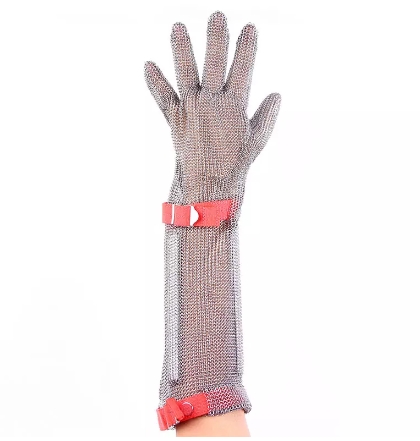
Stainless steel long gloves are not one-size-fits-all products. They incorporate several design features aimed at improving fit, safety, and usability.
Proper fit is essential for both comfort and safety. A glove that is too loose may slip or reduce dexterity, while one that is too tight can cause hand fatigue. Manufacturers typically provide size charts based on hand measurements. A common sizing standard relates to the circumference of the palm and the length of the hand.
For instance, a size chart might list the following parameters :
XX-Small: Palm circumference of 5-5.5 inches (approx. 127-140 mm), hand length of 200 mm.
Small: Palm circumference of 7-7.5 inches (approx. 178-190 mm), hand length of 215 mm.
Medium: Palm circumference of 8-8.5 inches (approx. 203-216 mm), hand length of 220 mm.
Large: Palm circumference of 9-9.5 inches (approx. 229-241 mm), hand length of 230 mm.
X-Large: Palm circumference of 10-10.5 inches (approx. 254-267 mm), hand length of 240 mm.
Sizes generally range from XXS to XXL, allowing users to select a glove that matches their anthropometric data . Some gloves are also designed to be reversible, meaning they can be worn on either the left or right hand, which simplifies inventory management .
To secure the glove to the hand and arm, various strap systems are employed. The choice of strap can impact hygiene and ease of use. Hebei Linchuan, for example, categorizes its long gloves based on the strap type :
Textile Strap: Often made of fabric, these are adjustable but may absorb contaminants in wet environments.
Plastic Strap: Fully encased plastic straps enhance cleanability and reduce bacteria retention, making them suitable for food processing areas where hygiene is a concern .
Metal Claw: A more robust fastening mechanism that hooks into the mesh.
Spring Strap: Utilizes a spring mechanism, often with ultra-flat stainless steel springs, for a secure and quick fastening at the wrist and elbow .
The defining feature of a long glove is the extended sleeve. This is not merely an aesthetic addition but a functional extension of protection. Standard short gloves protect the hand and wrist, but the long sleeve safeguards the forearm, which is also at risk during tasks like meat cutting or handling large sheets of glass. Data from suppliers indicates that the sleeve length is measured from the wrist to the end of the sleeve, with common extensions being 8cm, 15cm, and 20cm . Some manufacturers offer custom lengths based on specific buyer requirements.
Stainless steel long gloves are utilized across a spectrum of industries where cut hazards are present. Their adoption is driven by the need to reduce workplace injuries and comply with safety regulations.
The most common application for these gloves is in the food industry. In slaughterhouses, butcher shops, and poultry processing plants, workers use sharp knives constantly. A slip of the knife could result in a severe laceration. Stainless steel mesh gloves act as a guard, stopping the blade before it contacts the skin.
The hygiene aspect is also critical. Stainless steel is non-porous and can withstand high-temperature washing and sanitizing procedures. Standard cleaning protocols involve vigorous brushing with water at 50°C followed by rinsing with water at 82°C to ensure bacteriological safety . This resistance to fats, oils, and cleaning agents makes them more durable than fabric gloves in these greasy environments .
In industries dealing with glass, the risk of deep cuts from sharp edges is a constant hazard. During the manufacturing, cutting, or installation of glass, workers must handle panels with exposed edges. Stainless steel gloves provide the necessary cut protection while allowing for the grip strength needed to maneuver heavy materials. Similarly, in metal fabrication, handling sheet metal with burrs or sharp corners poses a significant laceration risk .
The textile and leather industries utilize cutting tools such as rotary blades and straight knives to cut multiple layers of material. Workers guiding these blades are at risk of cutting their non-dominant hand. Wearing a stainless steel glove on the guiding hand provides a level of security, allowing the worker to hold the material steady without fear of injury .
Other applications include wood processing (where splinters and saw blades are hazards), plastic processing, and even security and public safety roles where personnel may encounter edged weapons .
To verify their protective qualities, stainless steel gloves are subjected to standardized testing. Compliance with these standards provides a benchmark for comparing products and ensuring they meet minimum safety requirements.
One of the primary standards for this type of equipment is EN 1082, which covers the requirements for protective clothing against hand cuts and stabs by hand knives. This standard specifically addresses chainmail gloves and other metal mesh protection. It outlines the design, material specifications, and ergonomic requirements to ensure the glove provides effective protection without causing harm to the user .
EN 420 is the general requirement for protective gloves. It covers aspects such as innocuousness (the glove must not cause harm to the user), comfort and efficiency, sizing, and marking. A glove certified under EN 420 ensures that the materials used are safe for skin contact and that the glove is constructed to a basic level of quality .
Specific technical data points are often provided to demonstrate performance. For example, a glove might be rated with a 200N tensile force, meaning it can withstand 200 Newtons of force before the rings or welds begin to fail . The "4:1 ring assembly" design, where each ring connects to four others, distributes force more evenly across the glove, reducing the size of gaps and minimizing the risk of a knife point penetrating through the mesh .
The longevity of a stainless steel long glove is directly related to how well it is maintained. Proper care ensures that the protective qualities are not compromised over time.
Because these gloves are often used in food environments, cleaning is a mandatory part of daily use. The recommended method involves physically removing debris with a brush under warm water (around 50°C) to dislodge any particles trapped in the rings. This is followed by a rinse in hot water, often cited at 82°C, which acts as a thermal disinfection step . It is important to use non-acidic cleaning agents authorized for food contact surfaces, as acidic cleaners can corrode even stainless steel over time.
After cleaning, gloves should be dried thoroughly before storage. Storing them in a dry environment prevents moisture from being trapped in the ring junctions, which could eventually lead to surface corrosion. They should not be left in direct contact with harsh chemicals.
Regular inspection is necessary to identify damage. Users should check for broken rings, cracks in welds, or deformed mesh that could create openings. A glove with a broken ring has a compromised structure and should be repaired or replaced immediately, as the integrity of the entire garment is reduced .
Hebei Linchuan Safety Protective Equipment Co., LTD is an established supplier in the safety equipment sector. Based in Hebei, China, the company has been an audited supplier for several years, with profile certifications from organizations like SGS/BV, indicating a level of verification regarding their business practices .
Their product line includes a variety of stainless steel long gloves designed to cater to different user preferences. The company distinguishes its offerings primarily through the type of strapping system used—textile, plastic, metal claw, or spring strap—allowing customers to select based on their specific needs for hygiene or fastening convenience .
The gloves are available in a full range of sizes from XXS to XXL and utilize standard stainless steel materials like 304/316ss. They are marketed towards the meat processing industry, but their applications extend to garment manufacturing, leather processing, and other fields requiring cut protection . The company packages long gloves individually in boxes, often including a glove tightener to help users achieve a better fit, which is a practical accessory for ensuring the glove performs as intended .
The stainless steel long glove represents a specialized but essential category of personal protective equipment. Its construction from materials like 304 and 316 stainless steel provides a verifiable level of cut and puncture resistance that is necessary in industries ranging from food processing to heavy manufacturing. Data regarding ring diameter, wire thickness, sleeve length (8cm, 15cm, 20cm), and tensile strength (200N) allow safety officers and procurement specialists to make informed decisions based on the specific hazards present in their workplace.
Companies like Hebei Linchuan Safety Protective Equipment Co., LTD contribute to this industrial safety ecosystem by manufacturing and supplying these gloves, offering various sizes and strap types to meet diverse operational requirements. While they do not render a user invulnerable, and are not a substitute for safe work practices, stainless steel long gloves are a tool that, when properly selected, fitted, and maintained, provides a reliable barrier against one of the most common workplace injuries: lacerations.