
Author: Site Editor Publish Time: 2026-07-31 Origin: Site


Chainmail gloves used in meat processing, glass handling, and other industrial applications experience significant wear during normal operation. The metal rings that form the protective mesh can break, stretch, or separate over time. A broken link creates a gap in the protective structure, potentially reducing the glove's cut resistance. Understanding how to identify damage and determine the appropriate repair approach is essential for maintaining worker safety and managing PPE costs.
The decision to repair versus replace a damaged chainmail glove depends on several factors: the extent of damage, the availability of proper repair materials, certification requirements, and economic considerations. This guide examines the repair process for broken chainmail glove links, covering assessment methods, repair techniques, and the important distinction between user-performed repairs and manufacturer-authorized service.
Hebei Linchuan Safety Protective Equipment Co., LTD manufactures stainless steel chainmail gloves for food processing and industrial applications. Our gloves are constructed from welded steel rings and are designed to provide durable cut protection. This guide reflects our technical knowledge of chainmail construction and our experience working with customers who maintain chainmail glove inventories in their facilities.
Before attempting any repair, understanding the weave pattern of the chainmail is essential. Industrial chainmail gloves used in meat processing and food handling are typically constructed in a pattern called European 4-in-1. In this weave, each ring passes through four other rings. This interlocking pattern creates a dense, flexible mesh that distributes cutting force across multiple rings and provides the glove's protective properties.
The European 4-in-1 pattern means that when a ring is missing or broken, there will be four surrounding rings that are no longer connected to one another. Identifying these four parent rings is the first step in planning a repair. The repair must restore the original weave pattern to maintain consistent cut resistance across the glove surface.
Industrial chainmail gloves differ from historical or costume chainmail in two important aspects. First, the rings are typically welded rather than butted, meaning the ends of each ring are permanently fused together. Second, the gloves are certified to meet safety standards such as EN 1082 for protection against cuts and stabs by hand knives. These certifications apply only when the glove remains in its original manufactured condition.
Before beginning any repair work, the damage must be assessed to determine whether repair is practical or whether replacement is the appropriate course of action. The number of broken links, their location on the glove, and the overall condition of the surrounding mesh all factor into this decision.
A single broken link in an isolated area is generally repairable. The repair cost is low, and the structural integrity of the glove can be fully restored with proper technique. However, gloves with extensive damage, such as multiple broken links in the same area or damage that affects the wrist closure mechanism, may not be economical to repair. Professional repair services often apply a guideline that if three or more major components are damaged, replacement is more cost-effective than repair.
The location of the damage matters for both repair difficulty and safety considerations. Damage in the palm area, where cut resistance is most critical, requires careful repair to ensure the weave pattern is fully restored. Damage at the wrist or cuff area may also affect how securely the glove fits, which impacts overall protection. The glove must still fit properly after repair to provide the intended level of protection.
For gloves used in food processing environments, hygiene considerations also affect the repair decision. The repaired area must be cleanable to the same standard as the rest of the glove. Any repair technique that creates crevices or surface irregularities may compromise cleaning effectiveness and create areas where bacteria could accumulate.
Repairing a broken link in a chainmail glove requires specific tools and matching replacement rings. The primary tools are two pairs of pliers. One pair holds the ring steady while the other opens or closes the replacement ring. Smooth-jawed pliers are preferred over toothed pliers because they do not scratch the ring surface. Scratches can create stress points that may lead to premature ring failure.
Replacement rings must match the original rings in three key properties: material composition, wire gauge, and internal diameter. A ring that is too thick will not weave properly into the existing pattern. A ring that is too thin will provide less cut resistance and may fail under normal operating loads. A ring with a different internal diameter will not correctly engage the four surrounding rings. For industrial chainmail gloves, replacement rings should be the same stainless steel alloy and the same wire gauge as the original construction.
Good lighting and a stable work surface are also important for effective repair. The rings are small, and accurate weaving requires clear visibility of the weave pattern. A work surface that prevents the glove from shifting during repair makes the process easier and produces more consistent results.
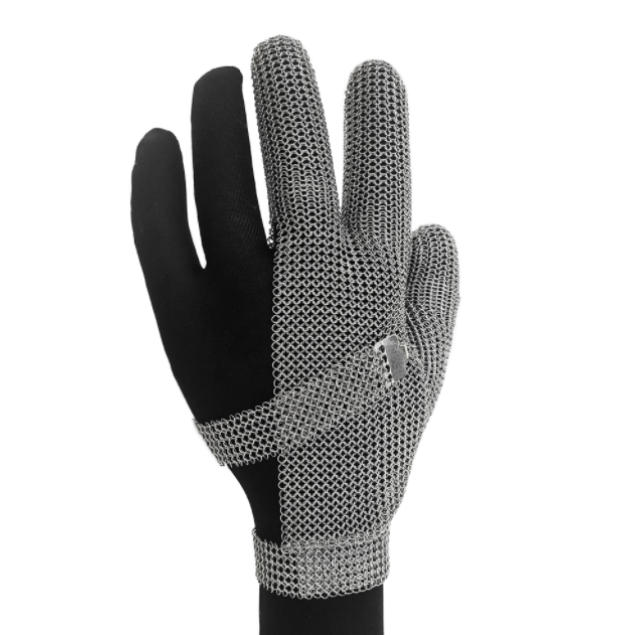
Replacing a broken link in a chainmail glove follows a systematic process. The first step is to identify the hole in the weave pattern. With the glove laid flat on a work surface, examine the damaged area to locate the four rings that should be connected to the missing link. In a European 4-in-1 weave, these four rings form a square pattern around the gap.
With a replacement ring held in two pairs of pliers, the next step is to open the ring. The correct technique is to twist the ring open rather than pulling it apart. Pulling the ring will deform its circular shape. The twisting motion, pushing one end forward while pulling the other back, opens a gap while maintaining the ring's shape. The ring should be opened only enough to pass it through the surrounding rings.
The opened ring is then threaded through the four parent rings in the correct weave pattern. The ring must pass over and under the existing rings to match the European 4-in-1 pattern. This is the most critical part of the repair because incorrect weaving creates a weak point in the glove structure. If the new ring is woven incorrectly, it will not interlock properly with the surrounding rings and may separate during use.
Once the ring is correctly positioned through all four surrounding rings, it is closed using the reverse twisting motion. The ends should meet flush with no gap. A correctly closed ring has a smooth seam. A gap between the ends allows the ring to catch on other rings or on the material being processed. An overlap creates a raised area that may snag and creates a stress concentration point. The closed ring should sit flush with the surrounding rings and the weave should appear uniform.
For larger holes with multiple missing rings, the repair proceeds from the edges inward. Each new ring is installed one at a time, connecting to the existing stable weave at the edge of the hole. This builds a patch of new rings that gradually closes the gap. Working from the center outward is not recommended because the new rings may not have stable connections to anchor them properly.
After the repair is complete, the area should be inspected carefully. The weave should appear uniform with no gaps. The new ring should sit flat and move freely within the weave, just like the surrounding rings. Any ring that seems loose or that does not lie flat should be removed and reinstalled.
The ring type significantly affects the repair process. Butted rings have ends that are simply pushed together with no additional connection. These rings can be opened and closed with pliers and are the standard construction for costume and historical chainmail. They are also the ring type used in the repair guides commonly found online.
Industrial chainmail gloves, in contrast, typically use welded rings. The ends of each ring are permanently fused together during manufacturing. Welded rings are stronger and resist opening under cutting forces. However, this also means that a welded ring cannot be opened with pliers. Attempting to open a welded ring will deform or break the ring, and the welded connection cannot be restored by the user.
This difference has important implications for chainmail glove repair. Professional repair services use specialized equipment, including precision welders, to replace damaged rings in welded chainmail gloves. The replacement ring is welded closed to match the original construction, restoring the glove to its intended strength.
Users should not attempt to repair welded chainmail gloves with hand tools. Opening a welded ring with pliers is not possible without damaging the ring. Attempting to close a broken welded ring will not restore the ring's strength. For welded chainmail gloves, the appropriate repair approach is manufacturer-authorized service using proper welding equipment and matching replacement rings.
Regulatory standards for protective gloves carry specific requirements regarding repair. The EN 1082 standard for gloves and armguards protecting against cuts and stabs by hand knives requires that protective gloves provide consistent protection throughout their service life. Any repair must maintain the glove's compliance with the standard.
Manufacturers of certified protective gloves typically specify that only the manufacturer is authorized to repair defective gloves. This is not a marketing position but a compliance requirement. The glove's certification applies to the glove as manufactured. A repair performed by someone other than the manufacturer may alter the glove's protective properties in ways that are not tested or certified.
The manufacturer has access to the correct materials and knows the specific weave pattern, ring size, and ring material for each glove model. The manufacturer's repair service uses tools and techniques that restore the glove to factory condition. The manufacturer also knows when a glove is beyond repair and should be replaced.
Using a non-authorized repair service or attempting user repairs on certified protective gloves may void the glove's certification. If a worker wearing a repaired glove is injured, the employer may face questions about whether the glove provided the required protection. For this reason, safety managers are advised to use manufacturer-authorized repair services for certified protective gloves.
Professional repair services provide a systematic approach to restoring chainmail gloves. A typical professional repair process includes inspection, cleaning, assessment, repair, and quality control. Gloves sent for repair are first cleaned to remove debris and biological residues that may be present from food processing use. This ensures that the repair area is clean and that the technician can properly inspect the glove.
After cleaning, a technician inspects the glove to identify all damage. This includes not just broken rings but also worn straps, damaged closure mechanisms, and any area where the weave may be compromised. The technician assesses whether repair is economical or whether replacement is recommended.
For gloves that are repairable, the technician replaces broken rings, welds replacements into place, and ensures the weave pattern is correct. Straps and closures are inspected and replaced if necessary. The glove then undergoes a final cleaning and inspection before being returned to the customer.
Professional repair services typically charge by the repair. Costs vary by the extent of damage and the components that need replacement. For industrial chainmail gloves, a standard glove repair may include charges for mesh repair and additional charges for strap replacement. Aprons and larger protective items have different repair costs.
The turnaround time for professional repair varies. Some services offer several weeks turnaround for repairs, depending on the volume of work and the extent of repairs needed. Facilities should plan their glove inventory to account for repair turnaround times to avoid production interruptions.
The economic decision to repair versus replace damaged chainmail gloves depends on the repair cost relative to the replacement cost. A new industrial chainmail glove typically represents a significant investment. A repair may cost substantially less than a new glove, saving a percentage of the replacement cost while restoring the glove to functional condition.
For gloves that require multiple repairs over their service life, each repair extends the useful life and reduces the total cost of ownership. Facilities that implement a repair program for chainmail gloves can realize significant savings over time. The savings from repair can be redirected to other safety investments or used to maintain higher inventory levels.
However, repair is not always the better economic choice. A glove with extensive damage, such as multiple broken links in the same area or damage to the wrist closure, may require repair costs approaching the cost of a new glove. In these cases, replacement is more cost-effective. Gloves that have been repaired multiple times may also show wear in the surrounding rings that reduces their service life after repair.
The environmental impact is another consideration. Repairing gloves instead of discarding them reduces waste and extends the service life of manufactured products. Discarded PPE contributes to waste streams and requires replacement production, which consumes energy and resources. For facilities focused on sustainability, repair is the environmentally preferred option for gloves that are still structurally sound.
Regular inspection of chainmail gloves can identify damage before it creates a safety hazard. Workers should inspect their gloves before each shift, looking for broken links, stretched rings, and visible wear. A glove with a single broken link should be removed from service for repair. Continuing to use a glove with a broken link increases the risk that the damage will spread or that the glove will fail at the damaged point.
Proper cleaning and maintenance also extend glove service life. Chainmail gloves used in food processing should be scrubbed vigorously in hot soapy water at the recommended temperature at least once daily. Rinsing should be at the appropriate temperature, followed by disinfection with an approved product. Gloves should not be cleaned by knocking them against hard surfaces, as this can damage the rings.
Storage conditions also affect glove condition. Cleaned gloves should be stored in a dry, cool, well-ventilated area. Storage in damp conditions can promote corrosion. Gloves with corrosion are more prone to ring breakage than gloves in good condition.
There are conditions where replacement is the only appropriate action. Gloves with extensive damage to the weave pattern that cannot be repaired without replacing many rings should be replaced. Gloves with damage in the wrist closure mechanism may not provide secure fit after repair. Gloves with corrosion affecting a large area of the glove may have compromised metal throughout the glove, making individual ring repair insufficient.
Certified protective gloves that are beyond their intended service life should also be replaced. Even a glove that has never suffered a broken link will experience wear from use. The wire gauge reduces over time through abrasion. A glove that has reached its recommended replacement age may no longer provide the same cut resistance as a new glove, even after repairs.
Any glove that has been subjected to extreme conditions, such as contact with corrosive chemicals or high heat, should be inspected carefully and may require replacement. The metal structure may have been compromised even if no visible damage is apparent. In these cases, replacement is the conservative safety decision.
Repairing broken links on chainmail gloves is a specific process that depends on the ring type and the extent of damage. For butted ring chainmail used in non-certified applications, user repair with pliers and matching replacement rings is possible following a systematic approach. For welded ring chainmail used in certified protective gloves, manufacturer-authorized repair service is the only appropriate method that maintains compliance with safety standards.
The repair decision should be based on assessment of damage extent, economic analysis, and regulatory compliance requirements. Minor damage to a glove in otherwise good condition is typically cost-effective to repair. Extensive damage or gloves near the end of their service life are better candidates for replacement. Facilities that implement regular inspection and proper maintenance programs can extend glove service life and reduce the frequency of repairs needed.
Hebei Linchuan Safety Protective Equipment Co., LTD manufactures stainless steel chainmail gloves and provides guidance on maintenance and repair for our products. We recommend consulting with the manufacturer for specific repair recommendations for each glove model. Proper repair and maintenance practices keep gloves in service longer, reduce PPE costs, and ensure that workers continue to receive the protection they need.