
Author: Site Editor Publish Time: 2026-09-06 Origin: Site


For workers in meat processing, butchery, and food service, a broken ring on a chainmail glove is a common occurrence that raises an important question: can it be repaired? The short answer is yes, broken rings can be repaired, but the process depends on the type of ring construction and whether the repair is performed by the user or by a professional service. Understanding the repair options, limitations, and compliance requirements is essential for safety managers and workers who rely on these gloves for daily protection.
Unlike textile cut-resistant gloves that must be discarded when damaged, chainmail butcher gloves offer the distinct advantage of repairability. The interlocking ring structure can be restored by replacing broken or missing rings, extending the service life of the glove. This repairability is one of the key reasons chainmail gloves are a cost-effective choice for demanding applications, despite their higher initial cost.
Hebei Linchuan Safety Protective Equipment Co., LTD manufactures stainless steel chainmail butcher gloves with welded ring construction. Our gloves are certified to EN 1082-1 and EN 388 standards, and we offer a factory repair program for customers needing professional restoration services. This guide examines the repair options for broken rings on butcher gloves, including user repairs, professional services, and the compliance considerations that affect repair decisions.
The type of ring construction in a chainmail glove determines whether it can be repaired by the user or requires professional service. Two primary ring types exist: butted rings and welded rings.
Butted Rings – Butted rings have ends that are simply pushed together with no additional connection. These rings can be opened and closed with pliers and are the standard construction for costume and historical chainmail. Butted rings are the type typically featured in online repair guides that demonstrate user repairs. However, butted rings are not suitable for industrial applications because they can separate under the forces encountered during cutting operations.
Welded Rings – Industrial chainmail butcher gloves, including those used in meat processing and food service, typically use welded rings. The ends of each ring are permanently fused together during manufacturing. Welded rings are stronger and resist opening under cutting forces. However, this also means that a welded ring cannot be opened with pliers. Attempting to open a welded ring will deform or break the ring, and the welded connection cannot be restored by the user.
This difference has important implications for chainmail glove repair. Professional repair services use specialized equipment, including precision welders, to replace damaged rings in welded chainmail gloves. The replacement ring is welded closed to match the original construction, restoring the glove to its intended strength. Users should not attempt to repair welded chainmail gloves with hand tools. Opening a welded ring with pliers is not possible without damaging the ring. Attempting to close a broken welded ring will not restore the ring's strength.
For industrial chainmail butcher gloves with welded rings, user repairs with hand tools are not recommended. Opening a welded ring with pliers will deform or break the ring, and the welded connection cannot be restored by the user. Attempting to close a broken welded ring will not restore the ring's strength. The appropriate repair approach for welded chainmail gloves is manufacturer-authorized service using proper welding equipment and matching replacement rings.
In some limited cases, users may perform temporary emergency repairs using split rings or replacement rings that are not welded. However, these repairs do not restore the glove to its certified protection level and should only be used as a short-term measure until professional repair can be arranged. Any repair that does not maintain the glove's compliance with EN 1082-1 or other applicable standards should not be considered a permanent solution.
For butted ring chainmail gloves used in non-certified applications, user repair with pliers and matching replacement rings is possible following a systematic approach. However, industrial butcher gloves are almost exclusively manufactured with welded rings, and user repairs are not appropriate for these products.
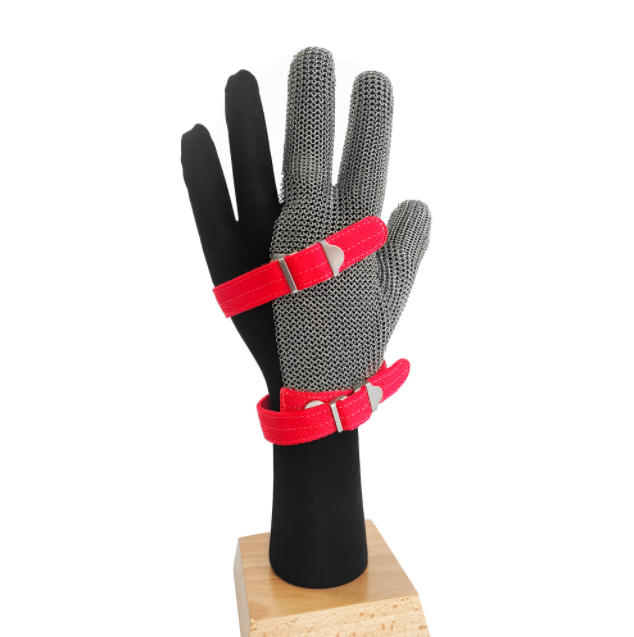
Professional repair services provide a systematic approach to restoring chainmail butcher gloves. These services are the recommended solution for gloves with welded ring construction.
A typical professional repair process includes inspection, cleaning, assessment, repair, and quality control. Gloves sent for repair are first cleaned to remove debris and biological residues that may be present from food processing use. This ensures that the repair area is clean and that the technician can properly inspect the glove.
After cleaning, a technician inspects the glove to identify all damage. This includes not just broken rings but also worn straps, damaged closure mechanisms, and any area where the weave may be compromised. The technician assesses whether repair is economical or whether replacement is recommended.
For gloves that are repairable, the technician replaces broken rings, welds replacements into place, and ensures the weave pattern is correct. Straps and closures are inspected and replaced if necessary. The glove then undergoes a final cleaning and inspection before being returned to the customer.
Some professional repair services use a "Rule of Three" guideline: if three or more major components are damaged, replacement is more cost-effective than repair. This helps customers avoid spending money on repairs that approach the cost of a new glove. Minor repairs, however, often take just minutes to complete and offer significant cost savings.
Transparent Pricing – Professional repair services typically offer transparent pricing. For example, standard mesh repair for a glove may cost a modest amount, while a repair that includes strap replacement may cost slightly more. For larger items such as aprons, standard repairs may cost more. If the repair cost approaches the cost of a new glove, the service will typically recommend replacement instead. Some services also offer repairs for specific components, such as tube springs or cross-wire springs, at additional cost.
Turnaround Time – The turnaround time for professional repair varies depending on the service provider and the extent of repairs needed. Some services offer turnaround times of four to six weeks, while others may complete repairs more quickly. Facilities should plan their glove inventory to account for repair turnaround times to avoid production interruptions.
Regulatory standards for protective gloves carry specific requirements regarding repair. The EN 1082 standard for gloves and armguards protecting against cuts and stabs by hand knives requires that protective gloves provide consistent protection throughout their service life. Any repair must maintain the glove's compliance with the standard.
Manufacturers of certified protective gloves typically specify that only the manufacturer is authorized to repair defective gloves. This is not a marketing position but a compliance requirement. The glove's certification applies to the glove as manufactured. A repair performed by someone other than the manufacturer may alter the glove's protective properties in ways that are not tested or certified.
The manufacturer has access to the correct materials and knows the specific weave pattern, ring size, and ring material for each glove model. The manufacturer's repair service uses tools and techniques that restore the glove to factory condition. The manufacturer also knows when a glove is beyond repair and should be replaced.
Using a non-authorized repair service or attempting user repairs on certified protective gloves may void the glove's certification. If a worker wearing a repaired glove is injured, the employer may face questions about whether the glove provided the required protection. For this reason, safety managers are advised to use manufacturer-authorized repair services for certified protective gloves.
Manufacturers offering factory repair programs provide a reliable solution for maintaining chainmail butcher gloves. Hebei Linchuan Safety Protective Equipment Co., LTD offers a factory repair program for its chainmail gloves. The program provides professional repair services using original replacement rings and proper welding equipment.
The factory repair process typically includes a full inspection of the glove to identify all damage, including broken rings, worn straps, and damaged closure mechanisms. The technician assesses whether repair is economical or whether replacement is recommended. For repairable gloves, the technician replaces broken rings, welds replacements into place, and ensures the weave pattern is correct. Straps and closures are inspected and replaced if necessary. The glove then undergoes a final cleaning and inspection before being returned to the customer.
Factory repair services restore the glove to its original condition and maintain compliance with safety standards. The repaired glove performs like new, with no visible gaps or weaknesses in the weave. Using manufacturer-authorized repair services ensures that the glove's certification remains valid and that workers continue to receive the required level of protection.
While broken rings can often be repaired, there are conditions where replacement is the only appropriate action. Gloves with extensive damage to the weave pattern that cannot be repaired without replacing many rings should be replaced. Gloves with damage in the wrist closure mechanism may not provide secure fit after repair. Gloves with corrosion affecting a large area of the glove may have compromised metal throughout the glove, making individual ring repair insufficient.
Certified protective gloves that are beyond their intended service life should also be replaced. Even a glove that has never suffered a broken link will experience wear from use. The wire gauge reduces over time through abrasion. A glove that has reached its recommended replacement age may no longer provide the same cut resistance as a new glove, even after repairs.
Professional repair services often apply a guideline that if three or more major components are damaged, replacement is more cost-effective than repair. Customers should consider whether the repair cost approaches the cost of a new glove. If the repair cost exceeds approximately one-third to one-half of the replacement cost, replacement may be the better economic choice.
Broken rings on butcher gloves can be repaired, but the repair method depends on the ring type and the specific glove construction. For welded ring chainmail gloves used in certified protective applications, manufacturer-authorized repair service is the only appropriate method that maintains compliance with safety standards.
Users should not attempt to repair welded chainmail gloves with hand tools. Opening a welded ring with pliers will damage the ring, and the welded connection cannot be restored by the user. The appropriate repair approach for welded chainmail gloves is manufacturer-authorized service using proper welding equipment and matching replacement rings.
Professional repair services provide a systematic approach to restoring chainmail gloves, including inspection, cleaning, assessment, repair, and quality control. The repair restores the glove to its original condition and maintains compliance with safety standards. The repair decision should be based on assessment of damage extent, economic analysis, and regulatory compliance requirements.
Hebei Linchuan Safety Protective Equipment Co., LTD manufactures stainless steel chainmail butcher gloves with welded ring construction and offers a factory repair program for customers. Our repair services use original replacement rings and proper welding equipment to restore gloves to factory condition. We recommend that customers send damaged gloves to our factory repair program to maintain compliance with safety standards and ensure consistent worker protection.