
Author: Site Editor Publish Time: 2026-08-17 Origin: Site


For professionals working with sharp knives and cutting tools, selecting the right chainmail glove involves more than just choosing the correct cut level or size. The cuff length is a critical decision that affects protection, comfort, and range of motion. Chainmail gloves are available in two primary cuff configurations: short cuff, which terminates at or just below the wrist, and gauntlet cuff, which extends up the forearm. Each configuration serves specific applications and work environments.
Short cuff chainmail gloves extend past the wrist and slightly up the arm, typically with a cuff length of approximately 115 millimeters from the hand, offering protection for the lower arm while retaining full range of movement. Gauntlet cuff gloves, also known as long cuff gloves, extend further up the forearm, with cuff lengths ranging from 195 to 240 millimeters depending on the size. This additional coverage provides protection for the forearm and wrist area, which is particularly important in applications where knife slips can travel up the arm.
The term "gauntlet" historically refers to an armored glove with an extended cuff covering part of the forearm. In the context of chainmail gloves, gauntlet cuff models provide extended coverage that overlaps with the sleeve of a protective apron or jacket, creating a continuous barrier against blade contact.
Hebei Linchuan Safety Protective Equipment Co., LTD manufactures both short cuff and gauntlet cuff chainmail gloves for industrial and food processing applications. Both styles are available in sizes from XS through XXL and are certified to EN 1082-1 and EN 14328 standards. This guide examines the key differences between short cuff and gauntlet cuff chainmail gloves to help users select the appropriate configuration for their specific application.
Short cuff chainmail gloves are designed for tasks where wrist mobility and dexterity are prioritized over forearm protection. The cuff typically ends at or just below the wrist, providing coverage for the hand and lower wrist area without restricting the range of movement.
Key Characteristics – Short cuff chainmail gloves typically feature a cuff length of approximately 115 millimeters from the hand for all sizes. The short length means the glove terminates at the wrist crease, allowing unrestricted wrist articulation. This design is particularly suitable for tasks requiring fine manipulation and frequent hand and wrist movement. The weight of a short cuff glove ranges from approximately 240 grams for extra small sizes to 315 grams for extra large sizes, depending on the model.
Applications – Short cuff chainmail gloves are commonly used in meat processing, fish processing, oyster shucking, and food preparation where workers need to maintain full wrist flexibility. They are also suitable for plastics handling, leather processing, textile cutting, and paper processing where the forearm is not exposed to cutting hazards. Oyster shucking operations frequently use short cuff gloves because the repetitive wrist motion required for shucking benefits from the unrestricted movement that short cuffs provide.
Advantages – The primary advantage of short cuff gloves is the unrestricted range of motion at the wrist. Workers can bend, flex, and rotate their wrists freely without the glove resisting or bunching. They are also easier to put on and remove than long cuff versions, and they typically cost less due to the reduced material content. Short cuff gloves weigh less than gauntlet cuff models, reducing fatigue during extended wear periods. The lighter weight is a significant consideration for workers who wear the glove for entire shifts.
Limitations – Short cuff gloves do not provide protection for the forearm. In applications where knife slips can travel up the arm, the forearm remains vulnerable. The short cuff also creates a gap between the glove and any apron or sleeve, which can be an entry point for a blade. Workers wearing short cuff gloves must rely on the fit of their jacket or apron sleeves to cover the wrist area.
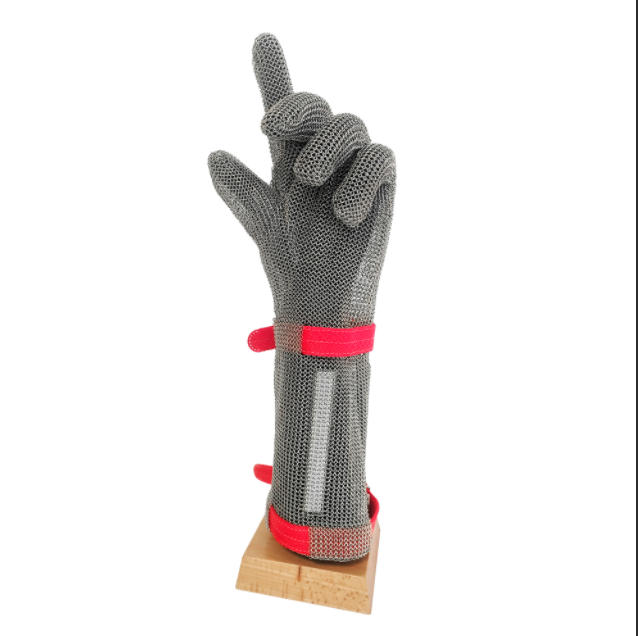
Gauntlet cuff chainmail gloves, also referred to as long cuff gloves, provide extended coverage for the forearm. The cuff extends from the wrist up the arm, with lengths typically ranging from 195 to 240 millimeters depending on the glove size. This additional coverage protects the forearm from knife slips that could otherwise cause severe injuries to arteries and tendons.
Key Characteristics – Gauntlet cuff chainmail gloves extend up the forearm, with the cuff length increasing proportionally with the glove size. For example, an extra small glove may have a cuff length of 195 millimeters, while an extra large glove may have a cuff length of 240 millimeters. The total length of the glove, including the hand and cuff, is typically 445 to 470 millimeters for medium to extra large sizes. The weight of gauntlet cuff gloves is higher than short cuff versions due to the additional rings, with medium sizes weighing approximately 330 grams and extra large sizes weighing approximately 395 grams.
Applications – Gauntlet cuff chainmail gloves are recommended for applications where the forearm is exposed to cutting hazards. They are particularly important in butchery and slaughterhouse operations where knives are larger and the risk of slips affecting the arm is higher. The additional forearm protection is essential when working with powered knives, as slips can be more dramatic and extend up the arm. Long cuff gloves are also used in glass handling, metal fabrication, and recycling where sharp materials may contact the forearm.
Advantages – The primary advantage of gauntlet cuff gloves is the extended coverage for the forearm. This protects the arteries and tendons in the wrist and lower arm, which are critical areas for serious injury prevention. In meat processing, protection of the arteries within the arm is a key consideration, as an accident to this part of the arm can be fatal. The extended cuff also overlaps with apron sleeves, creating a continuous barrier against blade contact and eliminating gaps where a knife could enter.
Limitations – The extended cuff restricts wrist movement more than short cuff versions. The additional material can feel bulky and may interfere with tasks requiring fine motor control. Gauntlet cuff gloves are heavier than short cuff models, which can increase fatigue over long shifts. They are also more expensive due to the additional rings and are more difficult to put on and remove.
Several factors should be considered when choosing between short cuff and gauntlet cuff chainmail gloves. The specific hazards present in the work environment, the nature of the tasks being performed, and the compatibility with other personal protective equipment all influence the decision.
Hazard Assessment – The frequency and severity of cut hazards should be the primary factor in the decision. If the forearm is exposed to cutting hazards or if knife slips commonly travel up the arm, a gauntlet cuff glove is recommended. In butchery, the knife-yielding hand should be covered by a glove offering cut protection, and the protection of arteries within the arm is key. The non-yielding hand should also be covered to protect against slashing and cutting accidents. If the cut hazards are limited to the hand and lower wrist, a short cuff glove may provide sufficient protection.
Task Requirements – The nature of the tasks being performed affects the suitability of each cuff type. Tasks requiring fine manipulation, frequent wrist articulation, or high dexterity are better suited to short cuff gloves. The short cuff provides the flexibility needed for precise cutting and trimming operations. Tasks involving heavy cutting, large knives, or powered knives benefit from the additional protection of gauntlet cuff gloves. The extended cuff provides a margin of safety in high-risk operations.
Compatibility with Other PPE – The interaction between the glove cuff and other PPE affects protection and comfort. Short cuff gloves are typically worn under apron or jacket sleeves, relying on the sleeve fit to cover the wrist area. Gauntlet cuff gloves extend over the sleeve, creating a sealed barrier against blade contact. The choice should consider how the glove will integrate with the facility's existing apron, sleeves, and other protective equipment.
Comfort and Wearability – Worker comfort and acceptance affect compliance with PPE requirements. Short cuff gloves are generally more comfortable for tasks that require extensive wrist movement. The reduced weight and bulk make them easier to wear for extended periods. Gauntlet cuff gloves, while providing more protection, may be less comfortable due to the additional weight and restriction of wrist movement. Facilities should consider worker feedback and trial periods when selecting between cuff types.
Cost Considerations – Gauntlet cuff gloves typically cost more than short cuff gloves due to the additional material and complexity of construction. The cost difference should be weighed against the protection benefit. In applications where forearm protection is not required, the additional cost of gauntlet cuff gloves may not be justified. In applications where forearm protection is essential, the cost is justified by the injury prevention value.
Different applications have different requirements for cuff length. The following recommendations provide guidance for common applications based on the typical hazards and task requirements.
Meat Processing and Butchery – In meat processing operations, the risk of knife slips is high and injuries can affect both the hands and forearms. For workers performing boning and breaking tasks, gauntlet cuff gloves are recommended to provide protection for the forearm and wrist area. The extended cuff overlaps with the apron sleeve, creating a continuous barrier against blade contact. For workers performing trimming and portioning tasks with lighter knives, short cuff gloves may provide sufficient protection while allowing better dexterity for precise cuts.
Seafood Processing – In fish processing and oyster shucking, the primary hazards are from fish spines, oyster shells, and cutting tools. Short cuff gloves are commonly used in these applications because workers need the wrist flexibility for fine manipulation. The forearm is typically not exposed to cutting hazards, and the risk of injuries to the forearm is lower than in red meat processing. However, facilities processing larger fish or using powered knives may choose gauntlet cuff gloves for additional protection.
Glass Handling – In glass handling applications, the hazard is from sharp glass edges rather than knives. Short cuff gloves are typically sufficient because the forearm is not usually exposed to the sharp edges during normal handling operations. However, if workers are handling large glass sheets or performing tasks where the forearm contacts sharp edges, gauntlet cuff gloves may be appropriate.
Metal Fabrication – In metal fabrication, the hazards include sharp metal edges and burrs. Short cuff gloves are commonly used for handling sheet metal and components. If workers are performing tasks where the forearm contacts sharp edges, gauntlet cuff gloves may be specified.
Recycling and Waste Sorting – In recycling operations, the hazards include broken glass, sharp metal objects, and other sharp materials. The unpredictability of the material stream may justify gauntlet cuff gloves for additional forearm protection. The extra coverage provides a margin of safety in environments where hazards are not easily identified before contact.
Proper fit is essential for both short cuff and gauntlet cuff chainmail gloves. A glove that fits correctly provides consistent protection, while a poorly fitted glove can create gaps or restrict movement.
For short cuff gloves, the cuff should sit at or just below the wrist crease. The glove should fit snugly around the hand without restricting movement or causing discomfort. The wrist closure should secure the glove in place without being too tight. Workers should measure the hand at the widest point of the palm, excluding the thumb, and use the manufacturer's sizing table to select the appropriate size.
For gauntlet cuff gloves, the extended cuff should cover the forearm without restricting elbow movement. The cuff should fit snugly around the wrist and forearm to prevent the glove from shifting during use. The fit at the wrist is particularly important because the glove must stay in position to provide consistent protection. Workers should ensure that the gauntlet cuff is long enough to overlap with the apron or jacket sleeve, creating a continuous barrier against blade contact.
The color-coded sizing system is commonly used for both cuff types, with sizes indicated by strap colors. The color coding helps workers quickly identify correctly sized gloves and prevents mix-ups in processing environments. Standard size colors include XXS-Brown, XS-Green, S-White, M-Red, L-Blue, XL-Orange, and XXL-Dark Green.
The choice between gauntlet cuff and short cuff chainmail gloves depends on the specific hazards, task requirements, and compatibility with other PPE. Short cuff gloves provide unrestricted wrist movement and reduced weight, making them suitable for tasks requiring fine manipulation and where forearm protection is not needed. Gauntlet cuff gloves provide extended forearm protection, making them suitable for tasks where the forearm is exposed to cutting hazards and for compatibility with aprons and sleeves.
Key recommendations for selecting cuff type include conducting a thorough risk assessment to identify forearm exposure to cutting hazards. Select short cuff gloves for tasks requiring high wrist mobility and where forearm protection is not required. Select gauntlet cuff gloves for tasks involving heavy knives, powered knives, or where forearm exposure is present. Consider compatibility with other PPE such as aprons and sleeves. Evaluate worker comfort and acceptance through trials before making a final decision.
Hebei Linchuan Safety Protective Equipment Co., LTD manufactures both short cuff and gauntlet cuff chainmail gloves for industrial and food processing applications. Our gloves are available in a range of sizes and are certified to EN 1082-1 and EN 14328 standards. We recommend that customers conduct a thorough hazard assessment and consult with our technical staff to select the appropriate cuff type for their specific application.