
Author: Site Editor Publish Time: 2026-03-09 Origin: Site


In occupational safety, the distinction between full-coverage and short gloves is significant. Chainmail short gloves, characterized by their wrist-length cuff as opposed to extended forearm coverage, serve specific functions in industries where dexterity and tactile feedback are paramount. This article examines the technical specifications, sizing standards, and application contexts for chainmail short gloves in professional environments.
Chainmail short gloves are five-finger protective gloves constructed from interlocking stainless steel rings that terminate at the wrist. Unlike long-cuff variants that extend 15 to 20 centimeters up the forearm, short gloves provide coverage only for the hand itself, with the cuff ending approximately at the wrist joint.
The primary advantage of this configuration is enhanced wrist mobility. Tasks requiring fine manipulation and frequent wrist articulation benefit from the reduced material mass and unrestricted movement that short gloves provide. The trade-off is the absence of forearm protection, making these gloves suitable for applications where the forearm is not exposed to cutting hazards.
Chainmail short gloves manufactured for professional use incorporate specific ring dimensions optimized for hand protection.
Data from product specifications indicate that standard chainmail short gloves are constructed with a wire diameter of 0.53 mm. The rings have an inner diameter of 2.75 mm and an outer diameter of 3.81 mm. These dimensions represent a balance between protection density and flexibility.
The relatively small ring inner diameter (2.75 mm) creates a tight mesh that presents a high density of metal to any approaching blade. This close weave reduces the likelihood of a knife point finding a gap between rings and increases the number of rings that must be displaced or cut before penetration can occur.
The weight of a chainmail short glove varies with size due to the additional material required for larger hand dimensions. A size medium short glove typically weighs approximately 200 grams (0.44 pounds) . This weight is distributed across the hand and does not impose significant fatigue during extended wear periods.
Proper fit is essential for both protection and comfort. Chainmail short gloves utilize a standardized sizing system based on hand anthropometry, with color-coded straps for rapid identification.
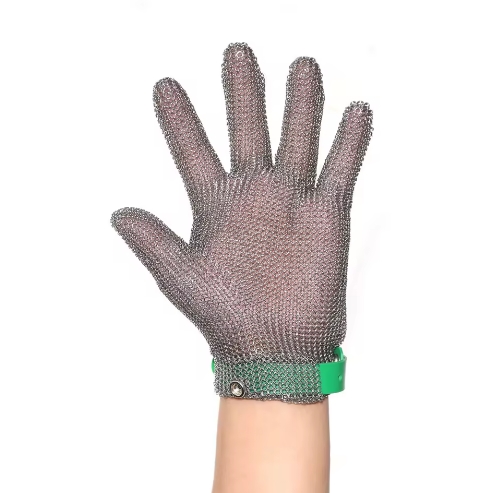
Sizing is determined by two primary measurements: palm perimeter and palm length. Industry standards define the following size ranges -4:
| Size | Strap Color | Palm Perimeter | Palm Length |
|---|---|---|---|
| XXS | Brown | 5-5.5 inches | 200 mm |
| XS | Green | 6-6.5 inches | 200 mm |
| S | White | 7-7.5 inches | 215 mm |
| M | Red | 8-8.5 inches | 220 mm |
| L | Blue | 9-9.5 inches | 230 mm |
| XL | Orange | 10-10.5 inches | 240 mm |
The strap color system serves multiple practical functions. In processing environments where multiple workers share equipment or where gloves are issued to specific individuals, color coding allows immediate visual verification that the correct size has been selected. This reduces the risk of workers using improperly sized gloves that may compromise protection or comfort.
A defining feature of chainmail short gloves is their ambidextrous configuration. Unlike textile gloves that are molded specifically for right or left hands, chainmail gloves can be worn on either hand by simply turning them inside out.
This design offers several operational advantages:
Inventory Simplification: Facilities need only stock one glove model rather than separate right and left inventories.
Even Wear Distribution: Workers can alternate the glove between hands, distributing wear more evenly and extending service life.
Replacement Efficiency: A single damaged glove can be replaced without discarding a matched pair.
Chainmail short gloves intended for occupational protection must comply with applicable safety standards.
The primary standard governing chainmail gloves is EN 1082-1:1996, which specifies requirements for protective gloves against cuts and stabs from hand knives. This standard addresses design criteria, penetration resistance testing, ergonomic characteristics, and marking requirements.
Compliance with EN 1082-1 requires that gloves undergo testing to verify that the mail construction prevents blade penetration under standardized test conditions. Gloves that meet this standard are classified as Category III PPE, indicating they protect against risks that could cause serious and irreversible harm.
For applications involving food handling, additional certifications are required:
LFGB: German food safety certification confirming that materials do not transfer harmful substances or odors to food products.
FDA Approval: United States Food and Drug Administration certification for materials intended for incidental food contact.
Chainmail short gloves are specified for specific occupational contexts based on their design parameters.
In butchery operations, short gloves are used for tasks requiring precision handling of cuts while maintaining cut protection. The unrestricted wrist movement facilitates the fine motor control needed for trimming and portioning.
Oyster shucking represents a primary application for single chainmail short gloves. The shucker wears one glove on the hand holding the oyster while the other hand manipulates the knife. The glove's cut and puncture resistance protects against slips that would otherwise drive the knife into the palm.
Beyond food processing, chainmail short gloves find application in:
Garment manufacturing: Protecting against rotary blade cutters during cloth cutting operations.
Wood carving: Preventing lacerations from chisels and carving tools.
Glass and leather processing: Shielding hands from sharp edges and cutting implements.
Chainmail short gloves are non-disposable items designed for extended service life with proper maintenance.
Cleaning procedures for short gloves follow the same principles as other chainmail products:
Washing with mild soap and warm water to remove organic residues.
Rinsing thoroughly to eliminate detergent traces.
Sanitizing with approved food-contact disinfectants.
A significant advantage of quality chainmail gloves is their repairability. Manufacturers such as Hebei Linchuan Safety Protective Equipment Co., LTD offer factory repair programs that can restore damaged gloves to serviceable condition. This capability reduces long-term replacement costs compared to disposable alternatives.
Signs that a chainmail short glove requires replacement include:
Broken or separated rings that compromise mesh integrity.
Stretched rings that have lost their original dimensions.
Strap failure that prevents secure fastening.
Corrosion or material degradation .
The selection of chainmail short gloves should consider the specific ergonomic demands of the task. For operations requiring sustained precision work, the reduced weight and unrestricted wrist motion of short gloves provide advantages over longer-cuff variants. Workers performing overhead work or tasks requiring extreme wrist angles particularly benefit from the short configuration.
Chainmail short gloves represent a specialized category of protective equipment optimized for tasks requiring hand protection without forearm coverage. Constructed from stainless steel wire with specific ring dimensions (0.53 mm diameter, 2.75 mm inner diameter), these gloves provide EN 1082-1 certified cut protection while maintaining the dexterity required for precision operations. The color-coded sizing system facilitates proper fit selection, and ambidextrous design simplifies inventory management. Hebei Linchuan Safety Protective Equipment Co., LTD manufactures chainmail short gloves meeting these specifications for industrial and food processing applications.