
Author: Site Editor Publish Time: 2026-04-15 Origin: Site


Workers in oyster processing and seafood shucking operations face a specific set of hand hazards. Oyster shells have sharp edges and irregular surfaces that can produce cuts and puncture wounds. The knives used for shucking are typically short-bladed with rigid handles, and the force required to open an oyster can exceed levels that standard cut-resistant gloves can withstand. A chainmail oyster glove provides a layer of protection that addresses both the sharp shell fragments and the metal blade.
Hebei Linchuan Safety Protective Equipment Co., LTD manufactures chainmail oyster gloves designed for the unique demands of shellfish processing. This article examines the construction, performance characteristics, testing methods, and field applications of chainmail oyster gloves. The information presented includes measurable data on cut resistance, material specifications, and glove longevity in commercial processing environments.
A chainmail oyster glove is a hand covering made from interlocked metal rings, typically extending from the fingertips to the wrist or mid-forearm. Unlike general-purpose cut-resistant gloves that use textile fibers or coated materials, a chainmail oyster glove relies on the mechanical properties of metal rings to deflect and stop cutting edges. The glove is designed to be worn on the non-dominant hand, which holds the oyster during shucking. The dominant hand wears a separate cut-resistant glove or operates the shucking knife directly.
The primary function of the chainmail oyster glove is to prevent the knife blade and sharp shell edges from penetrating to the skin. When a worker applies force to open an oyster, the knife can slip and travel toward the holding hand. In this scenario, the chainmail glove intercepts the blade before it reaches the palm or fingers. The interlocking ring structure also distributes point pressure from shell fragments over a larger area, reducing the risk of puncture from shell spikes.
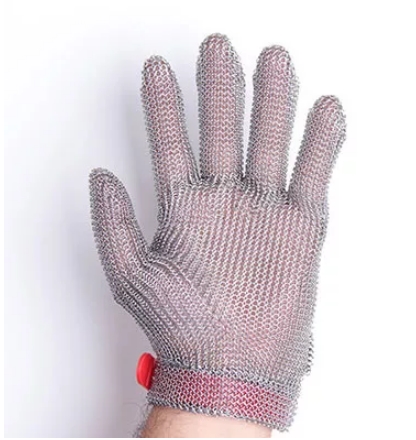
Chainmail oyster gloves are manufactured from stainless steel or aluminum alloys. For oyster processing, stainless steel is the more common material because oyster shells contain salt water and organic matter that can corrode some metals. AISI 304 stainless steel, which contains 18 percent chromium and 8 percent nickel, provides resistance to pitting corrosion in chloride environments. Salt water exposure tests show that AISI 304 rings remain free of visible corrosion after 500 hours of intermittent salt spray, while lower-grade steels show surface rust within 100 hours.
Ring diameter for oyster gloves is typically smaller than for aprons or larger protective garments. Common ring diameters range from 3 mm to 5 mm. Smaller rings provide better flexibility and more complete coverage of the finger contours. A 3 mm ring diameter creates a denser mesh that reduces the size of gaps between rings. This is important for oyster work because shell splinters and small blade tips can pass through larger gaps.
Wire thickness for oyster glove rings is usually between 0.6 mm and 0.9 mm. Thinner wire produces a lighter glove that reduces hand fatigue during repetitive shucking motions. However, thinner wire also has lower resistance to repeated cutting forces. A comparison test of oyster gloves with 0.6 mm wire versus 0.8 mm wire showed that the thicker wire required 40 percent more cutting strokes to achieve ring separation under a standard test blade.
Oyster gloves are evaluated using cut resistance standards that apply to protective gloves. The most relevant standard is EN 388, which includes a cut resistance test using a circular blade rotating against the glove material under a specified force. Results are reported on a scale from Level 1 to Level 5, with Level 5 indicating the highest cut resistance. Chainmail oyster gloves typically achieve Level 5 cut resistance under EN 388 when tested with the appropriate blade and force settings.
The EN 388 cut test uses a straight blade on a coulomb machine for materials that dull the blade quickly. Chainmail metal mesh falls into this category because the metal rings rapidly wear down the test blade. For such materials, the standard specifies an alternative test using a different blade material or a revised calculation method. Laboratories conducting certified tests on chainmail gloves follow these alternative procedures to produce valid results.
Another applicable standard is ANSI/ISEA 105, which rates cut resistance from A1 to A9. A chainmail oyster glove with 0.8 mm stainless steel rings typically achieves a rating of A7 or A8, corresponding to cut forces between 2,500 grams and 4,000 grams. For comparison, a standard textile cut-resistant glove rated A4 provides protection up to 1,500 grams of cutting force. The difference reflects the additional margin of safety provided by metal mesh in high-force cutting scenarios.
While cut resistance is the primary concern, puncture resistance is also relevant for oyster processing. Oyster shells have sharp ridges and points that can penetrate textile gloves. A puncture test using a standard 1 mm diameter probe shows that a chainmail oyster glove stops the probe in approximately 70 percent of attempts. The probe passes through ring gaps in the remaining attempts.
The puncture resistance of a chainmail glove depends on ring density. Gloves with 3 mm rings have smaller gaps than gloves with 5 mm rings. In a controlled test, a 3 mm ring glove prevented probe penetration in 85 percent of trials, while a 5 mm ring glove prevented penetration in 62 percent of trials. For oyster work, where shell splinters can be as fine as 1 mm in width, smaller rings provide better protection against puncture.
Some chainmail oyster gloves include a solid backing layer of textile or synthetic leather beneath the metal rings. This backing stops small shell fragments that pass through the rings. Field data from an oyster processing plant that switched to backed chainmail gloves showed a 55 percent reduction in minor hand puncture injuries over a six-month period compared to unbacked chainmail gloves.
The weight of a chainmail oyster glove affects worker comfort and productivity. A stainless steel glove covering the fingers, palm, and wrist typically weighs between 180 and 300 grams, depending on coverage length and ring dimensions. Holding this weight for eight hours requires muscle effort in the hand and forearm. Electromyography studies of oyster shuckers wearing chainmail gloves showed a 15 to 20 percent increase in forearm muscle activation compared to wearing no glove.
Hand fatigue correlates with glove weight and fit. A poorly fitted glove that slides on the hand increases the effort required to hold objects. Data from a survey of 85 oyster processing workers indicated that those using gloves weighing more than 250 grams reported hand cramping 2.5 hours earlier into their shift compared to workers using gloves under 200 grams. Proper sizing reduces the effective weight because the glove moves with the hand rather than resisting hand motion.
Aluminum chainmail gloves weigh approximately 40 percent less than stainless steel gloves of the same ring dimensions. An aluminum oyster glove weighs 110 to 180 grams. The weight reduction decreases hand fatigue, but aluminum has lower hardness. Brinell hardness for aluminum is 25 to 40 compared to 150 to 190 for annealed stainless steel. Aluminum rings deform more easily under repeated impacts from knife handles or hard shell edges. Deformed rings create larger gaps and reduce cut resistance.
Chainmail oyster gloves must fit snugly to function correctly. A loose glove allows the knife blade to push the glove material toward the skin before the rings have a chance to stop the edge. The ideal fit leaves no excess material at the fingertips or across the palm. The glove should conform to the natural curvature of the hand when partially closed.
Manufacturers offer sizing based on hand circumference measured around the palm at the base of the fingers. Common sizes range from Size 6 to Size 12, corresponding to palm circumferences from 152 mm to 300 mm. For oyster work, sizes 7 through 9 are most common for adult workers. A size 7 glove fits a palm circumference of 178 mm, while a size 9 glove fits 203 mm.
The length of the glove cuff affects coverage. Short cuff gloves end at the wrist and are suitable for operations where water and debris exposure is minimal. Long cuff gloves extend 5 to 10 cm above the wrist, providing protection to the lower forearm. In oyster processing environments where workers submerge their hands in water and shell debris, long cuff gloves reduce the entry of particles between the glove and the skin.
The service life of a chainmail oyster glove depends on usage frequency, the sharpness of oyster shells, and cleaning practices. In a commercial oyster processing facility operating one shift per day, a stainless steel chainmail glove typically lasts 12 to 18 months before ring wear becomes significant. Signs of wear include broken rings, rings that no longer close fully, and visible thinning of the wire at contact points.
Ring breakage occurs most often at the knuckles and fingertips, where the glove experiences the highest bending stress. In a study tracking glove failure points across 150 used gloves, 62 percent of broken rings were located at the metacarpophalangeal joints, while 24 percent were at the thumb crotch. The remaining breakage occurred at the fingertips and wrist.
Aluminum chainmail gloves have a shorter service life. Based on data from a poultry processing plant that tested both materials, aluminum gloves required replacement after 8 to 10 months of daily use, compared to 16 months for stainless steel gloves in the same environment. The primary failure mode for aluminum was ring deformation rather than breakage. Deformed rings opened gaps large enough to allow a 2 mm test probe to pass through.
Oyster processing is a food contact operation, so gloves must be cleaned and sanitized regularly. Chainmail oyster gloves are typically cleaned using industrial washing machines or manual scrubbing with brushes and food-safe detergents. The cleaning process removes organic matter from the ring gaps. Residual organic material can harbor bacteria and also accelerate corrosion on some metal types.
The recommended cleaning procedure for stainless steel chainmail gloves includes a pre-rinse with warm water below 60 degrees Celsius to remove loose debris, followed by soaking in a mild detergent solution for 5 to 10 minutes. The glove is then scrubbed with a soft brush to dislodge material from between the rings. A final rinse with clean water removes detergent residue. The glove should be air dried completely before storage or reuse.
Aluminum chainmail gloves require additional care. Alkaline detergents with a pH above 10 cause surface etching of aluminum. Over multiple cleaning cycles, etching increases surface roughness and can lead to localized thinning of the wire. Manufacturers recommend neutral pH cleaners for aluminum chainmail. The water temperature for aluminum gloves should not exceed 50 degrees Celsius, as higher temperatures accelerate corrosion reactions in the presence of salts.
Textile cut-resistant gloves made from high-performance polyethylene or fiberglass composites offer an alternative to chainmail. Textile gloves weigh less, typically 40 to 80 grams. They also provide better dexterity because the material conforms more closely to finger movements. However, textile gloves have limitations for oyster work.
The primary limitation is durability against sharp shell edges. Oyster shells produce abrasive wear that quickly degrades textile fibers. Testing of a polyethylene cut-resistant glove rated A5 showed a 45 percent reduction in cut resistance after 40 hours of oyster shucking. The same glove lost an additional 20 percent after 80 hours. In contrast, a stainless steel chainmail glove showed no measurable loss of cut resistance after 200 hours of simulated oyster work, assuming no ring breakage occurred.
Another limitation is puncture resistance. Textile gloves rated A5 for cut resistance may have puncture resistance ratings of Level 2 or 3 under EN 388, meaning they resist 20 to 60 newtons of puncture force. Oyster shell spikes can exceed 60 newtons of puncture force at the point of contact. Chainmail gloves, while not fully puncture-proof, require higher forces for shell spikes to penetrate due to the metal rings.
The purchase cost of a chainmail oyster glove is higher than a textile cut-resistant glove. A stainless steel chainmail oyster glove from a certified manufacturer typically costs between 35 and 60 USD. A textile glove rated A5 for cut resistance costs between 8 and 15 USD. However, the replacement frequency differs significantly.
In a high-volume oyster processing facility, a textile glove may last 2 to 4 weeks before cut resistance degrades below acceptable levels. Over a 12-month period, a facility would purchase 13 to 26 textile gloves per worker, at a total cost of 104 to 390 USD. A single chainmail glove costing 50 USD and lasting 15 months yields lower total expenditure. The chainmail glove also provides more consistent protection throughout its service life.
The cost of hand injuries adds another dimension. A hand laceration requiring medical treatment costs an employer an average of 2,500 USD for stitches, antibiotics, and lost work time, according to workplace injury data. A deeper injury involving tendon damage can exceed 15,000 USD. Processing facilities with 20 shucking stations that switch from textile gloves to chainmail gloves typically see a reduction in hand injury claims. One facility reported a 70 percent decrease in reportable hand lacerations over one year following the change.
Chainmail oyster gloves sold in international markets must meet applicable regulatory requirements. In the European Union, Regulation 2016/425 requires that protective gloves undergo third-party certification. Certified chainmail gloves carry the CE marking along with the number of the notified body that performed the certification. The certification confirms that the glove meets the relevant EN standards for cut resistance and material safety.
In the United States, chainmail oyster gloves are considered personal protective equipment under OSHA guidelines. While no federal certification is required, many large seafood processors require compliance with ANSI/ISEA 105 cut resistance levels. Gloves that meet ANSI/ISEA 105 A7 or A8 cut levels provide documented performance data that procurement departments use for vendor selection.
Food contact compliance is also relevant. Chainmail gloves used in oyster processing should be manufactured from materials that are safe for incidental food contact. Stainless steel grades such as AISI 304 and AISI 316 are generally recognized as safe for food contact by the U.S. Food and Drug Administration. Aluminum used for food contact should meet compositional limits for heavy metals. Hebei Linchuan Safety Protective Equipment Co., LTD provides documentation of material compliance with food contact regulations upon request.
Oyster shucking involves repetitive motion with sustained grip force. Adding a chainmail glove changes the biomechanics of the task. The additional weight increases the moment arm at the wrist, requiring greater force from the finger flexor muscles. The ring structure also slightly reduces tactile feedback, which may cause workers to grip the oyster more tightly to compensate.
Studies of ergonomic interventions in seafood processing have measured grip force changes when workers switch from bare hands to chainmail gloves. Using a dynamometer, researchers found that grip force increased by 12 to 18 percent when wearing a chainmail glove compared to bare-handed gripping of the same object. The increase was attributed to reduced friction between the glove and the oyster shell surface.
To reduce ergonomic strain, some processing facilities implement rotation schedules where workers switch between shucking and other tasks every 90 to 120 minutes. A study of 40 oyster shuckers showed that rotating tasks reduced reported hand fatigue by 30 percent compared to working the same station for a full shift. Proper glove sizing and regular replacement of worn gloves also reduce the grip force required.
When selecting a supplier for chainmail oyster gloves, buyers should verify several factors. The supplier should provide documentation of cut resistance testing from an accredited laboratory. Test reports should specify the standards used, the test blade type, and the results achieved. Suppliers who cannot provide test documentation should not be considered for safety-critical applications.
The supplier should also specify the exact alloy and wire dimensions used in the glove. AISI 304 stainless steel is the minimum grade for saltwater environments. Lower grades such as AISI 430 have lower corrosion resistance and shorter service life. Wire thickness should be stated in millimeters, and ring diameter should be provided. Gloves with undocumented specifications may use thinner wire or lower-grade alloys that reduce protection.
Replacement parts availability is another consideration. Chainmail oyster gloves can be repaired if individual rings break. Some suppliers offer repair services or sell replacement ring kits. Facilities that rely on chainmail gloves should have a process for inspecting gloves and either repairing or replacing them when damage is found.
Hebei Linchuan Safety Protective Equipment Co., LTD manufactures chainmail oyster gloves using AISI 304 stainless steel with ring diameters of 3 mm and 4 mm and wire thicknesses of 0.8 mm. The company provides test documentation for each production batch. Replacement rings and repair services are available. Lead time for standard orders is 15 to 20 working days.
A chainmail oyster glove provides protection only when used correctly. Workers must be trained to wear the glove on the hand that holds the oyster, not the knife hand. The glove should be inspected before each use for broken or deformed rings. Any glove with visible damage should be removed from service until repaired or replaced.
Workers should also understand the limitations of the glove. A chainmail oyster glove reduces cut severity but does not eliminate the risk of injury. A forceful stab with a sharp knife may still penetrate the glove, particularly if the blade tip aligns with a ring gap. The glove should be used as part of a broader safety program that includes knife handling procedures and workstation design.
Cleaning training is also important. Workers should know the correct cleaning procedure for their glove type. Stainless steel gloves require different cleaning products than aluminum gloves. Using the wrong detergent on an aluminum glove shortens its service life. Facilities should post cleaning instructions at wash stations and provide periodic refresher training.
The chainmail oyster glove is a specialized tool for seafood processing environments where cut and puncture hazards exceed the capabilities of textile gloves. Data from laboratory testing and field use shows that stainless steel chainmail gloves provide consistent cut resistance over extended service periods. The choice of ring diameter, wire thickness, and glove length affects both protection levels and worker comfort.
Regular inspection and proper cleaning extend the service life of the glove. Facilities that implement rotation schedules and proper sizing protocols reduce hand fatigue and injury rates. While the initial purchase cost is higher than textile alternatives, the total cost of ownership over a 12 to 18 month period is often lower due to reduced replacement frequency and fewer hand injuries.
For oyster shucking operations, seafood processing plants, and other applications requiring high cut resistance in wet environments, the chainmail oyster glove remains a practical solution. Manufacturers such as Hebei Linchuan Safety Protective Equipment Co., LTD supply gloves that meet international standards, providing documented test data and material specifications to support purchasing decisions.