
Author: Site Editor Publish Time: 2026-04-15 Origin: Site


Chainmail cutting gloves are personal protective equipment designed to protect hands from cuts and punctures during food processing, meat cutting, and industrial operations involving sharp blades. Unlike fabric-based cut-resistant gloves that rely on high-performance fibers, chainmail gloves use stainless steel ring mesh construction to provide a physical barrier against knives, boning tools, mandoline blades, and glass handling equipment.
Hebei Linchuan Safety Protective Equipment Co., LTD is a manufacturer of stainless steel ring mesh safety products based in Shijiazhuang, Hebei Province. The company produces chainmail gloves, aprons, and other protective equipment for meat processing, poultry processing, garment manufacturing, and glass handling industries. This guide provides technical specifications, sizing data, performance standards, and selection criteria for chainmail cutting gloves based on industry standards and manufacturing data.
Chainmail cutting gloves are protective gloves constructed from interlocking stainless steel rings. Each ring is welded or closed to form a continuous metal mesh that covers the hand and, in some designs, extends to the wrist or forearm. The metal ring construction provides cut and puncture resistance that exceeds most textile-based cut-resistant gloves.
The protection principle of chainmail is straightforward: a sharp blade cannot cut through the metal rings because the rings deflect or stop the blade edge. This differs from fiber-based gloves, where cut-resistant yarns slow or stop blade movement through material strength and friction.
Chainmail gloves are classified as non-disposable PPE. With proper cleaning and storage, a single pair can last several years. Many chainmail glove designs are ambidextrous, meaning the same glove can be turned inside out to fit either hand. This feature reduces inventory requirements for food processing facilities.
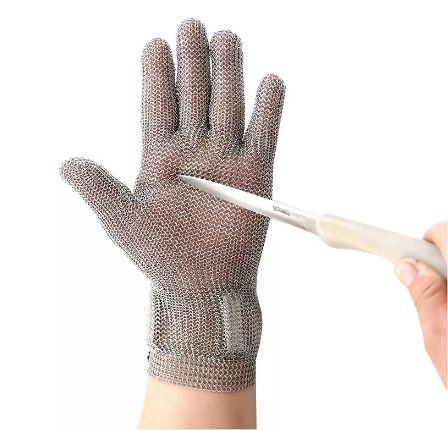
Chainmail cutting gloves are manufactured from stainless steel wire that is formed into rings, then interlinked to form a mesh. The wire diameter and ring dimensions directly affect the glove’s cut resistance, weight, and finger mobility.
Based on manufacturer specifications for commercial chainmail cutting gloves, the following dimensions are typical for stainless steel rings used in food processing applications:
| Parameter | Typical Value Range |
|---|---|
| Wire diameter | 0.50 mm to 0.55 mm |
| Ring inner diameter | 2.75 mm to 3.00 mm |
| Ring outer diameter | 3.81 mm to 4.00 mm |
| Rings per square inch | Approximately 150 to 180 |
Thicker wire diameters provide higher cut resistance but increase glove weight and reduce dexterity. Thinner wire produces lighter gloves with better finger mobility but lower cut protection. The 0.53 mm wire diameter is a commonly specified value for general meat and poultry processing applications.
Most chainmail cutting gloves use 304 stainless steel or equivalent grades. This austenitic stainless steel offers corrosion resistance suitable for wet food processing environments, including exposure to meat juices, cleaning solutions, and sanitizers. The material does not rust under normal use conditions when properly cleaned and dried after each shift.
Some manufacturers offer 316 stainless steel for applications involving higher salt exposure or more aggressive chemical cleaning protocols. However, 304 stainless steel remains the industry standard for most food processing applications due to its balance of corrosion resistance and cost.
The rings in chainmail gloves can be closed using two primary methods:
Welded Rings – Each ring is welded at the overlap point. Welded rings provide permanent closure and maximum strength. The ring cannot open under load, making welded chainmail suitable for heavy cutting applications.
Closed (Non-Welded) Rings – The rings are mechanically pressed closed but not welded. This method is less expensive but provides lower resistance to ring opening under high force. Non-welded rings are generally used for light to medium cutting applications.
Manufacturers specify which closure type is used for each glove model. For industrial meat processing involving large knives or powered blades, welded rings are recommended.
Chainmail gloves include wrist closures to secure the glove in position and prevent it from slipping during use. Common closure types include:
Polyurethane straps with snap buttons
Fabric straps with buckle closures
Nylon wrist cuffs with hook-and-loop fasteners
The strap is typically color-coded to indicate glove size. This color system allows quick size identification in food processing facilities where multiple workers share PPE. For example, a brown strap may indicate XXS, green for XS, white for S, red for M, blue for L, and orange for XL.
Chainmail cutting gloves are sized based on palm circumference and hand length. The European standard EN 420 defines glove sizing, and most chainmail glove manufacturers follow this system. Proper fit is important because oversized gloves reduce dexterity and control, while undersized gloves cause hand fatigue and may tear at the seams.
The following sizing data is based on manufacturer specifications for chainmail cutting gloves used in food processing:
| Size | Strap Color | Palm Perimeter (inches) | Palm Length (mm) | Typical Hand Width (mm) |
|---|---|---|---|---|
| XXS | Brown | 5.0 - 5.5 | 200 | 70 - 75 |
| XS | Green | 6.0 - 6.5 | 200 | 75 - 80 |
| S | White | 7.0 - 7.5 | 215 | 80 - 85 |
| M | Red | 8.0 - 8.5 | 220 | 85 - 90 |
| L | Blue | 9.0 - 9.5 | 230 | 90 - 95 |
| XL | Orange | 10.0 - 10.5 | 240 | 95 - 100 |
| XXL | - | 11.0 - 11.5 | 250 | 100 - 105 |
Palm perimeter is measured around the hand at the knuckles, excluding the thumb. Palm length is measured from the tip of the middle finger to the base of the palm at the wrist crease.
To select the correct chainmail glove size, follow this measurement procedure:
Palm Perimeter – Wrap a measuring tape around the dominant hand just below the knuckles. Do not include the thumb. Close the hand slightly to simulate a relaxed gripping position. Record the measurement in inches or millimeters.
Hand Length – Measure from the tip of the middle finger to the crease at the wrist. Keep the hand flat with fingers together.
Comparison to Size Chart – Compare both measurements to the size chart. If the two measurements fall into different size categories, select the larger size for comfort.
Some chainmail glove models provide extended coverage beyond the hand. Extended cuff designs are used in applications involving large cutting tools or where wrist and forearm exposure is significant. For example, certain products measure 380 mm (approximately 15 inches) in width and 330 mm (approximately 13 inches) in depth, providing protection to the mid-forearm.
Chainmail cutting gloves weigh between 0.14 kg (approximately 5 ounces) and 0.6 kg (approximately 1.3 pounds) depending on size, wire thickness, and cuff length. Smaller sizes with short cuffs weigh less. Larger sizes with extended forearm coverage weigh more.
The weight distribution of chainmail gloves affects user fatigue during extended wear. Lighter gloves are preferred for tasks requiring frequent hand movement, while heavier gloves with thicker wire are specified for higher cut risk applications.
Chainmail cutting gloves are tested and certified under EN 1082-1, the European standard for gloves and arm protectors against cuts and punctures caused by hand knives. This standard specifically addresses metal mesh gloves used in food processing and butchery applications.
The EN 1082-1 standard requires:
Cut Resistance Testing – A specified blade is drawn across the chainmail sample under controlled force. The glove must prevent blade penetration at defined force levels.
Puncture Resistance Evaluation – A pointed test probe is pressed against the chainmail. The glove must resist puncture at specified force levels.
Construction Integrity Assessment – The chainmail mesh is inspected for ring closure integrity, missing rings, and edge finishing.
User Instruction Documentation – Manufacturers must provide cleaning, inspection, and replacement instructions.
While EN 1082-1 is specific to chainmail gloves, many products also reference EN 388, the general standard for mechanical risk gloves. EN 388 provides cut resistance ratings on a scale. Chainmail gloves typically achieve the highest cut resistance rating under this standard.
The EN 388 cut resistance test uses a circular blade that moves back and forth across the glove material under a fixed force. The number of cycles required to cut through the material determines the cut resistance level. Chainmail gloves generally exceed the maximum cycles measured by the test, resulting in the top rating.
For the North American market, chainmail cutting gloves are rated under ANSI/ISEA 105, the American standard for hand protection classification. This standard assigns cut resistance levels from A1 (lowest) to A9 (highest). Chainmail gloves typically achieve A7 to A9 ratings depending on wire thickness and ring density.
Chainmail cutting gloves used in food processing must comply with food contact material regulations. In the European Union, this means compliance with Regulation (EC) No 1935/2004. In the United States, compliance with FDA food contact requirements is required. Stainless steel chainmail gloves are generally acceptable for direct food contact because the material does not leach harmful substances and can be effectively cleaned and sanitized.
Chainmail cutting gloves are most commonly used in meat and poultry processing facilities. Workers who perform boning, trimming, slicing, and portioning operations wear chainmail gloves on the hand that holds the meat while the cutting hand operates the knife. This configuration protects the non-cutting hand from accidental blade contact.
In beef and pork processing, chainmail gloves with welded rings and thicker wire (0.55 mm) are specified because workers use heavy boning knives and apply significant force. In poultry processing, lighter chainmail gloves with thinner wire (0.50 mm) are acceptable because the cutting forces are lower.
Fish processing involves sharp fillet knives and slippery work surfaces. Chainmail gloves provide cut protection while allowing the dexterity needed for precise filleting movements. Stainless steel construction resists the corrosive effects of salt water and fish oils.
In garment manufacturing, workers use vertical reciprocating blades and hand shears to cut multiple layers of fabric. Chainmail gloves protect the non-cutting hand during fabric feeding and positioning. The cut resistance of chainmail prevents blade contact injuries even under the high speeds of industrial cutting equipment.
Glass sheets and containers have sharp edges that can cause severe cuts. Chainmail gloves are used in glass manufacturing and recycling facilities to protect workers during manual handling, inspection, and sorting operations.
Commercial kitchens use chainmail gloves for tasks involving mandoline slicers, deli slicers, and hand knives. While not required for all kitchen tasks, chainmail gloves are specified for high-volume food preparation where repetitive cutting increases the risk of hand injuries.
Chainmail cutting gloves should be cleaned after each use to remove food residues, fats, and proteins. The cleaning procedure typically involves:
Rinsing – Rinse the glove under warm running water to remove loose debris.
Washing – Wash with a mild detergent and a soft brush. Avoid abrasive cleaners that may scratch the stainless steel surface.
Rinsing Again – Rinse thoroughly to remove all detergent residues.
Drying – Shake off excess water and hang the glove to air dry. Do not use compressed air to dry chainmail gloves because high-pressure air may damage the ring closures.
Some chainmail glove models are machine washable. Check the manufacturer’s instructions before machine washing. Use a gentle cycle with mild detergent. Do not use bleach or chlorine-based sanitizers on stainless steel chainmail because these chemicals may cause pitting corrosion.
For food processing applications, chainmail gloves must be sanitized after cleaning. Immersion in a food-grade sanitizing solution containing quaternary ammonium compounds or chlorine dioxide is acceptable. Follow the sanitizer manufacturer’s concentration and contact time instructions.
Before each use, inspect the chainmail glove for:
Missing rings
Bent or deformed rings
Broken welds (for welded ring gloves)
Damaged or worn wrist strap
Loose or broken snap buttons
If any defect is found, remove the glove from service immediately. Minor repairs, such as replacing missing rings, may be possible if the manufacturer provides repair kits. Major damage requires replacement of the glove.
Chainmail cutting gloves have a typical service life of 12 to 36 months under normal use conditions, depending on usage frequency, cutting forces encountered, and cleaning practices.
The following factors reduce glove lifespan:
High Cutting Frequency – Facilities where workers make thousands of cuts per shift will see faster ring wear.
Heavy Blade Force – Boning and heavy meat cutting apply higher forces to the chainmail mesh, causing ring deformation over time.
Aggressive Cleaning – Harsh chemicals or abrasive cleaning methods accelerate wear.
Improper Storage – Storing chainmail gloves folded or crushed can deform rings.
Replace chainmail gloves when any of the following conditions are observed:
Five or more missing rings in a square inch area
Any broken weld on a welded ring glove
Ring deformation that creates gaps larger than 1 mm
Wrist strap damage that prevents secure closure
The required chainmail glove specification depends on the cut risk level of the application. Use this risk assessment guide:
Low Risk – Light cutting with small knives (poultry trimming, vegetable cutting). Thin wire (0.50 mm) with non-welded rings is acceptable.
Medium Risk – General meat cutting with standard boning knives (pork, lamb, fish). Standard wire (0.53 mm) with welded rings is recommended.
High Risk – Heavy meat cutting with large knives (beef processing, frozen meat cutting). Thick wire (0.55 mm) with welded rings and extended cuff is required.
Chainmail gloves must fit snugly without restricting blood flow. A properly fitted glove allows full finger flexion and extension without gaps between the glove and the hand. Gaps create pinch points where the chainmail can catch on equipment or the knife blade.
Welded ring chainmail gloves cost more than non-welded versions but provide longer service life in demanding applications. For facilities with high turnover or occasional use, non-welded gloves may be more economical. For daily use in industrial meat processing, welded gloves have a lower total cost of ownership despite the higher purchase price.
Q: What cut resistance level do chainmail cutting gloves provide?
Chainmail gloves typically achieve the highest cut resistance ratings under both EN 388 (Level 5) and ANSI/ISEA 105 (Level A7 to A9). The exact rating depends on wire diameter and ring density. Thicker wire and denser ring packing produce higher cut resistance.
Q: Can chainmail gloves be used with powered cutting equipment?
Chainmail gloves provide protection against hand-held knives but are not rated for powered blade equipment such as band saws or circular saws. The high speed and continuous cutting action of powered blades can cut through chainmail mesh. Workers operating powered cutting equipment should use machine guarding rather than relying on PPE.
Q: How do I clean chainmail cutting gloves?
Wash with mild detergent and a soft brush after each use. Rinse thoroughly and air dry. For food processing applications, sanitize after cleaning using a food-grade sanitizer. Some models are machine washable on gentle cycle.
Q: Are chainmail gloves dishwasher safe?
Some chainmail gloves can be cleaned in commercial dishwashers, but high-temperature drying cycles may damage wrist straps and closure components. Check the manufacturer’s specifications before dishwasher cleaning.
Q: How long do chainmail cutting gloves last?
Under normal daily use in meat processing, chainmail gloves last 12 to 24 months. Lighter use in food service or garment cutting extends lifespan to 36 months or more. Regular inspection and proper cleaning extend service life.
Q: Can left-handed workers use standard chainmail gloves?
Many chainmail gloves are ambidextrous designs that fit either hand. The glove can be turned inside out to switch from right-hand to left-hand orientation. For specialized applications, some manufacturers offer hand-specific designs.
Q: Do chainmail gloves protect against needles or sharp points?
Chainmail gloves provide puncture resistance against sharp points, but the level of protection depends on the point sharpness and the force applied. Fine needles may pass through the gaps between rings. For applications involving hypodermic needles, specify gloves with higher ring density or laminated construction.
Q: What is the difference between welded and non-welded chainmail gloves?
Welded gloves have each ring permanently welded at the overlap. Non-welded gloves have rings that are pressed closed but not welded. Welded gloves provide higher strength and are required for heavy cutting applications. Non-welded gloves are acceptable for light to medium cutting.
Q: How should chainmail gloves be stored?
Store chainmail gloves flat or hung on a hook. Do not fold or crush the gloves because this deforms the rings. Store in a dry area away from chemicals and direct sunlight.
Q: Are chainmail gloves conductive?
Stainless steel chainmail gloves are electrically conductive. Do not wear chainmail gloves when working near live electrical equipment. The metal mesh can conduct current and increase the risk of electrical shock.
Chainmail cutting gloves provide reliable cut and puncture protection for food processing, garment manufacturing, glass handling, and commercial kitchen applications. The stainless steel ring mesh construction offers durability and washability that textile-based cut-resistant gloves cannot match.
Hebei Linchuan Safety Protective Equipment Co., LTD manufactures chainmail cutting gloves to industry standards including EN 1082-1 and EN 388. The company offers multiple sizes from XXS to XXL with color-coded strap systems for easy size identification. Wire diameters range from 0.50 mm to 0.55 mm with welded or non-welded ring options depending on application requirements.
Proper sizing, regular inspection, and correct cleaning procedures extend the service life of chainmail cutting gloves. Users should select glove specifications based on the cut risk level of their specific application, with heavier wire and welded rings for high-force cutting operations.
For technical specifications, sizing assistance, or product inquiries, contact Hebei Linchuan Safety Protective Equipment Co., LTD directly with your application requirements and hand measurement data.