
Author: Site Editor Publish Time: 2026-08-19 Origin: Site


For procurement professionals, safety managers, and business buyers in the meat processing industry, selecting the right chainmail butcher gloves manufacturer is a critical decision that affects worker safety, operational efficiency, and regulatory compliance. Chainmail butcher gloves are designed to protect workers in meat processing, food preparation, and industrial cutting environments. Made from interlinked stainless steel rings, these gloves reduce the risk of cuts and punctures during boning, slicing, and trimming operations.
Chainmail butcher gloves are manufactured primarily in China, particularly in Hebei Province, which has emerged as a global hub for wire mesh and metal-based protective gear. Factories in cities like Anping specialize in stainless steel interlocking mesh technology used in cut-resistant gloves. Companies based in this region leverage decades of experience in metallurgical processing and access to raw materials such as 304 and 316-grade stainless steel. This guide examines the key manufacturers, manufacturing processes, product specifications, and selection criteria for chainmail butcher gloves.
Hebei Linchuan Safety Protective Equipment Co., LTD is a manufacturer specializing in safety gloves, including butcher protective chainmail gloves, based in Shijiazhuang, China. The company produces stainless steel chainmail gloves and other protective equipment for the meat processing industry, with products certified to EN 1082-1 standards and SGS-certified, serving applications in slaughterhouses, fish and shellfish processing, and poultry processing.
A chainmail butcher glove is a protective glove made from interlocking metal rings that form a flexible mesh. This structure resists cuts from knives and other sharp tools used in meat processing and food handling. These gloves are commonly used by butchers and meat cutters, slaughterhouse workers, food factory employees, fish and poultry processors, and commercial kitchens.
The construction of butcher chainmail gloves involves interlinking metal rings, typically stainless steel, to create a mesh-like barrier against sharp edges. The design of chainmail gloves allows for dexterity while ensuring the user's hands remain protected. The materials used are chosen for their durability and resistance to corrosion, making them suitable for rigorous use in moist and acidic conditions found in food processing.
Key features of chainmail butcher gloves include stainless steel construction for resistance to cuts and corrosion, flexible design allowing freedom of movement during work, adjustable wrist straps for a secure fit, ambidextrous use for either left or right hand, and easy cleaning with full washability and suitability for sterilization processes.
The manufacturing of butcher chainmail gloves is heavily concentrated in Hebei Province, China. Manufacturers in this region leverage decades of experience in metallurgical processing and access to raw materials such as 304 and 316-grade stainless steel. The quality of ring construction significantly affects the glove's durability and protective properties. Rings that are individually welded for maximum strength provide better durability and resistance to ring separation under stress.
Hebei Linchuan Safety Protective Equipment Co., LTD produces stainless steel chainmail gloves with precise technical specifications. The company's chainmail gloves feature stainless steel ring specifications of inner diameter 2.75 millimeters, outer diameter 3.81 millimeters, and wire diameter 0.53 millimeters. The gloves offer extreme cut and puncture resistance and are available with textile, plastic, hook, or spring strap options.
Hebei Linchuan's gloves are ambidextrous, meaning they can be turned inside out for the other hand. They pass CE certification according to PPE EN 1082-1 and hold US FDA certification and SGS LFGB approval. The company offers a factory repair program and uses color-coded straps for size identification: XXS-Brown, XS-Green, S-White, M-Red, L-Blue, XL-Orange, XXL-Olive Green.
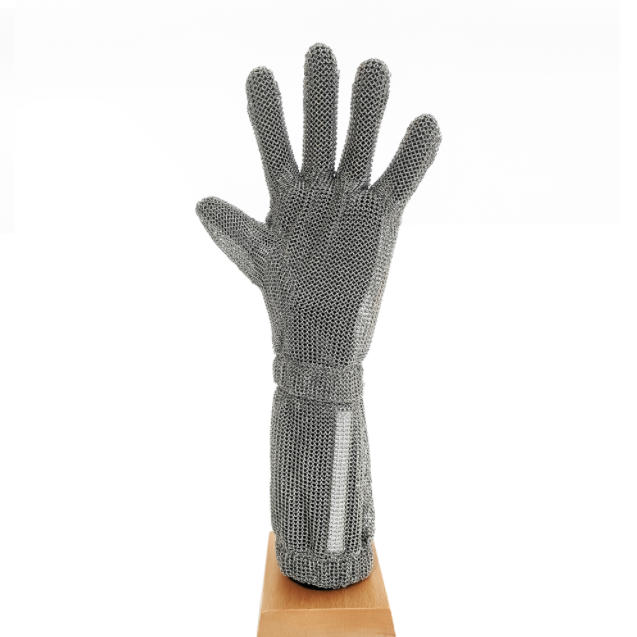
The production of chainmail butcher gloves follows a systematic manufacturing process that requires precision and quality control. Unlike general chainmail products, butcher chainmail gloves require stricter hygiene standards, precise ring construction, and consistent mesh integrity.
Step 1: Precision Wire Preparation – The process starts with stainless steel wire that is straightened, cleaned, and verified for consistent diameter. Consistent diameter is critical for uniform rings, and the surface must be smooth and free of defects.
Step 2: Coil Winding and Ring Cutting – The wire is wound into coils and cut into individual rings. Automatic coiling machines ensure uniform size, and rings are cut with minimal burrs to maintain quality.
Step 3: Ring Welding for Strength – Unlike decorative chainmail, butcher gloves require welded rings. Micro-welding ensures each ring is closed, preventing ring separation during cutting tasks and improving overall safety performance.
Step 4: Mesh Assembly – Rings are interlinked into a mesh structure using the standard 4-in-1 pattern, where four rings connect to one ring. Assembly can be semi-automated, and the pattern must remain consistent across the entire glove.
Step 5: Glove Forming and Shaping – The flat mesh is shaped into a glove, with finger sections formed individually and thumb positioning critical for usability.
Step 6: Edge Finishing and Strap Installation – Final shaping includes smoothing edges to avoid skin irritation and adding adjustable wrist straps for a secure fit.
Step 7: Cleaning and Food-Grade Treatment – Since these are butcher gloves, hygiene is essential. Gloves undergo ultrasonic cleaning to remove residues, surface polishing to improve smoothness, and sanitization before packaging.
Chainmail butcher gloves are available in multiple configurations to suit different applications and user requirements. Understanding these specifications is essential for selecting the appropriate product.
Material Composition – Gloves are manufactured from stainless steel grades 304 or 316L. 316L offers better corrosion resistance than 304, making it particularly suitable for applications where the glove is exposed to salts, acids, or frequent washing.
Ring Specifications – Standard ring dimensions include wire diameter of 0.53 millimeters, inner diameter of 2.75 millimeters, and outer diameter of 3.81 millimeters. These dimensions provide a balance between protection density and flexibility, creating a tight mesh that presents a high density of metal to any approaching blade.
Available Sizes – Gloves are available in sizes from XXS to XL, with palm length ranging from 188 to 250 millimeters depending on the size. Size identification is typically color-coded: Brown (XXS), Green (XS), White (S), Red (M), Blue (L), Orange (XL).
Product Variants – Manufacturers offer several glove configurations:
Five-finger chainmail gloves are the most common type, offering extreme cut and puncture resistance for the full hand. These gloves feature color-coded strap identification and are ambidextrous for use on either hand.
Three-finger gloves, where only the thumb, index finger, and middle finger are protected, are popular for garment manufacturing and applications requiring maximum flexibility. They offer lightweight design, great flexibility, and unrestricted movement.
Long cuff gloves provide extended wrist protection for use with long knives or saws, making them ideal for slaughterhouse and deboning applications. Cuff lengths are available in 8 centimeters, 15 centimeters, and 20 centimeters.
Strap Types – Gloves are available with different strap options: textile straps for standard applications, plastic straps with press-button buckles for optimum hygiene and reduced bacteria retention, hook straps for secure fastening, and spring straps with self-adjusting tension systems made of stainless steel.
Chainmail butcher gloves must meet recognized safety standards to be classified as personal protective equipment. The primary standard for butcher chainmail gloves is EN 1082-1, which specifies requirements for protective clothing against cuts and stabs from hand knives.
Testing according to EN 1082-1 includes dimensional assessment to verify ring size and wire gauge meet specifications, impact cut testing to evaluate cut resistance using a knife blade mounted on a weight dropped onto the sample, and tensile strength testing on individual rings to verify adequate strength.
The EN 388 standard provides ratings for mechanical protection including cut resistance, abrasion resistance, tear resistance, and puncture resistance. Manufacturers must test samples from each production batch to verify protection claims.
For food processing applications, additional hygiene certifications are required. Hebei Linchuan's chainmail gloves hold US FDA certification and LFGB approval for food contact safety.
Quality control in professional factories involves material inspection where incoming wire is verified for diameter tolerance and checked for micro-cracks. In-process inspection includes checking ring diameter, wire tension, and weld integrity at statistically defined intervals. Final inspection includes dimensional verification, visual defect review, and metal detection for mail items to rule out loose ring fragments.
When selecting a chainmail butcher gloves manufacturer, procurement professionals should evaluate several key criteria. The manufacturer's quality management systems should be assessed, including ISO certification and the presence of dedicated quality control staff. The manufacturer should have documented processes for verifying product quality at each stage of production.
Product certification and test reports should be reviewed to verify that the gloves meet the required safety standards. The manufacturer should provide EN 1082-1 certification for chainmail gloves and test reports from certified laboratories.
Material quality affects both the glove's protective properties and its service life. The grade of stainless steel used is important, with 316L offering better corrosion resistance than 304. The manufacturer should provide material specifications, including ring diameter and wire gauge.
Manufacturing capabilities affect the supplier's ability to meet order requirements and quality standards. Larger manufacturers with automated production lines can typically offer more consistent quality and faster delivery times than smaller operations. The use of automated welding and assembly equipment is an indicator of production quality.
The manufacturer's experience and industry reputation should be considered. Manufacturers with a long history in the industry and established customer relationships are generally more reliable than newer, less established suppliers. Customer testimonials and references can provide evidence of the manufacturer's reliability and product quality.
Production capacity affects the supplier's ability to meet order deadlines. Manufacturers with sufficient capacity to handle both regular orders and unexpected demand surges are better equipped to maintain consistent supply. The manufacturer should be able to demonstrate that they have the resources to meet the buyer's order requirements.
Customization capabilities are important for buyers with specific requirements. Some manufacturers can customize glove designs to meet particular application needs. For chainmail gloves, this may include modifications to ring size, weave pattern, or cuff design.
Chainmail butcher gloves manufacturers are concentrated in Hebei Province, China, with companies like Hebei Linchuan Safety Protective Equipment Co., LTD and RETON Ring Mesh Co., Ltd. producing gloves that meet EN 1082-1 certification requirements. The manufacturing process involves precision wire preparation, coil winding, ring welding, mesh assembly, glove forming, and hygiene treatment.
When selecting a chainmail butcher gloves manufacturer, buyers should evaluate quality management systems, product certification and test reports, material quality, manufacturing capabilities, experience and reputation, production capacity, and customization capabilities. The manufacturer should be able to provide EN 1082-1 certification for chainmail gloves and appropriate food safety certifications for food processing applications.
Hebei Linchuan Safety Protective Equipment Co., LTD is a manufacturer of stainless steel chainmail butcher gloves, producing gloves that meet EN 1082-1 standards and hold US FDA and LFGB certification. The company offers five-finger, three-finger, and long cuff variants in sizes from XXS to XL with various strap options, serving slaughterhouse, food processing, fish processing, and poultry processing applications.