
Author: Site Editor Publish Time: 2026-08-20 Origin: Site


For professionals in meat processing, food service, and industrial cutting applications, the fit and security of protective gloves are as important as the cut resistance they provide. Adjustable wrist strap butcher gloves address a critical safety requirement: keeping the glove securely positioned on the hand during demanding cutting operations. A glove that shifts or slips during use can create gaps in protection, exposing the hand to potential injury even when the glove material itself is cut-resistant.
Adjustable wrist strap butcher gloves are available in several configurations, including stainless steel chainmail gloves and cut-resistant fabric gloves. The wrist strap provides a secure, customizable fit that prevents the glove from moving during use. Most adjustable wrist strap gloves feature color-coded sizing for easy identification and are ambidextrous for use on either hand.
Hebei Linchuan Safety Protective Equipment Co., LTD is a manufacturer of chainmail butcher gloves based in Shijiazhuang, China. The company produces stainless steel chainmail gloves with adjustable wrist strap options, including textile straps, plastic straps with press-button buckles, hook straps, and spring straps. This guide examines the features, benefits, and selection criteria for adjustable wrist strap butcher gloves.
Adjustable wrist strap butcher gloves incorporate closure systems that allow the wearer to customize the fit at the wrist. The strap secures the glove in position, preventing it from shifting during cutting operations. This security is essential for maintaining consistent protection and reducing the risk of injury from knife slips.
The strap closure system typically consists of a textile or plastic strap that passes around the wrist and fastens with a buckle, snap, or hook-and-loop closure. Some straps are fully adjustable over a range of wrist sizes, allowing the glove to fit different users comfortably. The strap material affects durability, hygiene, and ease of cleaning, which are important considerations for food processing applications.
Adjustable wrist straps are available in several configurations. Textile straps with press-stud closures provide a secure, adjustable fit and are fully encased to enhance cleanability and reduce bacteria retention. Plastic straps with press-button buckles offer optimum hygiene with reduced bacteria retention. Hook straps provide secure fastening for heavy-duty applications. Spring straps with self-adjusting tension systems are made from stainless steel and stand up to knife and blade damage.
Some adjustable wrist strap gloves feature a side slit that makes the glove easier to put on and take off. The side split allows the glove to open wider at the wrist, accommodating different hand shapes while still providing a secure fit when the strap is fastened.
Different strap types are available for adjustable wrist strap butcher gloves, each suited to specific applications and user preferences. The choice of strap affects fit, security, comfort, and hygiene.
Textile Straps – Textile straps are the most common type of adjustable wrist strap for butcher gloves. They feature a press-stud or buckle closure that allows the wearer to customize the fit. The textile material is typically a polypropylene webbing that is durable and resistant to stretching. Textile straps are fully encased to enhance cleanability and reduce bacteria retention, making them suitable for food processing applications. The strap can be replaced when worn, extending the service life of the glove.
Plastic Straps – Plastic straps with press-button buckles offer optimum hygiene for food processing environments. The plastic material does not absorb moisture or bacteria, making it easier to clean and sanitize than textile straps. Plastic straps are typically used in applications where hygiene is a primary concern, such as seafood processing and meat cutting operations.
Hook Straps – Hook straps provide secure fastening for heavy-duty applications where the glove may be subjected to significant force. The hook mechanism allows for quick adjustment and secure fastening, with the hook engaging with different ring positions on the glove. Hook straps are commonly used in butchery and slaughterhouse operations where the glove must stay in position during demanding cutting tasks.
Spring Straps – Spring straps are a newer generation of wrist closure that uses a self-adjusting tension system made from stainless steel. The spring stretches to the size of the wearer's wrist and requires no manual tightening. Because the spring is made from stainless steel, it stands up to knife and blade damage, unlike a fabric strap. This design promotes consistent wear time with no straps or press stud fastenings and may improve hygiene by eliminating fabric components that can harbor bacteria.
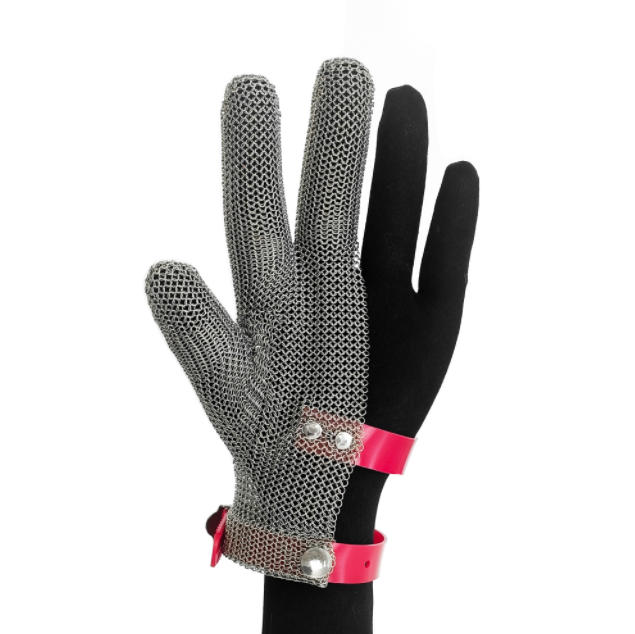
Proper sizing is essential for adjustable wrist strap butcher gloves to provide effective protection. A glove that is too large can slip during use, creating gaps in protection. A glove that is too small may be uncomfortable and restrict circulation. Color-coded sizing systems help workers quickly identify correctly sized gloves and prevent mix-ups in processing environments.
Standard size colors for adjustable wrist strap butcher gloves include XXS-Brown, XS-Green, S-White, M-Red, L-Blue, XL-Orange, and XXL-Dark Green. The color is typically applied to the strap or a small colored label on the strap for quick identification.
Size is determined by two primary measurements: palm perimeter and palm length. The following size ranges are standard for chainmail butcher gloves:
XXS - Brown - Palm Perimeter 5-5.5 inches - Palm Length 200mm
XS - Green - Palm Perimeter 6-6.5 inches - Palm Length 200mm
S - White - Palm Perimeter 7-7.5 inches - Palm Length 215mm
M - Red - Palm Perimeter 8-8.5 inches - Palm Length 230mm
L - Blue - Palm Perimeter 9-9.5 inches - Palm Length 235mm
XL - Orange - Palm Perimeter 10-10.5 inches - Palm Length 245mm
The strap color system serves multiple practical functions. In processing environments where multiple workers share equipment or where gloves are issued to specific individuals, color coding allows immediate visual verification that the correct size has been selected. This reduces the risk of workers using improperly sized gloves that may compromise protection or comfort.
Users should measure the dominant hand at the widest point of the palm, excluding the thumb. The glove should feel snug but not tight. When the user makes a fist, the rings should not dig into the skin. The strap should be adjusted to a comfortable tension that keeps the glove in position without restricting circulation.
Adjustable wrist strap butcher gloves used in food processing must be cleaned and sanitized regularly to maintain hygiene standards. The strap type affects cleaning procedures and the glove's overall hygiene profile.
Textile straps require particular attention during cleaning because the fabric can absorb moisture and harbor bacteria if not properly dried. Fully encased textile straps reduce bacteria retention, but they still require thorough cleaning and drying after each use. Textile straps should be inspected regularly for wear and replaced when they show signs of degradation.
Plastic straps offer better hygiene characteristics because the material does not absorb moisture or bacteria. They can be cleaned more easily with standard sanitization procedures and are less likely to harbor bacteria than textile straps. Plastic straps are preferred in applications where hygiene is a primary concern.
Spring straps, made entirely from stainless steel, offer the best hygiene characteristics. The spring construction has no fabric components that can harbor bacteria, and the steel construction can be cleaned and sanitized along with the chainmail itself. Spring straps are self-adjusting and require no manual adjustment, making them particularly suitable for food processing environments where hygiene is critical.
Regardless of strap type, adjustable wrist strap butcher gloves should be cleaned according to the manufacturer's instructions. Standard cleaning protocols include scrubbing with hot soapy water at 50 degrees Celsius, rinsing at a minimum of 82 degrees Celsius, and disinfection with an approved product. Gloves should be thoroughly dried before storage to prevent corrosion and bacteria growth.
The durability of adjustable wrist strap butcher gloves depends on both the chainmail construction and the strap material. Proper maintenance extends the service life of the glove and ensures consistent protection.
Textile straps are subject to wear from repeated tightening and loosening, as well as exposure to moisture and chemicals. The strap material can stretch, fray, or degrade over time, affecting the glove's fit and security. Textile straps can be replaced when worn, extending the service life of the glove without requiring replacement of the entire glove. Some manufacturers offer strap replacement programs for their gloves.
Plastic straps are more resistant to moisture and chemical exposure than textile straps, but they can become brittle over time or with exposure to certain chemicals. Cracking or breaking of the plastic strap compromises the glove's fit and security. Plastic straps should be inspected regularly for signs of wear or damage.
Spring straps are the most durable option because they are made from stainless steel. The spring construction resists damage from knife blades and stands up to the forces encountered during cutting operations. Spring straps do not have fabric components that can degrade, and they require no manual adjustment. However, the spring tension may change over time, and the spring should be inspected for any signs of fatigue or deformation.
Regular inspection of the strap closure mechanism is essential for maintaining protection. The buckle, snap, or hook mechanism should be checked for proper function. Any strap that does not secure the glove properly should be replaced. The glove should be inspected before each use to ensure the strap is intact and functioning correctly.
Adjustable wrist strap butcher gloves are available with different closure systems, each with advantages and limitations. The primary alternatives to adjustable wrist straps are spring-style closures and fixed-fit cuffs.
Spring-style closures use a stainless steel spring that adapts to the wrist shape. The spring stretches to fit the wrist and requires no manual tightening. This design provides consistent wear time with no straps or press stud fastenings and may improve hygiene by eliminating fabric components that can harbor bacteria. Spring-style closures are particularly suitable for food processing environments where hygiene is a primary concern.
Fixed-fit cuffs have no adjustable mechanism, relying on the material's elasticity to fit the wrist. These gloves are easier to put on and remove than adjustable strap gloves, but they offer less customization of fit. Fixed-fit cuffs may not provide adequate security for users with smaller or larger than average wrists. They are typically used in applications where the glove is worn for short periods and where a secure fit is less critical.
Adjustable wrist straps offer superior fit security compared to fixed-fit cuffs. The ability to customize the fit ensures that the glove stays in position during demanding cutting operations. This security reduces the risk of the glove shifting and exposing areas of the hand to potential injury. For applications where workers are exposed to high-frequency cutting hazards, adjustable wrist straps are the recommended option.
When selecting adjustable wrist strap butcher gloves, safety managers and procurement professionals should consider several factors to ensure the gloves meet their application requirements.
Strap Type – The strap type should be selected based on the specific application and user preferences. Textile straps offer durability and are suitable for general applications. Plastic straps offer better hygiene for food processing applications. Spring straps offer the best hygiene and ease of use. Hook straps provide secure fastening for heavy-duty applications.
Fit and Adjustability – The strap should be fully adjustable over a range of wrist sizes to accommodate different users. The strap should secure the glove in position without restricting circulation or causing discomfort. Color-coded sizing helps ensure that workers select the correct glove size.
Hygiene – For food processing applications, hygiene is a primary consideration. Plastic straps and spring straps offer better hygiene characteristics than textile straps. The strap should be easy to clean and sanitize, with no places where bacteria can accumulate.
Durability – The strap should be durable enough to withstand the forces encountered in the application. Textile straps should be made from webbing that resists stretching and fraying. Plastic straps should resist cracking and breakage. Spring straps should maintain their tension over time.
Compatibility – The strap should be compatible with the glove design and should not interfere with the glove's protective properties. The strap should not create gaps in protection or reduce the glove's cut resistance.
Cost – The cost of the glove and replacement straps should be considered. Gloves with replaceable straps offer lower long-term cost than gloves that must be replaced when the strap wears out.
Adjustable wrist strap butcher gloves provide a secure, customizable fit that keeps the glove in position during demanding cutting operations. The strap closure system allows the wearer to adjust the fit at the wrist, preventing the glove from shifting and exposing areas of the hand to potential injury. Color-coded sizing systems help workers quickly identify correctly sized gloves, and ambidextrous design allows the gloves to be worn on either hand.
Different strap types are available for adjustable wrist strap butcher gloves. Textile straps offer durability and are suitable for general applications. Plastic straps offer better hygiene for food processing environments. Spring straps offer the best hygiene and ease of use. Hook straps provide secure fastening for heavy-duty applications. The choice of strap type should be based on the specific application requirements and user preferences.
When selecting adjustable wrist strap butcher gloves, safety managers should consider strap type, fit and adjustability, hygiene characteristics, durability, compatibility, and cost. Proper sizing, based on palm perimeter and palm length measurements, is essential for effective protection. Color-coded sizing systems help ensure that workers select the correct size.
Hebei Linchuan Safety Protective Equipment Co., LTD manufactures stainless steel chainmail butcher gloves with adjustable wrist strap options, including textile straps, plastic straps with press-button buckles, hook straps, and spring straps. The gloves are available in sizes from XXS to XL with color-coded sizing and are ambidextrous for use on either hand.