
Author: Site Editor Publish Time: 2026-08-03 Origin: Site


Chainmail gloves are widely recognized for their cut resistance in meat processing, glass handling, and metal fabrication industries. However, a common question asked by safety managers and workers is whether these metal mesh gloves also provide protection against needle punctures. The answer is more nuanced than a simple yes or no. Chainmail gloves provide limited protection against needle punctures, but they are not designed or rated for this specific hazard. Understanding the distinction between cut resistance and puncture resistance is essential for selecting the correct hand protection for applications where needle hazards exist.
Needle puncture hazards are present in several industries and occupations. Workers in waste handling and recycling facilities encounter discarded hypodermic needles in the waste stream. Workers in the textile industry use needles for sewing and stitching operations. Workers in healthcare and laboratory settings handle needles for medical procedures and research activities. Workers in veterinary medicine handle needles for animal treatment. In each of these applications, the puncture hazard differs from the cut hazard that chainmail gloves are designed to address.
Based on manufacturing data and product specifications from Hebei Linchuan Safety Protective Equipment Co., LTD, which produces stainless steel chainmail gloves for industrial applications, the protection provided by chainmail gloves against needle punctures is limited. The glove's interlocking ring structure provides some resistance to penetration by pointed objects, but the gaps between rings allow smaller, sharper points to pass through. This article examines the mechanical properties of chainmail gloves relevant to puncture resistance, compares protection across different needle types, and provides guidance on selecting appropriate hand protection for needle hazards.
Cut and puncture are mechanically distinct types of injury that require different protective mechanisms. A cut occurs when a sharp edge, such as a knife blade or glass edge, slides across the material and separates it. The force is applied along the edge of the blade, creating a slicing action. A puncture occurs when a sharp point, such as a needle or awl, is pressed directly into the material. The force is concentrated at a single point, and the penetration occurs through displacement of material rather than separation.
Chainmail gloves protect against cuts through the mechanical interaction between the blade edge and the metal rings. When a blade contacts a chainmail glove, the edge encounters multiple rings simultaneously. The force is distributed across several contact points, and the rings physically block the blade's progress. The blade must either break the rings or force them apart to reach the skin. This mechanism is effective against cutting forces because the blade edge is relatively wide and the force is distributed.
Needle punctures operate differently. A needle has a sharp point that concentrates all the applied force on a very small area. This point can enter the gaps between the metal rings without breaking them. Once the point is through the ring layer, the needle can pass through the glove to reach the skin. The ring gaps in a chainmail glove, which are necessary for flexibility and comfort, are larger than the diameter of many needles. A standard sewing needle has a diameter of approximately 0.5 to 1 millimeter, while a hypodermic needle can be as small as 0.3 millimeters in diameter. These dimensions are smaller than the gaps between the rings in a typical chainmail weave.
The protective mechanism against puncture requires either a solid barrier that the point cannot penetrate or a very dense weave with gap sizes smaller than the needle diameter. Chainmail gloves do not provide either of these conditions for small-diameter needles. The rings themselves are resistant to puncture, but the gaps between them are not.
Several factors affect the degree of puncture protection that chainmail gloves provide. The most significant factor is the gap size between the rings, which is determined by the ring diameter, the wire gauge, and the weave density. A tighter weave with more rings per square inch creates smaller gaps and provides better resistance to needle penetration. Gloves with smaller rings and larger wire gauge have less open space in the weave pattern.
The needle diameter relative to the ring gap size is the primary determinant of whether penetration occurs. If the needle diameter is larger than the gap size, the needle cannot pass through the ring gaps without deforming the rings. If the needle diameter is smaller than the gap size, the needle can pass through without contacting the rings. Most standard sewing needles have diameters of 0.5 to 1.1 millimeters, while hypodermic needles range from 0.3 to 1.0 millimeters. The gaps in a standard chainmail glove typically range from 2 to 3 millimeters, which is larger than most needle diameters.
The angle of the needle relative to the glove surface also affects penetration. A needle approaching the glove at a perpendicular angle has the greatest chance of passing through a ring gap. A needle approaching at an oblique angle has a higher probability of contacting a ring surface, which would provide some resistance. In real-world conditions, the needle orientation is variable, making penetration a probabilistic rather than deterministic event.
The force applied to the needle is another factor. A low-force, gentle contact with a needle may be stopped by the glove surface without penetration. A high-force, intentional or accidental jab is more likely to drive the needle through the ring gaps. The glove provides some protection by requiring the needle to align with a gap and by slowing the needle's progress, but it does not provide complete protection against a forceful puncture attempt.
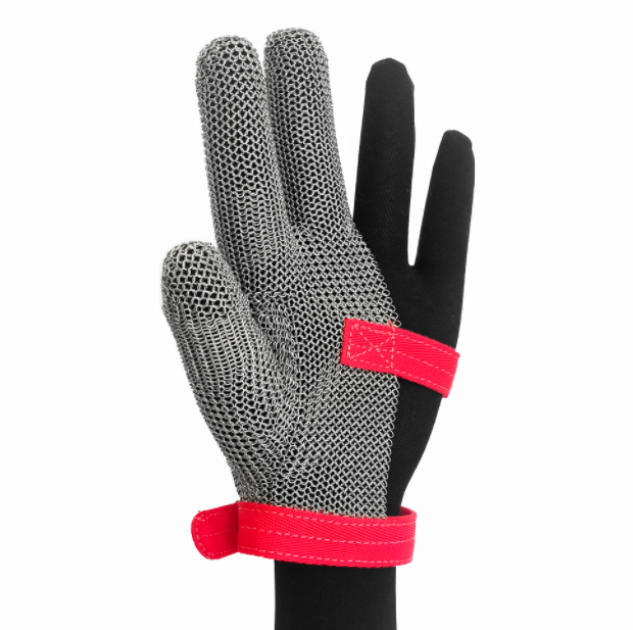
Different needle types have different characteristics that affect their ability to penetrate chainmail gloves. Hypodermic needles are the thinnest and sharpest needles commonly encountered in occupational settings. They have a beveled point that is extremely sharp and can easily pass between chainmail rings. The typical hypodermic needle has a diameter of 0.3 to 0.8 millimeters, which is significantly smaller than the ring gaps in most chainmail gloves. These needles can pass through the ring gaps without contacting the metal rings and reach the skin beneath.
Sewing needles used in textile manufacturing have diameters ranging from 0.5 to 1.1 millimeters. The larger sizes, particularly those above 0.8 millimeters, may contact the ring surfaces and encounter some resistance. However, the smaller sizes can still pass through the gaps. Sewing needles also have a sharp point that concentrates the force at a very small area, similar to hypodermic needles. The difference in protection between hypodermic and sewing needles is minimal when both are smaller than the ring gaps.
Larger pointed objects such as awls, ice picks, or large diameter needles may provide a different protection profile. If the pointed object has a diameter larger than the ring gap, it will contact the metal rings and be blocked. The force will be transferred to the rings, and the object will not penetrate. In these cases, chainmail gloves provide effective puncture resistance. The protective value of chainmail against puncture increases with the diameter of the pointed object, with larger diameters providing better protection.
Blunt-tipped needles or objects with rounded points do not penetrate chainmail gloves at all. The rounded point cannot force its way between the rings because the gap size is smaller than the point curvature. These objects are safely deflected by the glove surface. The puncture hazard is specific to objects with sharp points that are smaller than the ring gaps in the chainmail.
The material composition of the needle affects the type of damage it can cause to chainmail gloves. Standard stainless steel needles, such as hypodermic needles, are made from medical-grade stainless steel. These needles are sharp but relatively flexible. When a stainless steel needle contacts a chainmail ring, the needle is more likely to deform or break than the ring. The stainless steel in the glove is typically harder and more resistant to deformation than the needle material.
Industrial needles used in textile manufacturing are often made from hardened steel or tungsten carbide. These materials are harder and more resistant to deformation. If a hardened steel needle contacts a chainmail ring, the needle may not deform, and the ring may be scratched or damaged. However, the puncture mechanism is the same: the needle must pass through a gap to reach the skin. The needle's hardness does not change the need for the tip to align with a gap.
Some hypodermic needles are coated with lubricious materials to reduce the force required for penetration during medical use. These coatings can make the needle easier to insert and may reduce any frictional resistance from contacting the glove surface. A lubricated needle may slip through ring gaps more easily than an unlubricated needle of the same diameter. This effect is more relevant for intentional injection scenarios than for accidental workplace punctures, but it is a consideration in applications where coated needles are present.
Needle contamination is also a consideration in waste handling applications. Discarded needles may have residue from drugs, blood, or other biological materials. These contaminants can affect the needle's surface and may create additional hazards beyond the puncture itself. Chainmail gloves do not provide protection against these contaminants if the needle penetrates through the ring gaps. In waste handling applications, chainmail gloves are generally recommended as a secondary layer over a puncture-resistant underglove rather than as the primary protection against needle hazards.
Several workplace settings present needle hazards that may require hand protection. Waste handling and recycling facilities are among the highest-risk settings for needle injuries. Discarded hypodermic needles are common in municipal waste streams, particularly in areas where drug use is prevalent. Workers sorting waste manually or handling bags and containers are at risk of needle sticks from hidden needles. Chainmail gloves used in these settings provide some protection against cuts from glass and metal but limited protection against needle punctures.
Textile and garment manufacturing facilities use industrial sewing needles extensively. Workers in these facilities handle needles during machine setup, maintenance, and repair. Needle sticks are a reported injury in this industry, although they are less common than cuts and abrasions. Chainmail gloves are not typically used in textile manufacturing because the puncture hazard is secondary to the dexterity requirements of the work. When chainmail gloves are used, they provide some protection against larger needles but limited protection against standard sewing needles.
Healthcare facilities present a controlled environment where needle hazards are known and managed with specific puncture-resistant gloves. Hypodermic needles are handled daily for injections, blood draws, and other medical procedures. Healthcare workers use gloves made from materials that resist needle penetration, such as specialized synthetic materials with high density weave. Chainmail gloves are not used in healthcare settings because they are heavy and reduce dexterity, which is essential for medical procedures. The protection requirement in healthcare is specifically against needle punctures, which chainmail does not effectively provide.
Veterinary medicine presents a mixed hazard profile involving both needles and animal teeth and claws. Veterinarians treating large animals may use chainmail gloves for hand protection against bites and scratches. However, these gloves do not provide effective protection against hypodermic needles used for animal injections. The same limitation applies: the needle tip can pass through the ring gaps. For veterinary applications requiring both bite protection and needle protection, a layered approach with a cut-resistant outer layer and a puncture-resistant underglove may be necessary.
Pharmaceutical manufacturing and research laboratories handle needles for various applications. In these controlled environments, needle hazards are managed through safe handling protocols and appropriate PPE. Chainmail gloves are used in some laboratory settings for handling broken glassware or sharp instruments that present cut hazards. They are not considered effective for needle puncture protection, and facilities with significant needle hazards typically specify puncture-resistant gloves designed for that purpose.
For applications where needle puncture is a significant hazard, specialized puncture-resistant gloves are available. These gloves are constructed from materials that create a dense, continuous barrier that the needle cannot penetrate. High-density polyethylene fibers, aramid fibers, and composite materials are woven or bonded into gloves with low permeability to sharp points. The puncture resistance of these gloves is tested and rated according to standards such as the EN 388 puncture test or the ASTM F2878 needle puncture resistance test.
Puncture-resistant gloves used in healthcare settings have specific testing requirements to verify protection against hypodermic needles. The ASTM F2878-19 standard measures the force required for a hypodermic needle to penetrate the glove material. Gloves that meet this standard provide a quantified level of protection against needle sticks. These gloves are typically thinner and more flexible than chainmail gloves, making them suitable for tasks requiring dexterity.
For waste handling applications, a layered approach is recommended. Workers should wear a cut-resistant outer glove, such as chainmail, to protect against cuts from glass and metal, and a puncture-resistant inner glove to protect against needle sticks. This combination provides comprehensive hand protection for the mixed hazards present in waste streams. The chainmail outer layer protects against the abrasive and cutting hazards, while the puncture-resistant inner layer addresses the needle hazard.
Some manufacturers produce gloves that combine cut and puncture resistance in a single product. These gloves use high-performance materials woven in dense patterns that resist both types of penetration. The density of the weave prevents needle points from passing through, while the material strength resists cutting. These hybrid gloves may be appropriate for applications where both hazards are present and where the flexibility requirements allow the use of heavier materials.
The EN 388 standard, which is commonly used for mechanical gloves, includes a puncture test that measures the force required to penetrate the glove material with a sharp point. This test uses a standardized round point of specific diameter. The puncture protection levels range from Level 1 through Level 4, with Level 4 requiring the highest force. Chainmail gloves typically achieve Level 3 or Level 4 puncture protection in this test because the round point used in the test is larger than the ring gaps.
The ASTM F2878 standard specifically addresses hypodermic needle puncture resistance. This test uses an actual hypodermic needle to simulate the hazard more precisely. A needle is pressed into the glove material at a controlled rate, and the force required for penetration is measured. Gloves specifically designed for needle protection, typically used in healthcare, achieve measurable results in this test. Chainmail gloves are not tested under this standard because the test is intended for materials that provide a continuous barrier.
The EN 388 puncture test and the ASTM F2878 needle puncture test are not directly comparable because they use different test methods and different hazard definitions. The EN 388 test measures resistance to a larger pointed object, which chainmail gloves can resist effectively. The ASTM F2878 test measures resistance to a small diameter hypodermic needle, which chainmail gloves cannot effectively resist. The difference in test outcomes demonstrates why selecting gloves for needle hazards requires considering the specific hazard rather than relying on general puncture test results.
For facilities evaluating chainmail gloves for applications with needle hazards, the important consideration is the size of the needle relative to the ring gaps. If the needle diameter is larger than the gaps, the glove provides protection. If the needle diameter is smaller than the gaps, the glove provides limited protection. The testing data from EN 388 does not indicate protection against small-diameter needles, and facilities should not interpret general puncture resistance as protection against hypodermic needles.
Safety managers evaluating hand protection for applications with needle hazards should begin by identifying the specific needle types present in the work environment. The needle diameter, the sharpness, and the force with which the needle might contact the glove are all relevant factors. For small-diameter hypodermic needles, chainmail gloves are not adequate protection, and alternative gloves should be selected. For larger pointed objects such as awls or large needles, chainmail gloves may provide adequate protection.
In waste handling applications where needle hazards are present but the primary protection need is against cuts, a layered approach should be considered. A puncture-resistant underglove provides the needle protection, while a chainmail outer glove provides the cut protection. The combination ensures comprehensive protection against both hazards without compromising either. The underglove provides the continuous barrier that prevents needle penetration, while the outer glove provides the abrasion and cut resistance for handling sharp materials.
Worker training is essential in environments with needle hazards. Workers should understand that chainmail gloves provide limited protection against needle punctures and should never rely on them as the sole protection against this hazard. Safe handling protocols for needles, including proper disposal and immediate reporting of needle stick incidents, are essential components of a comprehensive safety program. Training should emphasize that chainmail gloves are cut protection, not puncture protection, and should not be used for applications requiring needle resistance.
Regular inspection of gloves for damage is particularly important in environments with needle hazards. A broken ring or stretched ring creates a larger gap through which a needle could pass. Even in gloves without visible damage, the ring gaps are sufficient for small needles to pass through. Inspection should focus on both ring integrity and gap size, with gloves showing any damage or wear considered for replacement.
Chainmail gloves provide limited protection against needle punctures. The interlocking ring structure creates gaps that are larger than the diameter of most hypodermic needles and sewing needles. These gaps allow needle points to pass through to the skin without contacting the metal rings. While chainmail gloves effectively resist cuts from blades and abrasion from sharp edges, they are not designed or rated for needle puncture protection.
For small-diameter needles such as hypodermic needles, chainmail gloves are not adequate protection and should not be relied upon for this hazard. For larger pointed objects, chainmail gloves may provide protection if the object diameter is larger than the ring gaps. The distinction between cut and puncture protection is essential for selecting appropriate gloves for specific hazards, and safety managers should evaluate the needle diameter relative to the ring gap size when assessing protection needs.
For applications where needle hazards and cut hazards coexist, a layered protection approach is recommended. A puncture-resistant underglove provides needle protection, while a chainmail outer glove provides cut protection. This combination ensures comprehensive hand protection for the mixed hazards present in waste handling, recycling, and other applications. Facilities with needle hazards should consult with their PPE supplier to select appropriate protection based on the specific needle types and conditions in their work environment.
Hebei Linchuan Safety Protective Equipment Co., LTD manufactures chainmail gloves designed for cut protection in industrial applications. We recommend that customers with needle hazards evaluate their hand protection needs carefully and select the appropriate glove combination for their specific application. Our technical staff can assist with hazard assessments and glove selection recommendations for facilities with mixed protection requirements.