
Author: Site Editor Publish Time: 2026-08-17 Origin: Site


For procurement managers, safety directors, and business buyers in the meat processing and food service industries, selecting the right butcher gloves manufacturer is a critical decision that affects worker safety, operational efficiency, and regulatory compliance. The global market for industrial cut-resistant gloves continues to expand, driven by increasing workplace safety regulations and the continued growth of the global meat processing industry.
Butcher gloves manufacturers produce a range of protective handwear, from chainmail stainless steel mesh gloves to cut-resistant fabric gloves and cotton knit liners. Each product type serves specific applications and risk profiles. Understanding the manufacturing landscape, key production regions, and evaluation criteria for suppliers is essential for making informed sourcing decisions. This guide examines the major butcher gloves manufacturing hubs, the product categories available, and the factors to consider when selecting a supplier.
Butcher gloves manufacturers typically produce three distinct glove categories, each designed for different tasks and protection requirements. Cut-resistant fabric gloves represent the most common type found on processing floors. These gloves protect against knife blade contact during boning, trimming, and portioning operations without sacrificing the grip and dexterity workers need. Cut resistance follows the ANSI/ISEA 105-2024 protection ratings from A1 to A9, with A5 through A9 gloves offering the appropriate protection range for hand knife tasks in meat processing.
Metal mesh butcher gloves, also known as chainmail gloves, offer the highest cut and puncture protection available. These gloves consist of interlinked stainless steel rings that create a physical barrier against blade contact. They are typically worn on the non-knife hand during high-risk boning and breaking tasks. Manufacturers produce these gloves with various ring diameters, wire gauges, and weave patterns to achieve different protection levels. The downside of metal mesh gloves is their heavier weight and reduced dexterity compared to cut-resistant fabric gloves.
Cotton knit butcher gloves serve a different role entirely. They function as liners for warmth in cold processing environments or for general handling tasks that do not involve knife contact. These gloves come in light, medium, and heavy weights to match different tasks and are often worn under metal mesh or cut-resistant gloves in cold storage operations.
The manufacturing of butcher gloves is heavily concentrated in China, particularly within industrial regions known for metallurgy, textile engineering, and precision metal mesh fabrication. Hebei Province has earned a reputation as a global hub for wire mesh and metal-based protective gear. Factories in cities like Anping specialize in stainless steel interlocking mesh technology used in cut-resistant gloves. Companies based in this region leverage decades of experience in metallurgical processing and access to raw materials such as 304 and 316-grade stainless steel.
Hebei Linchuan Safety Protective Equipment Co., LTD is one such manufacturer, producing stainless steel chainmail gloves and other protective equipment for the meat processing industry. The company's products meet EN 1082-1 standards and are certified by SGS, with applications in slaughterhouses, fish and shellfish processing, and poultry processing. Glove specifications include stainless steel ring inner diameter of 2.75 millimeters, outer diameter of 3.81 millimeters, and wire diameter of 0.53 millimeters.
Shandong, Jiangsu, and Henan provinces have developed expertise in integrating high-tenacity synthetic fibers such as high-performance polyethylene and aramid into hybrid glove designs. These regions supply cut-resistant fabric gloves that balance protection with comfort and dexterity. Multiple manufacturers in these provinces produce gloves that comply with ANSI/ISEA 105 and EN 388 standards.
RETON Ring Mesh Co., Ltd. is another manufacturer based in Hebei, producing chainmail gloves with stainless steel 304 or 316L material, ring diameters of 3.8 or 4.2 millimeters, and ring thicknesses of 0.5 or 0.8 millimeters. Their product range includes single strap, double strap, short cuff, and long cuff variants designed for meat processing, fish handling, and industrial cutting applications.
Shijiazhuang Tianyue Honest Co., Ltd., also located in Hebei, manufactures stainless steel wire mesh safety gloves using 316L stainless steel with ring outer diameter of 3.81 millimeters and wire diameter of 0.53 millimeters. Their gloves range in weight from 140 to 220 grams per piece and are available in sizes from XXS to XL.
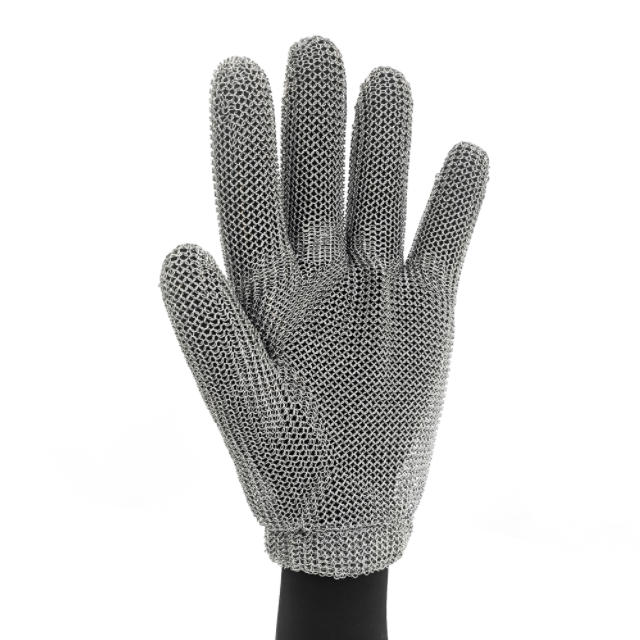
The production of chainmail butcher gloves follows a systematic manufacturing process that requires precision and quality control. The process begins with precision wire preparation, where stainless steel wire is straightened, cleaned, and verified for consistent diameter. This consistency is critical for uniform ring quality throughout the glove.
Coil winding and ring cutting follows, where the wire is wound into coils and cut into individual rings. Automatic coiling machines ensure uniform size, and rings are cut with minimal burrs to maintain quality. Ring welding is essential for butcher gloves because, unlike decorative chainmail, these gloves require welded rings for strength. Micro-welding ensures each ring is closed, preventing ring separation during cutting tasks and improving overall safety performance.
Mesh assembly involves interlinking the rings into a mesh structure using the standard 4-in-1 pattern, where four rings connect to one ring. Assembly can be semi-automated, and the pattern must remain consistent across the entire glove. Glove forming and shaping transforms the flat mesh into a glove shape, with finger sections formed individually and thumb positioning critical for usability. Edge finishing and strap installation includes smoothing edges to avoid skin irritation and adding adjustable wrist straps for a secure fit.
Cleaning and food-grade treatment is a critical final step. After forming, gloves are thoroughly cleaned to remove manufacturing residues. This step is critical for food processing applications, with some manufacturers applying antimicrobial coatings or treatments to meet food safety requirements. Quality control and testing are essential aspects of the manufacturing process. Each glove must be inspected for broken links, weak welds, or assembly mistakes. Finished gloves are tested according to EN 1082-1 and ANSI standards to verify protection claims.
Cut-resistant fabric gloves represent a different manufacturing category with its own production process and material requirements. These gloves are constructed from high-performance fibers such as high-density polyethylene, aramid, or fiberglass composites. The manufacturing process involves knitting or weaving these fibers into glove forms using specialized machinery.
Knitting processes for cut-resistant gloves include 7-gauge, 10-gauge, 13-gauge, and 18-gauge constructions. The gauge refers to the number of stitches per inch, with higher gauges producing thinner, more dexterous gloves and lower gauges providing thicker, more durable gloves. Manufacturers balance the fiber content, gauge, and coating type to achieve the desired protection level and comfort.
Yarn composition is a key factor in cut-resistant glove manufacturing. Manufacturers blend different fibers to achieve the desired protection level. Common blends include high-performance polyethylene with fiberglass for higher cut resistance or aramid fibers for heat resistance. The fiber selection affects both the cut rating and the glove's performance characteristics.
Coating application is another important step in fabric glove production. Coatings such as nitrile, polyurethane, and latex are applied to the palm and fingers to improve grip in wet or oily environments. The type and coverage of the coating affect the glove's suitability for different applications.
Manufacturers of cut-resistant fabric gloves typically maintain quality control systems that include testing for cut resistance, abrasion resistance, and tensile strength. The test results are documented and used to verify that the gloves meet the claimed ANSI or EN ratings. These quality systems are essential for maintaining certification and regulatory compliance.
Manufacturers of butcher gloves must maintain quality control systems to ensure product consistency and compliance with safety standards. The primary standards for butcher gloves are EN 1082-1 for chainmail gloves and arm guards protecting against cuts and stabs from hand knives, and EN 388 for mechanical protection including cut resistance, abrasion resistance, tear resistance, and puncture resistance.
For cut-resistant fabric gloves, the ANSI/ISEA 105 standard provides the cut resistance rating from A1 to A9. The rating is determined by testing the force required to cut through the material using a straight blade. Manufacturers must test samples from each production batch to verify that the gloves meet the claimed rating.
For chainmail gloves, EN 1082-1 testing includes dimensional assessment to verify ring size and wire gauge meet specifications. Impact cut testing is performed to evaluate the cut resistance of the chainmail, with a knife blade mounted on a weight and dropped onto the sample. Tensile strength testing is conducted on individual rings to verify that each ring has adequate strength to withstand the forces encountered during use.
Third-party certification provides independent verification of the glove's protection claims. Manufacturers who use third-party testing and certification can provide documentation from certified laboratories confirming their gloves meet the relevant standards. This certification is essential for facilities that must demonstrate PPE compliance during regulatory inspections.
When selecting a butcher gloves manufacturer, procurement professionals should evaluate several key criteria. The supplier's quality management systems should be assessed, including ISO 9001 certification and the presence of dedicated quality control staff. The manufacturer should have documented processes for verifying product quality at each stage of production.
Product certification and test reports should be reviewed to verify that the gloves meet the required safety standards. The manufacturer should provide EN 1082-1 certification for chainmail gloves and EN 388 or ANSI ratings for fabric gloves. Test reports should include the name of the testing laboratory, the date of testing, and the results for each test requirement.
Material quality affects both the glove's protective properties and its service life. For chainmail gloves, the grade of stainless steel used is important, with 316L offering better corrosion resistance than 304. For fabric gloves, the fiber composition and quality affect the cut resistance and durability. Manufacturers should provide material specifications and, for chainmail gloves, the ring diameter and wire gauge.
Manufacturing capabilities affect the supplier's ability to meet order requirements and quality standards. Larger manufacturers with automated production lines can typically offer more consistent quality and faster delivery times than smaller operations. The use of automated welding and assembly equipment is an indicator of production quality.
The manufacturer's experience and industry reputation should be considered. Manufacturers with a long history in the industry and established customer relationships are generally more reliable than newer, less established suppliers. Customer testimonials and references can provide evidence of the manufacturer's reliability and product quality.
Production capacity affects the supplier's ability to meet order deadlines. Manufacturers with sufficient capacity to handle both regular orders and unexpected demand surges are better equipped to maintain consistent supply. The manufacturer should be able to demonstrate that they have the resources to meet the buyer's order requirements.
Customization capabilities are important for buyers with specific requirements. Some manufacturers can customize glove designs to meet particular application needs. For chainmail gloves, this may include modifications to ring size, weave pattern, or cuff design. For fabric gloves, customization may involve specific fiber blends, coatings, or color options.
Butcher gloves manufacturers must comply with international standards to serve the global market. In the European market, the PPE Regulation requires that all PPE sold in the EU be CE marked. The EN 1082-1 standard is harmonized under this regulation, meaning that chainmail gloves meeting this standard are presumed to meet the essential health and safety requirements.
For the US market, the ANSI/ISEA 105 standard provides the cut resistance classification. OSHA regulations require employers to provide hand protection appropriate to the hazards present. Manufacturers supplying to the US market should be able to demonstrate that their products meet the applicable ANSI standards.
Food safety regulations apply to gloves used in food processing. In the US, FDA regulations govern materials that contact food, while in Europe, the Regulation (EC) No 1935/2004 sets requirements for food contact materials. Manufacturers serving food processing applications should be able to confirm that their gloves are compliant with food safety requirements.
The global butcher gloves manufacturing industry includes manufacturers in Hebei, Shandong, Jiangsu, and Henan provinces in China, with Hebei Province recognized as a global hub for chainmail glove production. Manufacturers produce three primary product types: chainmail gloves offering the highest cut protection, cut-resistant fabric gloves balancing protection and dexterity, and cotton knit gloves serving as liners or for general handling.
When selecting a butcher gloves manufacturer, buyers should evaluate quality management systems, product certification and test reports, material quality, manufacturing capabilities, experience and reputation, production capacity, and customization capabilities. The manufacturer should be able to provide EN 1082-1 certification for chainmail gloves and EN 388 or ANSI ratings for fabric gloves. Food safety compliance is essential for gloves used in food processing applications.
Hebei Linchuan Safety Protective Equipment Co., LTD is a manufacturer of stainless steel chainmail butcher gloves, producing gloves that meet EN 1082-1 standards and are SGS-certified. The company offers chainmail gloves in sizes from XXS to XL with various cuff lengths and closure types, serving slaughterhouse, food processing, fish processing, and poultry processing applications.