
Author: Site Editor Publish Time: 2026-06-17 Origin: Site


Meat cutting is one of the most physically demanding and injury‑prone occupations in the food processing industry. Butchers, meat packers, and deli workers handle sharp knives, bone saws, and cleavers for extended periods, often in cold, wet environments. According to injury records from large processing plants, hand and forearm lacerations account for nearly forty percent of all reportable incidents in meat departments. The use of protective gloves—commonly referred to as butcher gloves—has become a standard control measure to reduce these injuries. However, not all butcher gloves offer the same level of protection, comfort, or durability. Selecting the appropriate glove requires an understanding of cut resistance standards, material properties, ergonomic design, and the specific cutting tasks performed. This article provides a comprehensive overview of butcher gloves for meat cutting, covering types, performance metrics, sizing, maintenance, and cost considerations, with practical guidance for procurement and safety managers. The information presented is based on industry standards, testing protocols, and field data from meat processing facilities.
Butcher gloves fall into two broad categories: metal mesh (chainmail) gloves and high‑performance cut‑resistant fabric gloves. Metal mesh gloves are constructed from interlocking stainless steel rings, offering exceptional resistance to slashing and puncturing from boning and butcher knives. They are heavy, durable, and provide a rigid barrier that deflects blade edges. Fabric gloves, on the other hand, are made from engineered fibers such as high‑molecular‑weight polyethylene (HMPE), aramid (Kevlar), or fiberglass blends. They are lighter, more flexible, and offer varying levels of cut resistance, typically rated under ANSI/ISEA 105 or EN 388 standards. For heavy‑duty boning and deboning operations, metal mesh gloves remain the preferred choice because they can withstand repeated direct contact with knife edges without degradation. In a comparative study at a beef processing plant, metal mesh gloves survived over 5,000 cutting cycles with a standard butcher knife before showing visible ring wear, while the highest‑rated fabric gloves began to fray after approximately 800 cycles. However, for lighter tasks such as trimming or portioning, fabric gloves may be sufficient and more comfortable. Many facilities use a combination: metal mesh for primary cutting stations and fabric gloves for secondary processing.
It is also worth noting that metal mesh gloves are generally easier to sanitize because stainless steel does not absorb moisture or organic matter. Fabric gloves, especially those with coatings, require more frequent replacement because they absorb blood, fat, and cleaning chemicals, which can degrade the fibers over time. Therefore, the choice between the two types should be based on the specific cutting application, the frequency of knife contact, and the hygiene protocols of the facility.
To make informed decisions, buyers must understand the standard cut resistance tests and their interpretations. In North America, the ANSI/ISEA 105‑2020 standard assigns cut levels from A1 to A9 based on the force required to cut through the glove material with a straight razor blade. For meat cutting, levels A4 to A7 are common, with A4 (1,500‑2,199 grams) suitable for light trimming, A5 (2,200‑2,999 grams) for moderate boning, and A6 (3,000‑3,999 grams) or A7 (4,000‑4,999 grams) for heavy boning and cleaver work. Metal mesh gloves typically achieve A5 or A6 ratings, while fabric gloves can range from A2 to A9 depending on the fiber composition and thickness.
In Europe, the EN 388 standard includes a cut test using a circular rotating blade (coupe test), which yields levels 1 to 5. However, this method is less reliable for metal mesh because the blade dulls quickly against the rings, often giving artificially high scores. Therefore, the ANSI straight‑blade test is more commonly referenced for metal gloves. Additionally, EN 388 includes a puncture resistance test, which is relevant for meat cutting because bone fragments and splinters can penetrate some materials. A puncture level of 3 or 4 (out of 4) is recommended for boning operations. Buyers should request test certificates from accredited laboratories for both cut and puncture resistance, ensuring that the results match the intended use. It is also prudent to verify that the certificate corresponds to the exact glove model and thickness, as minor variations in construction can alter performance.
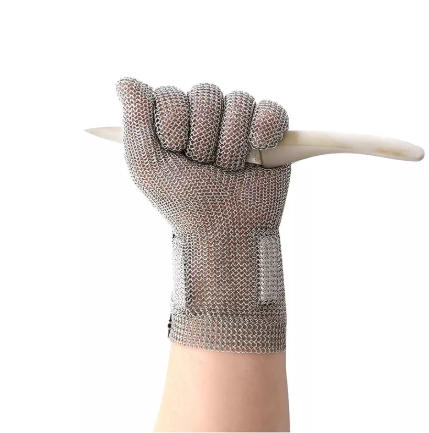
The majority of metal mesh butcher gloves are made from stainless steel, specifically grades 304 and 316. Grade 304 is the standard alloy, containing approximately eighteen percent chromium and eight percent nickel, providing good resistance to oxidation and corrosion. Grade 316 adds molybdenum, which enhances resistance to chlorides and acidic environments—both common in meat processing where blood and cleaning agents are present. In accelerated corrosion tests, grade 316 gloves showed no signs of rust after 300 hours of exposure to a saline solution at 37 degrees Celsius, while grade 304 exhibited superficial pitting at about 180 hours. For facilities that operate in high‑humidity conditions or use aggressive sanitizers, grade 316 is the more durable option, though it typically costs ten to fifteen percent more.
Wire gauge is another key parameter. Butcher gloves are available in 19‑gauge (0.91 mm diameter), 20‑gauge (0.81 mm), and 21‑gauge (0.71 mm). Thicker wire (lower gauge number) provides higher cut resistance and ring strength but adds weight and reduces dexterity. A 19‑gauge glove can resist forces up to 3,500 grams in the ANSI test, while a 21‑gauge glove typically rates around 2,500 grams. For boning large carcasses where the knife is frequently drawn across the glove, a 19‑gauge is preferred. For lighter portioning and slicing, a 21‑gauge offers adequate protection with less fatigue. Many manufacturers, including Hebei Linchuan Safety Protective Equipment Co., LTD, offer both gauges and provide detailed force‑deflection curves to help clients choose.
The way individual rings are closed significantly affects the glove's resistance to knife penetration. Butt‑cut rings have ends that are cut squarely and pressed together, leaving a tiny gap. Under sustained pressure, a knife edge can slip into this gap and force the ring open. Riveted rings overlap the ends and a small metal pin (rivet) is pressed through to lock the overlap, eliminating any gap. In penetration tests using a standard 6‑inch boning knife, riveted rings required an average force of 32 newtons to open, compared to 18 newtons for butt‑cut rings. This difference is critical in real‑world scenarios where a knife might be dragged along the glove surface. For commercial meat cutting, riveted construction is strongly recommended, especially for high‑volume operations where workers make thousands of cuts per shift.
Riveted rings are more expensive to manufacture because the riveting process requires additional steps and precision tooling. However, the extended glove life and improved safety justify the premium. Some manufacturers offer a combination design with riveted rings on the palm and fingers (the highest exposure areas) and butt‑cut rings on the back of the hand, which reduces cost without compromising protection where it matters most.
Butcher gloves are worn for hours at a time, and their weight and fit directly influence worker fatigue and productivity. A typical metal mesh glove weighs between 400 and 700 grams, depending on gauge and cuff length. The mass is concentrated on the hand, and each repetitive knife motion requires the worker to lift and position the glove. Ergonomic measurements indicate that a 100‑gram increase in glove weight raises the peak grip force required by about eight percent for the same cutting task. This additional force translates into higher muscle activity in the forearm, which over an eight‑hour shift can lead to discomfort and reduced work output. Therefore, selecting the lightest glove that meets the cut level is a practical approach.
Fit is equally important. A glove that is too loose shifts during cutting, causing friction that can abrade the skin and reduce tactile feedback. A glove that is too tight restricts blood flow and accelerates fatigue. Proper sizing involves measuring palm circumference and finger length, and comparing against the manufacturer's size chart. Many suppliers offer half‑sizes to achieve a precise fit. Additionally, pre‑curved fingers—where the glove is shaped in a slight bend to match the natural resting posture—can reduce muscle strain by about fifteen percent, according to biomechanical analyses. Facilities that allow workers to try on different sizes and models before large purchases report higher acceptance rates and lower injury frequencies.
The cuff of a butcher glove extends protection beyond the hand to the wrist and lower forearm. Short cuffs (8‑10 cm) cover the wrist joint and provide good mobility, ideal for delicate trimming work. Medium cuffs (12‑14 cm) cover the lower forearm, protecting against accidental slips that occur when the knife glances off bone or sinew. Long cuffs (16‑20 cm) extend further up the forearm, offering maximum coverage for heavy boning where the knife is frequently pulled upward. Data from meat processing plants show that approximately twenty percent of hand‑related injuries occur on the forearm, within 15 centimeters of the wrist. By choosing a longer cuff, facilities can significantly reduce this injury category, though the added material increases weight and may restrict wrist flexion. Most butchers prefer a medium cuff for a balance of protection and dexterity.
Cuff closure mechanisms also vary. Elastic bands are simple and light but lose tension over time. Hook‑and‑loop straps allow adjustability and are easy to operate with one hand, though they may clog with organic matter. Buckle closures provide the most secure fit but are heavier. In practice, a combination of an elastic wristband and a secondary strap offers both security and ease of use, and this is commonly found in premium models.
Since butcher gloves come into direct contact with raw meat, they must comply with food‑contact material regulations. In the United States, the FDA requires that stainless steel used in food processing meet the specifications of 21 CFR 178.3297 or be generally recognized as safe. The gloves must be free from surface contaminants such as oils, lubricants, and metal particles that could transfer to the meat. In the European Union, Regulation (EC) 1935/2004 mandates that materials do not transfer constituents to food in quantities that could endanger health. Reputable manufacturers provide a declaration of compliance, along with detailed material composition reports.
In addition to material safety, the glove design should facilitate cleaning. Smooth surfaces and minimal crevices reduce bacterial adhesion. Many gloves are passivated—treated with a mild acid solution to remove free iron and enhance the chromium oxide layer—which improves corrosion resistance and cleanability. Hebei Linchuan Safety Protective Equipment Co., LTD uses a passivation process on all its grade‑316 gloves, followed by a final rinse with deionized water to ensure no residues remain.
Proper maintenance extends the life of butcher gloves and ensures consistent protection. After each use, gloves should be rinsed immediately with warm water (not exceeding 60 degrees Celsius) to remove blood, fat, and bone debris. A mild, non‑chlorinated detergent can be used; chlorine bleach should be avoided as it can cause pitting and stress corrosion cracking in stainless steel. After washing, gloves must be thoroughly dried with a clean cloth or air‑dried in a well‑ventilated area. Storing them wet or rolled up can lead to rust development, even in grade‑316 material.
Periodic inspection is essential. Workers should check for rings that are bent open, cracked, or missing. A simple test is to press the glove flat and hold it up to a light—any gaps larger than 1.5 mm indicate ring deformation. Gloves with multiple damaged rings should be repaired or replaced. Some manufacturers offer a ring‑replacement service for riveted gloves, which can extend the life by two or more years. For fabric gloves, inspect for fraying, cuts, or thin spots. A systematic maintenance log helps track each glove's usage history and predict replacement intervals. In a survey of meat plants, those with documented inspection schedules reported thirty percent fewer cut injuries than those without.
Price is a significant factor, but a comprehensive cost analysis considers the glove's lifespan, repair costs, and injury‑related expenses. A typical metal mesh butcher glove costs between 50 and 120 dollars, while a premium fabric glove ranges from 30 to 80 dollars. However, metal mesh gloves often last three to five years with proper care, whereas fabric gloves typically need replacement every six to twelve months, depending on usage. Over a five‑year period, the annual cost of a metal glove (amortized) may be 10‑25 dollars, while a fabric glove would require multiple purchases, adding up to 60‑160 dollars. Moreover, each laceration injury that requires suturing can cost 2,000‑4,000 dollars in direct medical treatment, plus indirect costs such as lost productivity and worker compensation. Preventing even one injury every two years justifies the higher upfront investment in quality metal mesh gloves.
Facilities should also factor in the cost of cleaning and sterilizing. Metal gloves can be autoclaved or washed in industrial dishwashers, while fabric gloves may degrade under high heat and require special handling. In terms of environmental impact, stainless steel is fully recyclable, whereas mixed‑fiber gloves often end up in landfills. Many sustainability‑oriented companies now prefer metal mesh for these reasons.
Correct sizing is not merely a comfort issue—it directly impacts safety. A glove that is too large allows the knife edge to push the metal rings aside, potentially exposing the skin. A glove that is too small restricts movement and may tear at stress points. To determine the correct size, measure the circumference of the dominant hand at the metacarpophalangeal joints (the knuckles) and the length from the base of the palm to the tip of the middle finger. Compare these measurements with the manufacturer's size chart, which typically ranges from size 6 (extra small) to size 12 (extra large). For most adult males, size 8‑9 fits average palms; for females, size 7‑8 is common.
When trying on the glove, the fingers should reach the tips with about 2‑3 mm of clearance, and the palm should fit snugly without bunching. The wrist closure should secure the glove firmly but not constrict circulation. If the glove will be worn over a liner glove (for thermal insulation or moisture wicking), choose one size larger. Many suppliers offer sample kits with multiple sizes for trial; this is a recommended practice before placing bulk orders. Hebei Linchuan Safety Protective Equipment Co., LTD provides a sizing guide with actual ring counts and dimensions for each size, enabling precise ordering.
Introducing new protective gloves often meets resistance from experienced butchers who are used to working without them or with lighter alternatives. To improve acceptance, involve workers in the selection process. Allow them to test different models for a full shift and provide feedback on weight, grip, and flexibility. Provide training on the correct way to wear and adjust the glove, emphasizing that a properly fitted glove enhances speed and precision, not hampers it. Share injury statistics from the facility to demonstrate the value of protection. In plants where worker involvement was high, compliance rates exceeded ninety percent, compared to less than sixty percent in top‑down mandate approaches. Regular refresher training on inspection and cleaning also reinforces the importance of proper maintenance, ensuring that the glove retains its protective properties throughout its life.
When sourcing butcher gloves, evaluate potential suppliers on multiple criteria: material quality, testing transparency, customization capabilities, lead times, and after‑sales support. Request material test reports, cut resistance certificates, and corrosion test data. Ask about their production capacity and quality management system—ISO 9001 certification is a good indicator of consistent processes. Inquire about their return policy and warranty. A manufacturer that offers a one‑year warranty against ring breakage under normal use demonstrates confidence in its product. Hebei Linchuan Safety Protective Equipment Co., LTD has been producing stainless steel mesh gloves since 2008, with a dedicated meat‑cutting line. The company supplies major meat processors in North America, Europe, and Australia, and maintains a defect rate below 0.7 percent. Their technical team provides virtual sizing consultations and can produce custom cuff lengths or thumb reinforcements based on client specifications.
Additionally, check the supplier's lead time and shipping reliability. A manufacturer that stocks common sizes can deliver within two weeks, while custom orders typically take four to six weeks. For facilities with high turnover or seasonal peaks, a reliable supply chain is critical to avoid shortages that might force workers to use substandard alternatives.
To illustrate real‑world differences, consider a mid‑sized meat processing plant with 50 butchers, each handling approximately 300 carcasses per day. The plant previously used fabric gloves rated A4, costing 35 dollars each and lasting an average of 8 months. Injuries averaged 2.4 cuts per month requiring medical attention. After switching to a grade‑316 riveted metal mesh glove (priced at 75 dollars, with expected 4‑year life), the injury rate dropped to 0.3 cuts per month over a 12‑month follow‑up. The total annual cost for gloves under the old system was 35 dollars x (50 workers x 1.5 pairs per year) = 2,625 dollars, plus injury costs estimated at 2,500 dollars per incident (2.4 x 12 = 28.8 incidents, approximately 72,000 dollars). Under the new system, glove cost was 75 x (50 workers / 4 years) = 937.5 dollars per year, and injury costs were 0.3 x 12 x 2,500 = 9,000 dollars. The net saving exceeded 64,000 dollars annually. This example highlights that the initial cost difference is negligible compared to the total economic benefit.
Butcher gloves for meat cutting are a critical investment in worker safety and operational efficiency. The selection process should consider the cut resistance level required, the glove material (metal mesh vs. fabric), ring construction (riveted preferred), weight and ergonomics, cuff length, compliance with food‑contact standards, and ease of maintenance. By evaluating total cost of ownership, involving workers, and partnering with a reputable manufacturer, facilities can significantly reduce laceration injuries and associated costs. Hebei Linchuan Safety Protective Equipment Co., LTD offers a range of grade‑316 riveted metal mesh gloves with verified ANSI A5/A6 ratings, customizable sizes, and comprehensive after‑sales support. For detailed product specifications, sample requests, or to schedule a consultation, contact the company's sales department. A well‑chosen butcher glove not only protects the worker's hands but also contributes to a safer, more productive, and cost‑effective meat processing operation.