
Author: Site Editor Publish Time: 2026-09-02 Origin: Site


The question of whether butcher gloves are truly cut-proof requires a precise understanding of materials science, mechanical testing protocols, and the physical limits of protective materials. The short answer is that no glove currently manufactured can be considered absolutely cut-proof under all conditions. The more accurate description is that butcher gloves provide a specific, measurable level of cut resistance that exceeds the protection offered by general-purpose gloves, but this protection has defined limits based on the force applied, the sharpness of the cutting edge, and the condition of the glove itself.
Understanding these limitations is essential for safety managers and workers who rely on butcher gloves for hand protection. The term "cut-proof" implies absolute protection against all cutting forces, which is not achievable with any flexible hand covering. Butcher gloves are better described as cut-resistant, with the resistance quantified through standardized testing that measures the force required to cut through the glove material under controlled conditions. The protection level is substantial, but it is not infinite.
Based on technical data and manufacturing quality control records from Hebei Linchuan Safety Protective Equipment Co., LTD, which produces stainless steel chainmail gloves for meat processing and butchery applications, the protection provided by properly manufactured gloves falls within a specific performance range. This range is sufficient for the vast majority of industrial cutting applications but has measurable thresholds beyond which the glove will fail. This article examines the scientific basis for butcher glove cut resistance, the conditions under which gloves can be cut through, and the practical implications for workplace safety programs.
The protective mechanism of chainmail butcher gloves differs fundamentally from textile cut-resistant gloves. Textile gloves resist cutting through fiber tensile strength and the friction between the blade edge and the fibers. When enough force is applied, the fibers separate and the blade passes through. Chainmail butcher gloves, by contrast, resist cutting through the structural interlocking of metal rings. When a blade contacts a chainmail glove, the edge encounters multiple ring surfaces simultaneously. The blade must either deform or fracture the individual metal rings or force the rings apart to reach the skin.
This structural protection depends on three mechanical properties of the metal rings. The tensile strength of the stainless steel determines how much force the ring can withstand before stretching or breaking. The ring thickness, measured as the wire gauge, determines the cross-sectional area that the blade must cut through. The weave density, or the number of rings per unit area, determines how many rings the blade must engage before penetrating to the skin level. These factors combine to create a protective barrier that resists cutting forces through mechanical opposition rather than material absorption.
When a knife contacts a chainmail butcher glove, the cutting force distributes across multiple ring surfaces. The pressure on each individual ring is reduced by the number of rings in contact with the blade edge. A typical chainmail weave has four rings passing through each central ring, meaning the blade edge must sever multiple rings simultaneously to make progress through the glove. This distribution of force is the reason chainmail gloves provide higher cut resistance than fabric gloves of equivalent weight. The metal rings do not rely on friction against the blade but physically block the blade's progress through the glove structure.
The cut resistance of butcher gloves is evaluated using standardized laboratory tests that provide quantifiable protection ratings. In the European market, the EN 388 standard uses two test methods: the Coup Test and the TDM Test. The Coup Test uses a circular blade that moves back and forth across the glove material under a specified load. The number of cycles required to cut through the material determines the cut protection level, ranging from Level 1 through Level 5. The TDM Test uses a straight blade under a constant load and measures the distance the blade travels to cut through the material, providing levels from Level A through Level F.
Chainmail butcher gloves typically achieve the highest ratings on both tests due to the metal construction. However, these tests are conducted under specific conditions that do not represent all real-world cutting scenarios. The blade used in the Coup Test is a standardized steel blade with a defined sharpness. The load applied is constant. The cutting motion is continuous and uniform. In actual workplace conditions, blades vary in sharpness, cutting angles differ, and the force applied may be higher or lower than the test load. These variations mean that a glove rated at the highest level in the laboratory may fail in the field under conditions that exceed the test parameters.
The North American ANSI/ISEA 105 standard uses a different test methodology that measures the force in grams required to cut through the glove material using a straight blade. The rating scale ranges from A1 through A9, with A9 requiring the highest cutting force. Chainmail butcher gloves typically achieve ratings of A7 to A9 depending on the ring gauge and weave density. An A9 rating means the glove requires more than 6,000 grams of cutting force to penetrate under the test conditions. This is a substantial level of protection, but it is a finite number. A blade applied with greater force, with a sharper edge, or with a sawing motion can overcome this resistance.
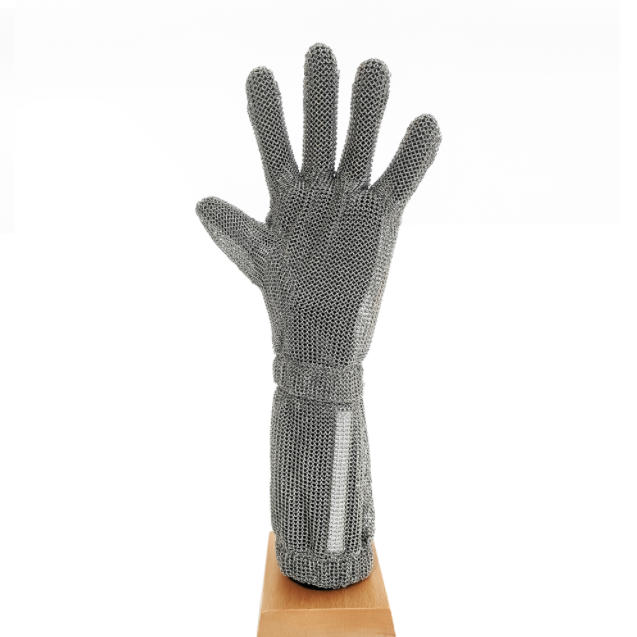
There are specific, identifiable conditions where butcher gloves will fail and allow a blade to reach the worker's skin. Understanding these failure modes is critical for proper glove selection and use. The first failure condition is the application of force exceeding the ring's tensile strength. When a knife blade is pressed against the glove with sufficient force, the individual rings will deform, stretch, and eventually fracture. The force required for this failure depends on the ring gauge, with thicker wire requiring higher force. A heavy-duty boning knife pressed with full body weight can exert force that approaches the break strength of the metal rings, particularly in smaller gauge gloves designed for dexterity rather than maximum protection.
The second failure condition is the use of blade types with cutting mechanisms that differ from the standard straight knife edge. Serrated blades, for example, concentrate force at the points of the serrations. These points create pressure points on individual rings that can exceed the ring's strength at lower overall force levels than a straight blade would require. A worker using a serrated utility knife against a chainmail glove may see glove failure at force levels that would not cut through the glove with a straight blade. This is not a defect in the glove but a limitation of the ring geometry against concentrated force points.
The third failure condition is damage to the glove structure that compromises the weave. When one ring in a chainmail glove breaks, the rings that pass through it lose their interlocking connection. This creates a gap in the protective structure. A blade can then slip through this gap and reach the skin without cutting through any metal. The glove may appear visually intact except for the single broken link, but the protective integrity is compromised. This is why regular inspection for broken links is essential for maintaining protection.
The fourth failure condition is material degradation over time. The metal rings in a chainmail glove experience wear from friction, abrasion, and corrosion. As the ring surface wears, the wire gauge decreases. A significant reduction in wire gauge results in a proportional reduction in the force required to cut or break the ring. A glove that initially provided ANSI Level A9 protection may, after extensive use and wear, effectively provide Level A7 or even Level A6 protection. The glove has not been cut through, but its resistance has been degraded to a lower level.
An important distinction in understanding butcher glove protection is the difference between cut-through and penetration. Cut-through refers to a blade physically severing the metal rings and passing through the glove structure. Penetration refers to a sharp object passing through the gaps between rings without cutting the rings themselves. Chainmail gloves provide excellent cut resistance against blades but provide less resistance against sharp, pointed objects such as needles, awls, or fish spines. These sharp points can pass between the rings without breaking them, reaching the skin beneath.
This distinction is important for applications such as handling hypodermic needles, fish processing with spines, or any task involving sharp pointed objects. For these applications, chainmail gloves are not sufficient protection on their own. Workers require additional puncture-resistant layers or gloves specifically designed for puncture resistance. Some manufacturers produce chainmail gloves with a leather or synthetic backing layer that provides puncture resistance while the chainmail provides cut resistance. These hybrid gloves address both hazards but are heavier and less dexterous than chainmail alone.
The structural limitation of chainmail against pointed objects is inherent to the weave design. The gaps between rings are necessary to allow flexibility and movement. A glove with no gaps would be rigid and unusable for hand work. The gap size is typically smaller than the tip of a standard knife but larger than the tip of a sharp needle. Workers in environments where both cut and puncture hazards exist must select gloves that address both hazards or add a puncture-resistant layer beneath the chainmail glove.
Examination of butcher gloves that have been cut through in workplace incidents provides valuable data on the conditions of failure. Across multiple industries, the most common failure scenario involves repeated abrasion on a specific area of the glove followed by a final cutting event at the weakened point. The palm area, particularly where the glove contacts the knife handle, shows the highest wear rates. This location experiences abrasion from the knife bolster and the material being cut. Over time, the ring surfaces in this area thin to the point where a normal cutting force can break the rings. The failure is not from a single exceptional force but from accumulated wear reducing the ring strength below the force of normal operation.
The second most common failure location is the thumb-index finger crotch. This area experiences high stress from gripping motions combined with twisting movements during cutting. The combination of tensile stress and abrasion accelerates wear in this location. In boning operations, this area contacts the knife handle during repetitive gripping and releasing, creating a specific wear pattern that is identifiable in gloves near the end of their service life. Failure in this location is usually indicated by noticeable thinning of the rings visible upon inspection.
Less common but more severe are failure incidents involving significant impact force combined with a cutting action. If a worker's hand strikes a hard surface while holding a cutting tool, the combination of impact and blade force can exceed the glove's structural capacity. These incidents often involve the knife being driven into the glove by the worker's own body weight or by movement of the material being cut. In these cases, the glove may fail catastrophically, with multiple rings breaking simultaneously at the impact point.
Butcher gloves provide a high level of cut resistance that is sufficient for the majority of industrial cutting applications. They consistently outperform textile alternatives in durability and sustained protection. However, they are not cut-proof under all conditions. A sufficiently sharp blade applied with sufficient force will cut through chainmail gloves, and pointed objects can penetrate between the rings without cutting through them. Protection degrades over time through wear, corrosion, and fatigue, requiring regular inspection and timely replacement.
The practical standard for evaluating butcher glove protection is not whether they can ever be cut through but whether they provide adequate protection for the specific application over a reasonable service life. For most industrial cutting applications, the answer is yes. The incident reduction achieved by chainmail glove implementation in meat processing, glass handling, and metal fabrication settings demonstrates their effectiveness.
Hebei Linchuan Safety Protective Equipment Co., LTD manufactures chainmail butcher gloves across a range of cut protection levels and ring gauges, allowing safety managers to select the appropriate protection level for their specific hazard assessment. Our gloves are constructed from stainless steel rings with welded connections for maximum durability. We recommend that customers work with their safety equipment supplier to select the appropriate protection level based on their specific hazard assessment and operational requirements.