
Author: Site Editor Publish Time: 2026-06-08 Origin: Site


Anti-cut glove suppliers provide protective equipment designed to prevent hand lacerations from sharp objects. These gloves are used across manufacturing, construction, food processing, glass handling, and metal fabrication industries. The global demand for cut-resistant gloves has increased as workplace safety regulations become more specific about hand protection requirements. An anti-cut glove supplier must maintain consistent product quality, provide accurate performance ratings, and supply documentation that confirms test results. Workplace injury data indicates that lacerations account for a significant percentage of hand injuries in industrial settings, with many of these incidents being preventable through proper glove selection. Hebei Linchuan Safety Protective Equipment Co., LTD operates as a supplier of anti-cut gloves, offering multiple levels of cut resistance based on international testing standards.
Anti-cut gloves are classified using standardized testing methods. The EN 388:2016 standard is widely used in Europe and many other regions. This standard includes a cut resistance test using a circular blade that moves across the glove material under a fixed load. The result is expressed as a level from A to F, where A provides the lowest resistance and F the highest. A glove rated A withstands a cut force of 2 newtons, while an F-rated glove withstands 30 newtons. The older EN 388 scale used levels 1 through 5, with level 5 requiring a cut index of 20 or higher. The ANSI/ISEA 105 standard is common in North America and uses levels A1 through A9. An A1 glove resists 200 grams of cutting force, while an A9 glove resists 6,000 grams. These two systems are not directly equivalent, but a general correlation exists: EN 388 level 5 corresponds roughly to ANSI A4 or A5, and EN 388 level F corresponds to ANSI A8 or A9. Suppliers should state which standard applies to each glove model. Many buyers require gloves rated at least ANSI A3 for general manufacturing tasks and ANSI A5 or higher for glass or metal handling. Hebei Linchuan Safety Protective Equipment Co., LTD supplies anti-cut gloves with ratings from ANSI A2 through ANSI A9 and EN 388 level C through level F.
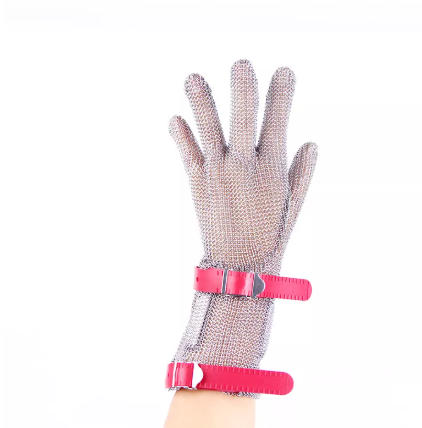
The cut resistance of a glove depends on its fiber composition. High-performance polyethylene (HPPE) is a common base material. HPPE fibers have high tensile strength relative to their weight. The specific strength of HPPE is approximately ten times that of steel by weight. HPPE is lightweight, which means an HPPE glove typically weighs between 40 and 80 grams per pair. Fiberglass is often combined with HPPE to increase cut resistance. A glove containing ten to twenty percent fiberglass achieves a higher cut level than a pure HPPE glove of the same thickness. The fiberglass component adds stiffness to the glove, which some workers find less comfortable. Steel core yarns consist of a stainless steel wire wrapped with synthetic fibers. The steel wire diameter in these yarns ranges from 0.025 mm to 0.050 mm. Gloves containing steel are detectable by metal detectors used in food processing facilities. Aramid fibers such as Kevlar provide cut resistance along with heat resistance. Aramid gloves can withstand brief contact with surfaces up to 400 degrees Celsius. However, aramid fibers absorb moisture, which can cause the glove to become heavy during use in wet environments. Tungsten and ceramic fibers are used in high-level cut gloves rated ANSI A8 or A9. These materials are harder than steel and resist blade penetration effectively. Hebei Linchuan Safety Protective Equipment Co., LTD manufactures anti-cut gloves using HPPE, fiberglass, steel core yarn, aramid, and ceramic fiber blends.
The palm and finger coating on an anti-cut glove affects grip, durability, and suitability for different work environments. Nitrile rubber coating provides resistance to oils, greases, and many solvents. A nitrile-coated glove maintains grip on oily surfaces better than an uncoated glove. The typical coating thickness ranges from 0.3 mm to 1.0 mm. A foam nitrile coating absorbs small amounts of oil to improve wet grip. Latex coating offers high friction and good grip on dry or slightly wet surfaces. However, latex is not suitable for workers with latex allergies, which affect approximately one to six percent of the general population. Latex coatings also degrade when exposed to petroleum-based oils. Polyurethane coating is thin, typically 0.2 mm to 0.4 mm, and provides good tactile sensitivity. This coating is used for tasks requiring fine motor control, such as electronic assembly or small parts handling. PVC coating is less common but offers good chemical resistance to acids and bases. For cold environments, a thermal lining can be added beneath the coating. A coated anti-cut glove has a longer service life than an uncoated knit glove because the coating protects the fibers from abrasion. Hebei Linchuan Safety Protective Equipment Co., LTD offers anti-cut gloves with nitrile, foam nitrile, latex, and polyurethane coatings in various thicknesses.
The production of anti-cut gloves involves several manufacturing stages. The first stage is yarn preparation, where raw fibers are blended and twisted to form a continuous yarn. For blended yarns, the percentage of each fiber type is controlled within narrow tolerances, typically plus or minus three percent. The second stage is knitting, where the yarn is formed into a glove shape using a knitting machine. Most anti-cut gloves are made using seamless knitting, which produces a glove without internal seams that could cause discomfort. The knitting machine uses needles arranged in a circle to create a tubular shape. The machine then forms the fingers and thumb through selective needle action. A standard knitting cycle for one pair of gloves takes between three and eight minutes depending on glove size and thickness. The third stage is inspection, where each glove is checked for missing yarns, holes, or irregular tension. A lights test is used for thin gloves: the glove is placed over a light source, and any translucent area indicates thin spots. The fourth stage is coating, applied by dipping the glove shell into a liquid compound. The dipping process may be single-dip or double-dip for thicker coatings. The coated glove passes through an oven to cure the coating. The final stage is packaging, where gloves are paired, labeled, and boxed. Hebei Linchuan Safety Protective Equipment Co., LTD operates knitting and dipping production lines for anti-cut gloves.
Reliable anti-cut glove suppliers use standardized testing equipment to verify cut resistance claims. The TDM (Tomodynamometer) test is used for EN 388:2016 cut level determination. In this test, a straight blade moves across the glove sample at a constant speed. The force on the blade increases continuously until cut-through occurs. The test records the force required to cut through the material. For a glove rated level F, the average cut force from five test specimens must reach 30 newtons. The Coup test is an older method that uses a rotating circular blade. The blade moves back and forth across the sample while the sample moves perpendicularly. The test measures how many cycles are needed to cut through. For a level 5 rating, the cut index must be 20 or higher, meaning the sample withstands 20 times more cycles than a reference material. The ANSI/ISEA 105 cut test uses a similar straight blade method with increasing force. The test continues until the blade cuts through the sample or until the maximum force of the machine is reached. Each glove model must be tested in at least two different conditions: as-received and after exposure to specified environmental conditions such as heat or moisture. A valid test report from an accredited lab includes the number of specimens tested, the mean cut force, the standard deviation, and the assigned level. Hebei Linchuan Safety Protective Equipment Co., LTD uses third-party laboratory testing for cut resistance verification and retains test reports for auditing purposes.
Anti-cut gloves used in food processing must meet additional requirements beyond cut resistance. The glove material must be compliant with food contact regulations. In the United States, FDA 21 CFR 177 governs the use of materials that contact food. The regulation specifies acceptable substances and maximum migration limits. In the European Union, Regulation (EC) 1935/2004 requires that food contact materials do not transfer constituents to food in amounts that could harm health. Stainless steel components in anti-cut gloves are generally accepted because steel is inert and non-absorbent. Gloves used in food processing must be cleanable. A smooth coating surface is easier to clean than a textured surface. Some food processing facilities require that gloves be detectable by metal detection equipment. Anti-cut gloves containing steel wire are detectable by standard industrial metal detectors set to a sensitivity of 1.5 mm ferrous sphere. Gloves without metal components are not detectable and may be prohibited in certain high-risk food lines. The glove color is also considered in food plants. Blue gloves are commonly used because blue is not a natural food color, making glove fragments easier to spot if they accidentally enter the product stream. Hebei Linchuan Safety Protective Equipment Co., LTD supplies food-grade anti-cut gloves with steel wire for detectability and blue coating for visual contrast.
The protective performance of an anti-cut glove depends on proper sizing. A glove that is too large can slip during use, exposing the hand to a blade. A glove that is too small can restrict blood flow and cause the wearer to remove the glove early. Standard sizing uses palm circumference measured around the knuckles. Size 6 fits a palm circumference of 152 mm, size 7 fits 178 mm, size 8 fits 203 mm, size 9 fits 229 mm, size 10 fits 254 mm, and size 11 fits 279 mm. Many anti-cut gloves are available in half sizes as well. A fit test can be performed by having the wearer make a fist. The glove fingertips should reach the ends of the wearer's fingers without excessive pressure. The glove should not form folds of material at the palm when the hand is closed. A study of glove fit across five hundred industrial workers found that sixty-two percent wore size 9, twenty-three percent wore size 8, ten percent wore size 10, and the remaining five percent wore sizes 6, 7, or 11. Some suppliers offer a sizing sample program where a customer can order one pair in each size to determine correct sizing before placing a bulk order. Hebei Linchuan Safety Protective Equipment Co., LTD provides a sizing chart and offers sample pairs for fit testing.
The cost of an anti-cut glove program includes purchase price, replacement frequency, and any associated logistics. A basic ANSI A2 cut-resistant glove without coating may cost between 0.80 and 1.50 US dollars per pair. A mid-level ANSI A4 glove with foam nitrile coating costs between 2.50 and 4.50 US dollars per pair. A high-level ANSI A7 glove with steel core yarn and double coating costs between 6.00 and 12.00 US dollars per pair. The service life of a glove depends on usage intensity. In a metal stamping operation, an anti-cut glove may last only two to three shifts due to abrasion and snagging. In a packaging operation, the same glove may last four to six weeks. A facility using one hundred pairs per week at an average cost of four dollars per pair spends twenty thousand dollars annually on gloves. Changing to a glove with double the service life at seven dollars per pair would reduce annual cost to seventeen thousand five hundred dollars while providing higher protection. A cost-per-use calculation divides the purchase price by the expected number of uses. For example, a five dollar glove used ten times costs fifty cents per use, while a three dollar glove used four times costs seventy-five cents per use. Hebei Linchuan Safety Protective Equipment Co., LTD can provide customers with guidance on selecting gloves based on both protection level and cost-per-use.
Buyers should evaluate anti-cut glove suppliers on multiple criteria. The first criterion is product consistency. A supplier should be able to demonstrate that cut resistance does not vary significantly between production batches. The coefficient of variation for cut force across batches should be below fifteen percent. The second criterion is documentation availability. The supplier should provide test reports, a declaration of conformity, and material safety data sheets when applicable. The third criterion is lead time reliability. Suppliers with in-house manufacturing control can typically quote lead times within a range of seven to twenty-one days for standard products. The fourth criterion is responsiveness to inquiries. A supplier that takes more than two business days to respond to a technical question may cause delays in safety program implementation. The fifth criterion is return policy. A reasonable return policy allows for return of defective or incorrectly supplied gloves within thirty days. The sixth criterion is the ability to provide product samples. Testing a sample in the actual work environment is the most reliable way to evaluate glove performance. Hebei Linchuan Safety Protective Equipment Co., LTD provides product samples, test reports, and responsive customer service to assist buyer evaluations.
Different industry sectors require specific levels of cut protection. In automotive parts manufacturing, workers handling stamped metal parts typically use ANSI A3 or A4 gloves. These gloves must also provide oil resistance. The glove cuff is usually a knit wrist to allow easy donning and doffing. In glass manufacturing, workers handling raw glass sheets or finished glass products use ANSI A7 or higher gloves. These gloves often include steel wire for additional cut resistance. The glove may have a long cuff to protect the forearm. In paper converting and corrugated box plants, the sharp edges of paper and cardboard require ANSI A4 or A5 cut protection. Paper cuts are shallow but frequent, so comfort and dexterity become important. In recycling facilities, workers handle mixed materials including broken glass and sharp metals. The recommended protection level is ANSI A6 or higher, with puncture resistance also required. In meat and poultry processing, workers using knives for boning and trimming use cut-resistant gloves with ANSI A4 to A7 ratings, depending on the sharpness of the knife and the presence of bone contact. In construction, workers cutting roofing materials or handling metal studs use ANSI A3 or A4 gloves with impact protection on the back of the hand. Hebei Linchuan Safety Protective Equipment Co., LTD supplies anti-cut gloves suitable for each of these industry sectors.
Proper maintenance extends the service life of anti-cut gloves. Many knit gloves can be washed in industrial laundry equipment. The washing temperature should not exceed 60 degrees Celsius for HPPE-based gloves, because higher temperatures can cause fiber shrinkage. Aramid gloves can withstand washing up to 90 degrees Celsius. Chlorine bleach should not be used because it degrades HPPE and aramid fibers. A mild detergent with a pH between 6 and 8 is recommended. After washing, gloves should be dried away from direct heat sources. High heat above 80 degrees Celsius can melt HPPE fibers. Gloves should be stored in a cool, dry area away from direct sunlight, as ultraviolet radiation degrades synthetic fibers over time. Inspection before each use is recommended. The user should check for holes, torn seams, or thinning areas. A glove with any visible damage should be replaced. The recommended replacement schedule depends on usage. For daily eight-hour use in moderate conditions, an anti-cut glove typically lasts three to six months. For heavy use in abrasive conditions, replacement may be needed monthly. Hebei Linchuan Safety Protective Equipment Co., LTD provides care instructions with each product shipment.
Anti-cut gloves are classified as personal protective equipment in most jurisdictions. In the European Union, Regulation (EU) 2016/425 requires that gloves sold as PPE undergo conformity assessment and carry the CE mark. The manufacturer or authorized representative must maintain a technical file for ten years after the last product is placed on the market. In the United States, OSHA does not certify gloves but requires employers to select appropriate hand protection under 29 CFR 1910.138. OSHA references ANSI/ISEA 105 as a consensus standard for cut resistance classification. In Canada, gloves used in federally regulated workplaces must comply with the Canada Labour Code and applicable standards such as CSA Z617. In China, the GB 24541 standard covers mechanical protective gloves, including cut resistance testing. Gloves imported into China require compliance with GB standards and may need testing by Chinese laboratories. Suppliers who export to multiple regions should be familiar with each region's requirements. Hebei Linchuan Safety Protective Equipment Co., LTD manufactures anti-cut gloves that meet EN 388, ANSI/ISEA 105, and GB 24541 standards, with applicable markings on product packaging.
Anti-cut glove suppliers play an essential role in industrial hand protection programs. Understanding cut resistance levels from EN 388 A through F and ANSI A1 through A9 allows buyers to match gloves to specific hazards. Material choices including HPPE, fiberglass, steel core, and aramid provide different balances of cut resistance, weight, and comfort. Coatings such as nitrile, latex, and polyurethane add grip and durability for different work environments. Proper manufacturing processes and testing verification ensure consistent product performance. Food industry applications require additional considerations including material compliance, cleanability, and metal detectability. Correct glove sizing and fit are necessary for the glove to provide its rated protection. Cost analysis should consider purchase price and service life together. Supplier evaluation should include consistency, documentation, lead time, and sample availability. Different industry sectors from automotive to glass to food processing require different cut protection levels. Regular maintenance and inspection extend glove service life. Regulatory compliance with regional requirements is necessary for legal sale and use. Hebei Linchuan Safety Protective Equipment Co., LTD supplies anti-cut gloves across these categories and provides documentation to support buyer safety programs. Buyers are encouraged to request test reports and product samples before finalizing supplier selection.