
Author: Lin Publish Time: 2026-11-11 Origin: Site


MOQ is the number that decides whether a wholesale chainmail glove order is worth doing. Ask five factories the same question and you will get five answers, because MOQ is not a policy, it is an output of production economics. It reflects how many pairs must run through a welding bench, an assembly bench and a packing line before the setup time, the material minimums and the inspection cost stop dominating the unit price. Understanding where the number comes from is the difference between accepting it and managing it.
A chainmail glove is not stamped out of sheet metal. Each glove consumes hundreds of individually welded rings, and production is organised around batches by size, by strap type and by ring specification. A batch carries fixed costs that do not scale down: the welding parameters have to be set and verified, the jigs for a given size have to be mounted, the strap colour and closure type have to be kitted, the first articles have to be inspected, and the packing specification has to be prepared. Run a hundred pairs and those fixed costs spread over a hundred units. Run five hundred and they spread over five hundred.
There is also a material minimum. Stainless steel wire is purchased by coil, and a coil of 0.53 mm wire covers a substantial number of gloves. A very small order either consumes a fraction of a coil, which the factory still has to buy, or it waits until the wire is already on the floor for another customer, which pushes your delivery date around. Both outcomes explain why small orders are often quoted at a premium rather than refused outright.
The table below shows the order bands buyers typically encounter for stock constructions. Treat them as planning benchmarks rather than fixed rules, and confirm the figure model by model, because a strap change costs far less to set up than a new ring specification.
Product type |
Typical MOQ band |
What drives the number |
Five finger short glove, stock strap, stock sizes |
50 to 200 pairs |
Existing jigs, existing strap stock, batch efficiency |
Long cuff glove, 20 cm sleeve |
100 to 300 pairs |
Longer assembly time, additional strap and buckle |
Three finger glove |
100 to 300 pairs |
Lower running volume, dedicated assembly pattern |
Chainmail apron, standard size |
50 to 150 pieces |
Large surface area, separate assembly bench |
Custom logo or private label |
200 to 500 pairs |
Label printing, artwork approval, packaging setup |
Custom strap colour or material |
300 to 1,000 pairs |
Minimum dye lot or minimum purchase quantity from the strap supplier |
New size or new glove pattern |
500 to 1,000 pairs |
New jigs, pattern development, first article inspection |
Custom ring specification, wire or ring diameter |
1,000 pairs or more |
Wire coil minimum, welding parameter development, testing |
MOQ is negotiable in both directions once you understand which variable you are pulling. The table below shows the levers and their usual effect.
Variable |
Effect on MOQ |
Reason |
Standard model, standard strap, standard sizes |
Down |
No setup beyond a normal batch change |
Colour-coded strap in a non-standard colour |
Up |
Strap supplier minimum dye lot |
Printed label with your artwork |
Slightly up |
Plate or digital setup and artwork approval |
Retail box instead of polybag |
Up |
Carton printing minimum and packing time |
Mixed sizes within one model |
Slightly down per size |
Same jigs, same strap, only size change |
Mixed models in one order |
Down overall |
Total volume reaches the economic batch even if each model is small |
New wire diameter or ring size |
Up significantly |
New welding parameters, new testing, wire coil minimum |
Additional certification for a new market |
Up |
Testing cost must be amortised over the batch |
Unit cost falls with quantity, but it does not fall evenly. The first break comes when the batch covers setup and inspection. The second comes when material is bought at full coil or full carton quantities. The third comes when the order is large enough to justify a dedicated production run rather than being slotted between other jobs, which mainly affects lead time rather than price.
A useful discipline is to ask for the price at three points: your trial quantity, your expected annual quantity, and double your expected annual quantity. If the price at double quantity is barely different from your annual quantity, the supplier has already reached efficient scale and your leverage is in payment terms and lead time rather than volume. If the curve is still steep at your annual volume, there is room to consolidate models into fewer, larger runs.
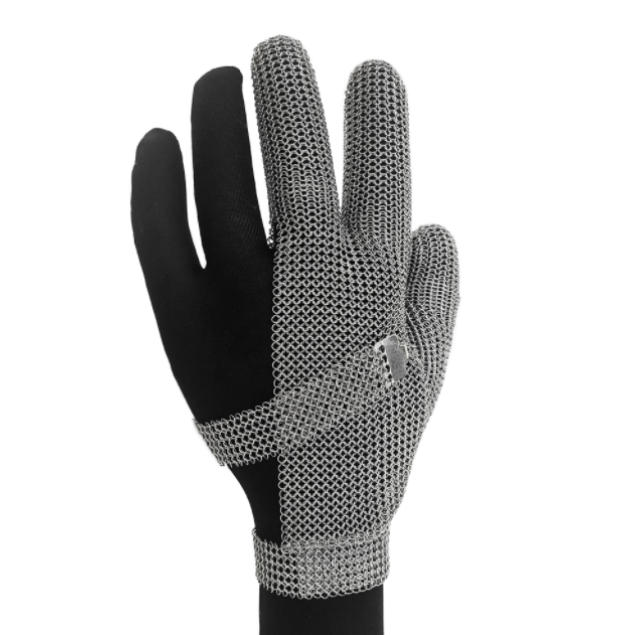
Most buyers do not need five hundred pairs of one glove. They need a range that covers a workforce: short gloves for trimming, long cuff gloves for boning, three finger gloves for specific grips, and aprons for the front-line staff. A mixed order can reach the economic batch while keeping each line item small.
Approach |
How it works |
Trade-off |
Mixed model, one shipment |
Combine short, long cuff and three finger models to reach total volume |
Packing and documentation become more complex |
Size run within one model |
Order XXS to XXL in proportion to your workforce |
Some sizes may sell slowly and sit in stock |
Colour assortment |
Use strap colour coding to cover several departments in one batch |
Limited to colours the strap supplier stocks |
Stock plus custom split |
Buy stock models at low quantity, customise only the high-runner |
Two specifications to manage in one programme |
Consolidated annual contract |
Commit annual volume with scheduled releases |
Requires accurate demand planning and a firm forecast |
Sampling and MOQ are usually negotiated together, and the sequencing matters. A sample is normally supplied from stock or from a small pilot run, and the sample fee is often credited against the bulk order once it is placed. That credit is a commercial gesture, not a reduction in MOQ, and buyers should not confuse the two.
The more useful connection is the specification lock. MOQ is quoted against a defined specification: model, wire diameter, ring size, closure type, strap, size range and packing. Change one of those after the sample is approved and the MOQ will move, sometimes upward, because the factory is now setting up a batch it did not plan. Locking the specification before discussing MOQ is therefore the single most effective way to keep the number where you want it.
First, remove customisation from the first order. Buy a stock strap and stock packing, prove the product in your market, and customise on the second order when volume is known. Second, accept a longer lead time, because the factory can then slot your small batch into an existing run of the same specification. Third, consolidate across models so total volume reaches the threshold even if individual lines are small. Fourth, accept the standard size range instead of insisting on a full XXS to XXL spread. Fifth, offer a firm annual forecast with scheduled releases, which converts a small first order into a committed programme. Sixth, pay a modest small-batch surcharge on the first order and negotiate it away on the second, which is usually cheaper than holding inventory you cannot sell.
Order type |
Typical quantity |
Purpose |
What to negotiate |
Sample order |
1 to 5 pairs |
Specification and fit validation |
Sample fee credit against bulk, freight cost |
Trial order |
At or near MOQ |
Market test and internal approval |
Small batch surcharge, lead time, packing standard |
Repeat order |
2 to 5 times MOQ |
Regular replenishment |
Volume break, payment terms, carton configuration |
Annual contract |
Full year forecast with releases |
Price stability and capacity reservation |
Price ladder, material index clause, capacity commitment |
A small order that is accepted still carries costs, and they reappear somewhere. The most common are a small batch surcharge of a few percent per unit, a shift to a slower production slot, packing into mixed cartons that raise freight cost per glove, and the loss of the sample fee credit. There is also an invisible cost: a factory running your tiny order between larger jobs is more likely to substitute a stock strap or a stock size when a component runs short, and that substitution is how specification drift begins.
Hebei Linchuan Safety Protective Equipment Co., LTD quotes MOQ per model and per specification rather than publishing a single blanket figure, because the number genuinely depends on the strap, the size range and the packing. Stock constructions such as the five finger short glove with textile strap and the long cuff glove with a 20 cm sleeve can be supplied in smaller batches than a new ring specification or a custom strap colour.
Send your model list, size mix, strap choice, packing requirement and target shipment date, and our export team will return the MOQ, the unit price at that quantity, the price at double quantity, and the lead time for each line. Where a first order falls below the economic batch, we will tell you which lever reduces it, whether that is a longer lead time, a mixed model shipment or a stock packing configuration, rather than quoting a premium without explanation.