
Author: Site Editor Publish Time: 2026-06-08 Origin: Site


Steel cut resistant gloves are a type of protective handwear that incorporates stainless steel wire or yarn to prevent lacerations from sharp objects. These gloves are manufactured in specialized factories that blend steel fibers with other materials or weave stainless steel rings into a mesh structure. Steel cut resistant gloves are used in meat processing, glass handling, metal fabrication, automotive assembly, and recycling operations. The inclusion of steel provides a high level of cut resistance that does not degrade as quickly as non-metallic alternatives. Factories producing steel cut resistant gloves must control wire diameter, yarn construction, and knitting parameters to achieve consistent performance. Hebei Linchuan Safety Protective Equipment Co., LTD operates a factory producing steel cut resistant gloves in both knit and chainmail configurations.
Steel cut resistant glove factories produce two main categories of products. The first category is steel wire knit gloves, where a fine stainless steel wire is wrapped with synthetic fibers such as HPPE or nylon to form a composite yarn. The steel content in these gloves ranges from fifteen to forty percent by weight. The steel core provides cut resistance while the synthetic fibers provide comfort and flexibility. These gloves are typically coated with nitrile, latex, or polyurethane on the palm and fingers for improved grip. The second category is chainmail or metal mesh gloves, where interlocked stainless steel rings form a flexible but rigid barrier. Chainmail gloves contain one hundred percent steel with no synthetic fibers. They are heavier than steel wire knit gloves but provide higher cut resistance and are cleanable at high temperatures. A third, less common category is steel plate gloves, where small overlapping steel plates are riveted to a fabric backing. These are used in specialized applications such as oyster shucking or shark processing. Each category requires different production equipment and quality control procedures. Hebei Linchuan Safety Protective Equipment Co., LTD produces both steel wire knit gloves and chainmail gloves in its factory.
The steel wire used in cut resistant gloves must meet specific specifications for diameter, tensile strength, and corrosion resistance. Wire diameter for knit steel gloves ranges from 0.025 mm to 0.050 mm. Thinner wire produces a more flexible glove but lower cut resistance. A 0.025 mm steel wire provides sufficient cut resistance for ANSI A4 to A5 levels. A 0.050 mm steel wire provides ANSI A6 to A7 levels. For chainmail gloves, wire diameter is larger, ranging from 0.4 mm to 0.6 mm. The larger wire diameter is necessary because chainmail rings are not supported by a fabric backing. Tensile strength of the steel wire is measured in megapascals. Grade 304 stainless steel wire for cut resistant gloves has a tensile strength of 700 to 900 megapascals in the drawn condition. Grade 316 stainless steel has similar tensile strength but higher corrosion resistance due to molybdenum content. The steel wire must be free of surface defects such as pits, scratches, or scale. Surface defects create stress concentration points that can lead to wire breakage during glove use or during the knitting process. Factories perform incoming inspection of steel wire using a micrometer to check diameter and a tensile testing machine to verify strength. Hebei Linchuan Safety Protective Equipment Co., LTD sources steel wire from mills that provide certificates of analysis for each batch.
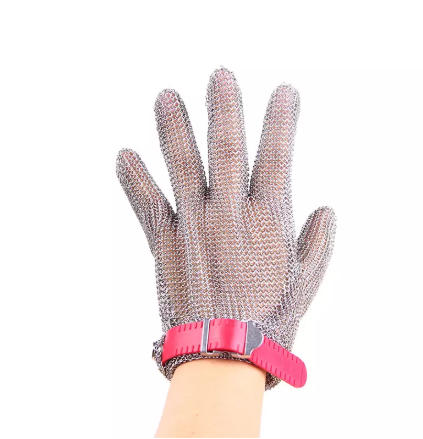
In steel core knit gloves, the steel wire is combined with other fibers to form a composite yarn. The most common construction is a wrapped yarn, where a steel wire core is surrounded by a sheath of high-performance polyethylene (HPPE), fiberglass, or nylon. The wrapping process uses a hollow spindle machine that rotates the sheath fibers around the steel core at a controlled pitch. The wrap density is typically ten to twenty turns per centimeter. A higher wrap density improves abrasion resistance but reduces flexibility. Another construction is a plied yarn, where a steel wire and synthetic fibers are twisted together. Plied yarns have a rounder cross-section than wrapped yarns and may be more comfortable against the skin. The percentage of steel in the yarn affects both cut resistance and glove weight. A yarn with thirty percent steel content provides higher cut resistance than a yarn with fifteen percent steel content, but the glove will be heavier and stiffer. The balance between steel and synthetic fibers is determined by the target cut level and customer preference. For food processing applications, the synthetic fibers must be compliant with food contact regulations. HPPE and nylon are generally acceptable for food contact, while some fiberglass yarns are not approved because of potential glass particle release. Hebei Linchuan Safety Protective Equipment Co., LTD produces steel core yarns with steel content from fifteen to forty percent.
Steel cut resistant gloves from factories must undergo standardized cut resistance testing. For steel core knit gloves, the EN 388:2016 test using a rotating circular blade is applicable. The test measures the number of cycles required to cut through the glove material compared to a reference cotton fabric. The result is expressed as a cut index. A steel core knit glove with 0.035 mm steel wire and HPPE sheath typically achieves a cut index of 20 to 30, corresponding to EN 388 level 5 on the old scale or level D on the new scale. The ANSI/ISEA 105 test uses a straight blade that moves across the glove material under increasing force. The result is the force in grams required to cut through. A steel core knit glove with moderate steel content achieves ANSI A5 to A7. For chainmail gloves, the EN 388 test using a rotating blade is not suitable because the blade would be damaged by the steel rings. Instead, the ISO 13999 test method uses a straight blade that moves across the glove surface under a load of five kilograms. The test measures the number of strokes required to cut through. A chainmail glove with 0.5 mm wire typically withstands more than 10,000 strokes. Factories must maintain test records for each glove model and production batch. Third-party testing from accredited laboratories provides verification for buyer requirements. Hebei Linchuan Safety Protective Equipment Co., LTD conducts EN 388 and ANSI/ISEA 105 testing for its steel cut resistant gloves.
The knitting process for steel cut resistant gloves is more demanding than for non-metallic gloves because steel wire is less flexible than synthetic fibers. Seamless knitting machines with specialized needles and yarn feeders are used. The knitting machine operates at a slower speed when processing steel content yarns, typically thirty to fifty percent slower than for pure HPPE yarns. The slower speed reduces needle breakage and yarn damage. The knitting pattern for a steel core glove is typically a plain knit or a jacquard knit for zones of different protection. Plain knit has a uniform stitch density across the entire glove. Jacquard knit uses a computer-controlled pattern to create zones with higher stitch density on the palm and fingers while the back of the hand has lower density for breathability. After knitting, the glove may be turned inside out to hide the yarn tails and provide a smoother surface. For chainmail gloves, the knitting process is different. Ring knitting machines interlock individual steel rings rather than knitting a continuous yarn. The machine uses a series of needles that open and close rings, passing them through adjacent rings. The process is slower, producing one chainmail glove blank in five to ten minutes. Hebei Linchuan Safety Protective Equipment Co., LTD operates both yarn knitting machines for steel core gloves and ring knitting machines for chainmail gloves.
Most steel knit cut resistant gloves receive a coating on the palm and fingers to improve grip and durability. The coating is applied by dipping the glove shell into a liquid compound. The dipping process has several stages. First, the glove shell is mounted on a hand-shaped former. Second, the former is lowered into a tank of coating compound. The depth of dip determines whether only the fingertips are coated (dip depth 30 mm), the palm is coated (dip depth 80 mm), or the entire glove is coated (dip depth 250 mm). Third, the former is withdrawn slowly to allow excess compound to drip off. Fourth, the coated glove passes through an oven to cure the compound. Curing temperature and time depend on the coating material. Nitrile rubber cures at 120 degrees Celsius for thirty minutes. Latex cures at 100 degrees Celsius for forty minutes. Polyurethane cures at 80 degrees Celsius for twenty minutes. After curing, the glove is stripped from the former and inspected. A common defect is coating thickness variation. The acceptable coating thickness tolerance is plus or minus 0.05 mm from the target thickness. Another defect is pinholes, which are small uncoated areas that reduce grip and allow contaminants to contact the glove shell. Factories use an electrical conductivity test to detect pinholes in the coating. Hebei Linchuan Safety Protective Equipment Co., LTD applies nitrile, foam nitrile, latex, and polyurethane coatings to its steel knit gloves.
Quality control in a steel cut resistant glove factory covers raw materials, in-process production, and finished gloves. For raw materials, the factory inspects steel wire diameter using a laser micrometer with an accuracy of 0.001 mm. The wire is also tested for tensile strength using a universal testing machine. A sample of five meters from each wire spool is tested. For synthetic fibers, the factory checks denier or decitex, which is a measure of linear density. For in-process production, the knitting machine tension is measured at the start of each shift. Tension that is too high causes yarn breakage. Tension that is too low produces a loose glove with inconsistent cut resistance. For finished gloves, a sample from each production batch is tested for cut resistance according to EN 388 or ANSI/ISEA 105. The factory also performs a visual inspection of each glove. Common defects include dropped stitches (missing yarn loops), holes, thin spots, and coating imperfections. The acceptable quality level for major defects is typically 1.0 percent, meaning no more than one glove in one hundred may have a defect that affects performance. For minor defects such as slight color variation, an AQL of 2.5 percent is common. Defective gloves are removed from the production batch and recorded for process improvement. Hebei Linchuan Safety Protective Equipment Co., LTD documents all quality control checks and retains records for two years.
Steel cut resistant gloves used in food processing must comply with food contact regulations. The steel component is generally acceptable for food contact because stainless steel is non-porous and does not migrate harmful substances. For the United States market, the FDA requires that materials used in food contact be manufactured from substances listed in 21 CFR. Stainless steel grades 304 and 316 are listed as acceptable. For the European Union, Regulation (EC) 1935/2004 requires that food contact materials do not transfer constituents to food in amounts that could endanger health. Steel gloves meet this requirement when manufactured from approved steel grades. The synthetic fibers in steel core gloves must also be compliant. HPPE and nylon are generally recognized as safe for food contact. Fiberglass, however, is not approved for direct food contact in some jurisdictions because glass particles could contaminate food. For food processing facilities with HACCP plans, steel gloves must be detectable by metal detectors. Steel core knit gloves are detectable because the steel wire content triggers the detector. The detection sensitivity for a steel core glove is typically 1.0 mm to 1.5 mm ferrous sphere equivalent. Chainmail gloves are also detectable. Factories should provide a letter of compliance stating that the gloves are manufactured from FDA-approved materials and are metal detectable. Hebei Linchuan Safety Protective Equipment Co., LTD provides food safety documentation for its steel cut resistant gloves.
Steel cut resistant gloves have advantages and disadvantages compared to non-steel alternatives such as pure HPPE, fiberglass, or aramid gloves. The primary advantage of steel gloves is consistent cut resistance over time. Steel wire does not degrade from abrasion or washing, while HPPE fibers lose tensile strength with each wash cycle. A study of glove durability in a meat processing facility found that steel core gloves maintained eighty-five percent of their initial cut resistance after fifty wash cycles, while pure HPPE gloves maintained only forty percent. The second advantage is metal detectability. Steel gloves can be detected by metal detectors in food processing lines, while non-steel gloves cannot. The third advantage is heat resistance. Steel wire does not melt or shrink at temperatures below 500 degrees Celsius, while HPPE melts at 150 degrees Celsius. The disadvantages of steel gloves include higher weight and lower flexibility. A steel core glove typically weighs 80 to 120 grams per pair, while a pure HPPE glove weighs 40 to 60 grams per pair. The steel content also increases the cost. A steel core glove costs twenty to forty percent more than a non-steel glove of the same cut level. For applications where metal detectability and long service life are not required, non-steel gloves may be a better choice. Hebei Linchuan Safety Protective Equipment Co., LTD produces both steel and non-steel cut resistant gloves.
Steel cut resistant glove factories offer customization options to meet specific buyer requirements. For steel core knit gloves, customization options include steel wire diameter (0.025 mm to 0.060 mm), sheath fiber type (HPPE, nylon, or aramid), steel content percentage (fifteen to forty percent), and coating type (nitrile, latex, polyurethane, or no coating). The glove size range is typically 6 to 11, but custom sizes can be produced from hand tracings. The cuff type can be knit wrist, knit gauntlet (extended cuff), or safety cuff with a breakaway feature for machine operation applications. Color options include gray, black, blue, and white. White gloves are used in food processing because dye contamination is a concern. For chainmail gloves, customization options include wire diameter (0.4 mm to 0.6 mm), ring size (3.5 mm to 5.0 mm), cuff length (wrist, elbow, or full-arm), and closure type (hook-and-loop, snap button, or elastic). The minimum order quantity for custom specifications is typically one thousand to five thousand pairs for knit gloves and five hundred to one thousand pairs for chainmail gloves. Lead time for custom orders is twenty to forty business days. Hebei Linchuan Safety Protective Equipment Co., LTD accepts custom orders for both steel core knit and chainmail gloves.
International buyers of steel cut resistant gloves often require that factories hold specific certifications or undergo audits. ISO 9001:2015 certification is the basic quality management standard. This certification indicates that the factory has documented procedures for production, inspection, corrective action, and continuous improvement. For gloves sold in the European Union, the factory must have a notified body that issues CE certification under Regulation (EU) 2016/425. The notified body audits the factory and tests the gloves before issuing the certificate. For food processing applications, BRC Global Standard for Food Safety certification is valued. A BRC-certified factory has systems for product safety, traceability, and contamination prevention. For environmental management, ISO 14001 certification demonstrates that the factory controls its environmental impact. Some buyers conduct their own audits using a supplier questionnaire or an on-site visit. The audit covers production equipment calibration, employee training records, raw material traceability, and in-process quality control. A factory that passes a buyer's audit may be designated as an approved supplier for multiple years. Hebei Linchuan Safety Protective Equipment Co., LTD holds ISO 9001 certification and has achieved CE certification for its steel cut resistant glove models.
Proper maintenance extends the service life of steel cut resistant gloves. For steel core knit gloves, washing is recommended after each use to remove dirt and oils that can degrade the synthetic fibers. The washing temperature should not exceed 60 degrees Celsius to prevent shrinkage of HPPE fibers. A mild detergent with pH between 6 and 8 should be used. Chlorine bleach should be avoided because it weakens HPPE and aramid fibers. The gloves can be dried in a tumble dryer on low heat or hung to dry. The average service life of a steel core knit glove used daily in moderate conditions is three to six months. For chainmail gloves, washing can be done at higher temperatures up to 82 degrees Celsius. Chainmail gloves can be washed in an industrial dishwasher. Drying is important to prevent rust. A centrifugal spin dryer removes water from between rings. The average service life of a chainmail glove used daily is twelve to twenty-four months. Both types of steel gloves should be inspected before each use. Signs of wear include broken wires or rings, thinning areas, and holes. Any glove showing these signs should be replaced. Hebei Linchuan Safety Protective Equipment Co., LTD provides washing and care instructions for its steel cut resistant gloves.
Steel cut resistant glove factories produce two main product types: steel core knit gloves and chainmail gloves. Steel core knit gloves use fine steel wire combined with synthetic fibers, weigh 80 to 120 grams per pair, and achieve ANSI A5 to A7 cut resistance. Chainmail gloves use interlocked steel rings with wire diameters of 0.4 mm to 0.6 mm, weigh 300 to 550 grams per pair, and achieve ANSI A7 to A9 cut resistance. Steel wire specifications include diameter tolerance of plus or minus 0.002 mm and tensile strength of 700 to 900 megapascals. Yarn construction for steel core gloves uses wrapped or plied configurations with fifteen to forty percent steel content. Coating applications include nitrile, latex, and polyurethane applied by dip coating. Quality control includes raw material inspection, in-process tension checks, and finished glove testing. Food safety compliance requires FDA or EU documentation for all materials. Steel gloves offer advantages in consistent cut resistance, metal detectability, and heat resistance compared to non-steel alternatives. Customization options include wire diameter, steel content, coating type, and sizing. Factory certifications such as ISO 9001 and CE provide assurance of quality. Proper maintenance through washing and inspection extends service life. Hebei Linchuan Safety Protective Equipment Co., LTD operates a steel cut resistant glove factory producing both knit and chainmail products with documentation for international buyers.