
Author: Site Editor Publish Time: 2026-04-01 Origin: Site


In industrial environments where sharp instruments, high-speed machinery, and cutting tools are part of daily operations, hand protection must meet the highest thresholds of durability and reliability. Stainless steel mesh gloves represent a category of personal protective equipment that has remained indispensable for decades, particularly in meat processing, glass handling, and metal fabrication industries. Unlike single-use or disposable alternatives, stainless steel mesh gloves are engineered for repeated use under extreme conditions, providing a combination of cut, puncture, and abrasion resistance that synthetic materials alone cannot consistently replicate in certain high-force applications.
As a manufacturer in the safety equipment sector, Hebei Linchuan Safety Protective Equipment Co., LTD. recognizes that the production of stainless steel mesh gloves involves precise metallurgical specifications, rigorous quality control protocols, and a deep understanding of international safety standards. This article provides a technical examination of the manufacturing processes, material properties, certification requirements, and application considerations for stainless steel mesh gloves, with a focus on what industrial buyers and safety managers should evaluate when sourcing these products.
The foundation of any stainless steel mesh glove is the metal alloy from which the rings are formed. Not all stainless steels offer the same performance characteristics, and the selection of the correct alloy directly influences the glove’s resistance to corrosion, tensile strength, and long-term durability under industrial laundering conditions.
The most common stainless steel grades used in mesh glove manufacturing are 304 and 316. Grade 304 stainless steel, which contains approximately 18 percent chromium and 8 percent nickel, provides a balance of corrosion resistance and formability. It is suitable for most food processing environments where the glove will be exposed to moisture, animal fats, and mild cleaning agents.
Grade 316 stainless steel incorporates an additional 2 to 3 percent molybdenum, which enhances resistance to chlorides and other corrosive agents. In environments where gloves are exposed to high concentrations of salt, acidic marinades, or aggressive sanitizing chemicals such as peracetic acid or high-temperature chlorine solutions, Grade 316 offers a measurable extension in service life. Corrosion testing data indicates that Grade 316 can withstand exposure to 5 percent sodium chloride solution at elevated temperatures with minimal pitting, whereas Grade 304 under identical conditions may show signs of surface corrosion after prolonged cycles.
The protective capacity of a stainless steel mesh glove is determined not only by the material grade but also by the physical dimensions of the wire used to form the rings. Wire diameter typically ranges from 0.25 millimeters to 0.45 millimeters. A thicker wire diameter increases the overall mass of the glove but also enhances resistance to cutting forces and puncture attempts.
Ring geometry also varies between manufacturers. Standard round rings are the most common, but some designs incorporate flattened or shaped rings that alter the surface contact area. The internal diameter of each ring, typically ranging from 3.5 millimeters to 5 millimeters, affects the flexibility and breathability of the glove. A glove constructed with smaller ring diameters offers a denser mesh pattern, which can provide increased resistance to fine-point puncture hazards such as fish bones or metal burrs.
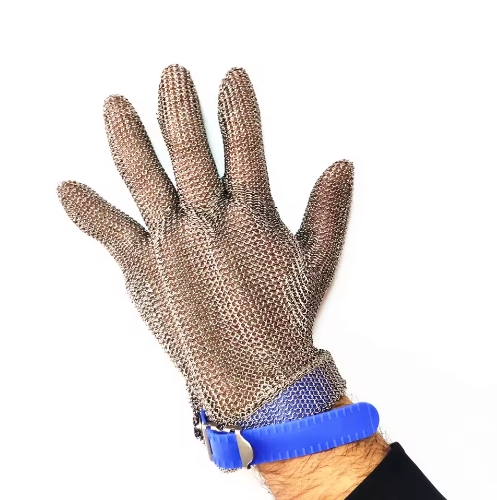
The production of stainless steel mesh gloves requires specialized machinery and multi-stage quality verification. Unlike cut-resistant gloves made from knitted fibers, which can be produced on automated knitting machines, stainless steel mesh gloves involve mechanical assembly of individual rings into a continuous mesh structure.
The manufacturing process begins with stainless steel wire drawn to precise specifications. The wire is fed into coiling machines that form individual rings with consistent diameter and closure. Each ring is then interlocked with adjacent rings in a pattern that creates a flexible yet structurally continuous mesh. This interlocking pattern—often a 4-to-1 or 6-to-1 link—determines the flexibility and coverage of the finished glove.
The interlocking process requires consistent tension control. If tension varies significantly across the glove, weak points may develop where ring connections are either too tight, restricting movement, or too loose, creating gaps that could allow a blade edge to contact the skin. In quality-focused manufacturing facilities, tension is monitored continuously during assembly, with periodic sampling to verify that ring-to-ring force requirements fall within specified ranges.
After the mesh panels are formed, they are assembled into glove shapes. This involves cutting the mesh to pattern specifications and joining the pieces using stainless steel wire stitching or, in some designs, reinforced rings at stress points such as the thumb crotch and finger gussets. The stitching pattern must be robust enough to withstand the tensile forces generated during donning, doffing, and use.
The closure mechanism—typically an adjustable strap with a buckle or hook-and-loop fastener—is attached to the glove cuff. The cuff itself may be constructed from stainless steel mesh, leather, or synthetic materials. For food processing applications, the cuff material must be non-absorbent and cleanable to prevent bacterial harborage.
Finished gloves undergo dimensional inspection to ensure they conform to specified sizing parameters. Tensile testing is performed on sample units to verify that the mesh structure maintains integrity under load. A typical quality control protocol may include testing the force required to separate a section of mesh, with acceptable thresholds defined based on the glove’s intended application.
Additionally, each glove is inspected for protruding wire ends, which can create snag hazards or cause discomfort to the wearer. Protrusions are ground smooth, and the glove is passed through a final visual and tactile inspection before packaging.
Stainless steel mesh gloves are valued for their performance across multiple hazard categories. Unlike some synthetic materials that may excel in cut resistance but offer limited puncture protection, stainless steel mesh provides balanced defense against several types of mechanical risks.
The cut resistance of stainless steel mesh gloves is evaluated under the same ANSI/ISEA 105 and EN 388 standards that apply to other cut-resistant gloves. Due to the metal construction, these gloves typically achieve cut resistance levels in the A8 to A9 range under the ANSI scale. This places them at the highest end of the cut resistance spectrum, suitable for tasks involving band saws, high-speed slicers, and heavy scimitar knives.
It is important to note that the cut resistance of a stainless steel mesh glove is not absolute; under sufficient force and with a sufficiently sharp blade, any material can be cut. However, the metal mesh structure distributes cutting force across multiple rings, requiring substantially more energy to penetrate than most knitted or coated synthetic gloves.
Puncture hazards in industrial environments include fish bones, broken glass, metal shavings, and animal bones. Stainless steel mesh gloves offer puncture resistance ratings that typically fall within EN 388 Level 4 or 5, the highest classifications available. The dense arrangement of interlocking rings creates a physical barrier that deflects or absorbs the force of a pointed object.
Testing data from puncture resistance evaluations show that stainless steel mesh requires a force exceeding 100 newtons to be penetrated by a standard puncture probe, whereas many high-performance synthetic gloves may be penetrated at forces between 50 and 80 newtons depending on construction. This difference becomes critical in applications such as seafood processing, where sharp shells and spines pose constant puncture risks.
The abrasion resistance of stainless steel mesh is inherent to its metal composition. The material withstands repeated contact with rough surfaces, equipment edges, and bone fragments without significant degradation. Tear resistance is similarly high; unlike knitted fabrics that can propagate a tear once a cut is initiated, the interlocking ring structure of a stainless steel mesh glove prevents localized damage from spreading across the glove.
For facilities processing food products, the cleanability of protective equipment is as important as its protective performance. Stainless steel mesh gloves are designed to withstand rigorous cleaning protocols that would degrade synthetic alternatives.
Stainless steel mesh gloves can be cleaned in commercial dishwashers or industrial washing machines at temperatures up to 90°C (194°F). This high-temperature cleaning capability is essential for facilities that require thermal sanitization to meet food safety standards. The gloves do not absorb liquids or organic matter, provided they are cleaned promptly after use. When washed at temperatures exceeding 70°C (158°F) with appropriate detergents, the surface of the gloves achieves a level of microbial reduction that meets the requirements of food processing hygiene audits.
Food processing facilities utilize a variety of sanitizing agents, including chlorine-based compounds, quaternary ammonium compounds, and organic acids. The corrosion resistance of the stainless steel alloy determines how well the glove maintains its structural integrity over time under these exposures. Grade 316 stainless steel gloves are specified for facilities using high-concentration chlorine sanitizers or operating in environments with elevated salinity, such as seafood processing plants located in coastal areas.
One of the defining features of stainless steel mesh gloves in food processing is their detectability by metal detectors and X-ray inspection systems. In the event that a fragment of the glove becomes separated and enters the product stream, it can be identified and removed before the product reaches the consumer. This attribute makes stainless steel mesh gloves the preferred choice in facilities where foreign material control is subject to regulatory oversight under the Food Safety Modernization Act (FSMA) and Hazard Analysis and Critical Control Points (HACCP) plans.
Facilities typically establish protocols for glove accountability, including issuance and return procedures, to ensure that no glove fragment remains unaccounted for at the end of a production shift. Gloves are often serialized with unique identification numbers to facilitate tracking.
Despite their metal construction, modern stainless steel mesh gloves are engineered to accommodate the ergonomic demands of industrial work. Design features influence user acceptance and compliance.
A stainless steel mesh glove typically weighs between 200 and 400 grams, depending on the wire thickness and glove size. This weight, while significantly higher than a knitted cut-resistant glove, is distributed across the hand and wrist. The use of adjustable cuffs and properly positioned fasteners helps transfer some of the load to the wrist rather than concentrating it on the fingers.
For workers engaged in full-shift operations, fatigue management is addressed through job rotation schedules. Many facilities rotate workers between positions that require stainless steel mesh gloves and positions that involve lighter hand protection, allowing muscle groups to recover. Data from ergonomic assessments in meat processing plants indicate that when rotation schedules are implemented, the incidence of upper extremity fatigue complaints decreases by approximately 25 percent compared to shifts where workers wear heavy gloves without rotation.
Proper sizing is critical for both safety and comfort. A stainless steel mesh glove that is too large may shift during use, reducing tactile feedback and potentially allowing the hand to move relative to the glove. A glove that is too small restricts finger movement and can cause pressure points at the base of the fingers.
Sizing is determined by measuring hand circumference at the palm and finger length from the tip of the middle finger to the base of the palm. Manufacturers provide sizing charts that correlate these measurements to sizes ranging from extra small to extra large. For facilities employing workers with a range of hand dimensions, maintaining an inventory of multiple sizes ensures that each worker receives a glove that fits properly.
In many meat processing applications, stainless steel mesh gloves are worn over a cut-resistant liner glove made from HPPE or other synthetic fibers. The liner provides additional thermal insulation, moisture management, and a second layer of cut protection. The combination of a synthetic liner and a stainless steel mesh outer glove offers protection that exceeds either component individually.
The liner also improves comfort by creating a barrier between the metal rings and the skin, reducing friction and preventing the sensation of cold metal against the hand in refrigerated environments. When specifying this combination, compatibility between the liner and the outer glove must be verified to ensure that the liner does not bunch or create pressure points that would interfere with circulation.
Different industrial applications require different configurations of stainless steel mesh gloves. Manufacturers offer variations in cuff style, coverage, and reinforcement to match specific hazards.
In applications such as industrial meat processing, where workers handle large primals or operate band saws, protection may be required beyond the hand and wrist. Stainless steel mesh arm guards extend coverage to the forearm and, in some designs, to the upper arm. These guards are constructed from the same interlocking ring material as gloves and are often integrated with the glove cuff to create a continuous barrier.
Arm guards are particularly common in pork and beef processing facilities where workers reach into carcass cavities or work in close proximity to moving blades. The extension of protection reduces the risk of lacerations to the forearms, which are among the most common injury sites in meat processing operations.
Poultry processing facilities often require stainless steel mesh gloves with finer ring diameters to provide increased flexibility for tasks such as wing cutting and thigh deboning. The smaller ring size creates a denser mesh that offers good cut resistance while allowing the finger articulation required for precise movements.
Seafood processing applications may call for gloves with reinforced palm areas to resist abrasion from crab shells or lobster exoskeletons. Some designs incorporate additional layers of mesh at the thumb and forefinger, where puncture hazards are most concentrated during shellfish handling.
Beyond food processing, stainless steel mesh gloves are used in glass manufacturing, automotive assembly, and metal fabrication. In these settings, the hazards include sharp edges of sheet metal, broken glass, and burrs from machined components. Gloves used in these industries may feature leather cuffs or palm reinforcements to provide additional abrasion resistance against rough surfaces.
Stainless steel mesh gloves must be certified to applicable safety standards to demonstrate their performance characteristics. Buyers should verify that products carry valid certifications from accredited testing laboratories.
Under the ANSI/ISEA 105 standard, stainless steel mesh gloves typically receive a cut level rating of A8 or A9. The A8 rating indicates that the glove withstood a cutting force between 3500 and 3999 grams during the standardized test, while A9 indicates resistance to 4000 grams or greater. These ratings are the highest available and are required for tasks involving the most severe cut hazards.
The EN 388 standard provides a four-digit or five-digit performance rating for mechanical risks. For stainless steel mesh gloves, the ratings typically appear as follows:
Abrasion resistance: Level 4 (highest)
Cut resistance (Coupe test): Level 5 (highest, though the test may not fully capture metal mesh performance)
Tear resistance: Level 4 (highest)
Puncture resistance: Level 4 or 5 (highest)
Cut resistance (TDM-100): Result in newtons, typically exceeding 20 newtons for Level 5
Buyers should request test reports from certified laboratories to verify that the gloves they purchase meet the performance levels required for their specific applications.
For food processing applications, stainless steel mesh gloves must comply with food contact material regulations. In the United States, this requires that the materials used meet FDA requirements for repeated contact with food. In the European Union, compliance with Regulation (EC) No 1935/2004 is required. Manufacturers should be able to provide documentation confirming that their gloves are manufactured from materials that are suitable for food contact.
The durability of stainless steel mesh gloves contributes to their cost-effectiveness over time. While the initial purchase price exceeds that of disposable or limited-use gloves, the extended service life reduces replacement frequency.
The service life of a stainless steel mesh glove is influenced by several factors. Frequency of use is a primary variable; a glove used for a full eight-hour shift daily will wear differently than one used intermittently. The nature of the work also matters—tasks that subject the glove to repeated abrasion against rough surfaces will accelerate wear at contact points. Cleaning frequency and the aggressiveness of sanitizing chemicals also affect longevity.
In typical meat processing applications, a stainless steel mesh glove may last between six months and two years before requiring replacement. Regular inspections for broken rings, stretched connections, or worn stitching help determine when a glove has reached the end of its serviceable life.
Some manufacturers offer repair services for stainless steel mesh gloves, allowing facilities to extend the service life of individual gloves. Common repairs include replacing broken rings, restitching cuffs, and replacing worn fasteners. A structured repair program can reduce annual glove expenditures by a measurable percentage compared to replacing gloves entirely when minor damage occurs.
When evaluating glove options, facilities should consider total cost of ownership rather than initial price alone. A stainless steel mesh glove with a service life of eighteen months may have a higher initial cost but lower annual expenditure than replacing high-performance synthetic gloves every two to three months. Additionally, the ability to withstand high-temperature sanitizing cycles reduces the need for separate glove inventories for different processing conditions.
For safety managers and procurement professionals, selecting a stainless steel mesh glove supplier involves evaluating multiple factors beyond product specifications.
Reputable manufacturers maintain quality management systems that provide traceability from raw material receipt to finished product shipment. Batch traceability allows buyers to identify the production history of specific gloves, which is valuable in the event of quality issues or for compliance with customer audit requirements.
Industrial facilities require reliable supply chains to maintain production schedules. Manufacturers should be able to provide consistent lead times and maintain safety stock of common sizes and configurations. For facilities with high worker turnover, the ability to obtain replacement gloves quickly is essential to maintaining compliance with safety protocols.
Some facilities require custom glove configurations to meet unique operational needs. This may include specific cuff lengths, color coding for size identification, or integration with facility-specific tracking systems. Manufacturers with in-house production capabilities are better positioned to accommodate such custom requirements without extended lead times.
Stainless steel mesh gloves occupy a distinct position in the industrial safety equipment market. Their combination of high-level cut resistance, puncture protection, and cleanability makes them the standard choice for meat processing, seafood handling, glass manufacturing, and other industries where mechanical hazards and hygiene requirements intersect.
The manufacturing of these gloves requires precision in metallurgical selection, consistency in ring formation and interlocking, and rigorous quality control to ensure that each glove meets the performance standards expected by industrial users. For facilities that rely on these products to protect their workforce and maintain compliance with safety regulations, understanding the technical specifications and manufacturing processes behind stainless steel mesh gloves informs better procurement decisions.
Hebei Linchuan Safety Protective Equipment Co., LTD. approaches the production of stainless steel mesh gloves with attention to material quality, manufacturing consistency, and certification requirements. For safety managers, production supervisors, and procurement professionals, selecting gloves from a manufacturer that prioritizes these technical fundamentals contributes to the long-term success of their hand protection programs. The continued use of stainless steel mesh gloves across industries reflects their proven performance, durability, and the critical role they play in preventing hand injuries where other materials may not provide sufficient protection.