
Author: Site Editor Publish Time: 2026-08-03 Origin: Site


Metal mesh gloves, commonly known as chainmail gloves, represent a significant capital investment for facilities in meat processing, glass handling, metal fabrication, and other industries requiring cut protection. Unlike disposable PPE, these gloves are expected to provide protection over an extended period. Understanding the service life expectancy of metal mesh gloves is essential for budget planning, inventory management, and maintaining consistent worker protection. The question of how long these gloves will last has no single answer, as service life depends on a combination of factors related to usage intensity, maintenance practices, and the specific conditions of the work environment.
Based on manufacturing data and field performance records from Hebei Linchuan Safety Protective Equipment Co., LTD, which produces stainless steel chainmail gloves for industrial applications worldwide, the service life of metal mesh gloves typically ranges from six months to two years of regular use. This wide range reflects the variability in operating conditions across different facilities and applications. This article examines the factors that determine service life, provides expected lifespan benchmarks for different applications, and offers guidance on maximizing the useful life of metal mesh gloves through proper maintenance and usage practices.
Service life for a metal mesh glove is defined as the period during which the glove provides the level of cut protection for which it was certified. This is not necessarily the same as the period until the glove physically fails or develops visible holes. A glove may still appear intact but no longer provide its rated protection due to metal fatigue, ring wear, or corrosion. The end of service life occurs when any of several measurable conditions are met, including ring breakage, wire gauge reduction beyond a specific threshold, significant ring stretching, or visible corrosion affecting the structural integrity of the mesh.
Safety standards for protective gloves, including EN 1082 and EN 14328, require that gloves maintain their protective properties throughout their declared service life. This means that the glove's cut resistance, as measured by standard tests, must remain at or above the rated level for the entire period the glove is in service. When the glove can no longer meet this requirement, it has reached the end of its service life, regardless of whether it appears damaged.
For practical purposes, facilities typically track service life in terms of months of active use. This measure accounts for the number of shifts the glove is worn, the duration of each shift, and the intensity of the work performed. A glove used for four hours per day in light trimming operations will have a longer service life in calendar months than the same glove used for eight hours per day in heavy boning operations, even if both gloves experience the same total hours of use.
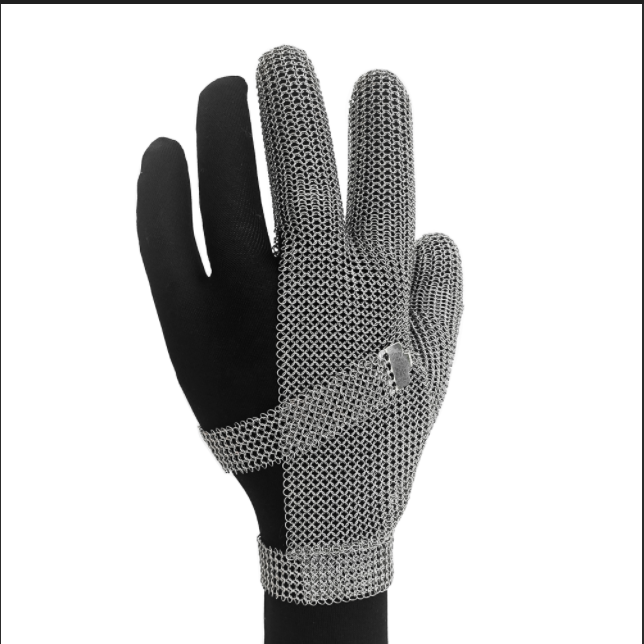
Several measurable factors influence how long a metal mesh glove will provide effective protection. The most significant factor is the frequency and intensity of blade contact. Each time a knife blade contacts the glove surface, it creates a small amount of abrasion on the ring surfaces. Over thousands of contacts, this abrasion reduces the ring cross-section. The rate of abrasion depends on the sharpness of the blade and the force applied during cutting. Sharper blades create less abrasion per contact because they require less force to cut. Conversely, dull blades require more force and create more abrasion per contact.
The type of material being processed also affects service life. Processing hard materials such as bone, frozen meat, or glass causes more rapid ring wear than processing soft materials. The presence of bone in meat processing, for example, increases the stress on the glove because knives deflect off bone surfaces and make incidental contact with the glove more frequently. In glass handling applications, the abrasive nature of glass edges creates wear even without knife contact, as the sharp edges abrade the ring surfaces during normal handling operations.
The frequency of washing and the washing method are also significant factors. Industrial washing of metal mesh gloves is necessary for hygiene compliance but contributes to ring wear through chemical and mechanical action. Detergents, particularly those containing chlorine compounds, can accelerate corrosion of stainless steel. High washing temperatures increase the chemical activity of cleaning agents and can also affect the metal properties over time. Each wash cycle represents a stress event for the glove material.
Worker technique and care during use also affect service life. Workers who allow their gloves to drag across cutting surfaces, who use their gloved hand to brace materials during cutting, or who subject the gloves to excessive force will experience faster wear than workers who use proper cutting techniques. The fit of the glove also matters. A properly fitted glove experiences less stress from slippage and less abrasive contact from the glove shifting during use.
Data from facilities using metal mesh gloves across different industries provides practical service life benchmarks. These benchmarks represent typical service life under average operating conditions and can serve as starting points for facilities planning their replacement schedules.
In poultry and fish processing facilities, where the cutting tools are typically lighter and the cutting forces lower than in red meat processing, metal mesh gloves generally provide 12 to 18 months of service life. The materials being processed are softer and the blade contact frequency is moderate. The primary wear mechanism in these applications is abrasion from repeated knife contact rather than impact damage. Gloves in this environment are typically washed multiple times per week, contributing to wear through chemical exposure.
In red meat boning and butchery operations, where workers use heavier knives and process larger carcasses, the average service life ranges from 8 to 12 months. The increased cutting force, more frequent blade contact with bone, and higher processing speeds all contribute to accelerated wear. The thumb-index finger crotch area typically shows the highest wear concentration because this area experiences the most stress during gripping motions. Facilities processing frozen meat, where the material is harder and requires more cutting force, may see service life at the lower end of this range.
In glass manufacturing and handling facilities, the service life of metal mesh gloves typically ranges from 10 to 14 months. The primary wear mechanism in these applications is abrasion from sharp glass edges rather than knife contact. The wear is more evenly distributed across the glove surface because glass edges contact all areas of the glove during handling operations. The abrasive nature of glass dust and fragments in the environment also contributes to wear, as these particles can become embedded between rings and act as an abrasive slurry during glove movement.
In recycling and waste sorting facilities, where workers handle mixed materials including broken glass, sharp metal objects, and other waste, the service life of metal mesh gloves typically ranges from 6 to 10 months. The unpredictable nature of the material stream and the presence of highly abrasive and sharp materials cause rapid wear. The high chemical variability of the waste stream, which may include acidic materials, corrosive substances, and varying levels of moisture, also affects the glove material and can shorten service life.
In frozen food processing facilities, where temperatures are below freezing, metal mesh gloves can experience longer service life, often ranging from 16 to 22 months. The lower temperature reduces the rate of chemical corrosion and may slow certain wear mechanisms. However, the cold temperature also makes the metal less ductile and more prone to impact damage if the glove is struck against hard surfaces. Facilities in frozen environments must balance the extended service life against the increased risk of ring fracture from impact.
The most reliable method for estimating remaining service life is measuring the reduction in ring wire gauge over time. New metal mesh gloves have a specific wire gauge that determines their cut resistance. As the glove is used, the ring surfaces wear, reducing the wire diameter. This reduction is measurable with standard calipers and provides a quantifiable indicator of remaining service life.
The relationship between wire gauge reduction and remaining service life is roughly proportional. A ten percent reduction in wire diameter reduces the cross-sectional area of the ring by approximately nineteen percent. Since the ring's strength is proportional to its cross-sectional area, a ten percent diameter reduction results in approximately nineteen percent reduction in the force required to break the ring. The cut protection provided by the glove is directly related to the ring's ability to withstand the cutting force.
For practical inspection purposes, a wire gauge reduction of twenty percent from the original thickness indicates that the glove has reached the end of its service life. At this point, the ring strength has been reduced by approximately thirty-six percent from the original value, and the glove no longer provides its rated protection. Measuring ring thickness at three or four locations on each glove during routine inspections provides data for tracking wear and predicting remaining service life.
In addition to wire gauge reduction, ring diameter can also increase over time due to stretching. Stretched rings no longer interlock properly with the surrounding rings, creating gaps in the weave. A ring diameter increase of more than fifteen percent indicates that the ring has been subjected to excessive tensile stress and should be considered worn. This type of stretching is most common in the palm area where the glove is subjected to gripping and pulling forces during material handling.
Visual inspection alone is not sufficient to determine remaining service life. Gloves that appear visually intact may have significant ring wear that reduces their protective properties. Facilities that rely solely on visual inspection for replacement decisions may keep gloves in service beyond their effective protection period. Using calipers to measure wire gauge and ring diameter provides objective data for replacement decisions and supports consistent protection levels.
Corrosion is a significant factor affecting the service life of metal mesh gloves, particularly in environments with moisture, chemicals, or high humidity. Although stainless steel is corrosion-resistant, it is not corrosion-proof. The specific alloy composition affects corrosion resistance, with higher chromium and nickel content providing better resistance. The 316 stainless steel alloy, which contains molybdenum, provides better resistance to chloride corrosion than the standard 304 alloy.
In food processing environments, exposure to salt, acidic foods, and chlorinated sanitizers can accelerate corrosion. Salt creates a corrosive environment that can attack the ring surfaces, particularly at points where the protective oxide layer is damaged by abrasion. Chlorine-based sanitizers are effective for hygiene but can promote pitting corrosion on stainless steel surfaces. The combination of abrasion from blade contact and chemical exposure from sanitizers creates conditions where corrosion is accelerated.
Corrosion manifests as pitting, a rough surface texture, or discoloration of the metal. Pitting corrosion is particularly damaging because it creates stress concentration points on the ring surface. When force is applied to a pitted ring, the stress concentrates at the pit, making the ring more likely to fracture at that point. A ring with pitting may fail at significantly lower force than an unpitted ring of the same wire gauge.
Facilities operating in corrosive environments should consider using gloves made from higher alloy stainless steel for extended service life. The additional cost of these alloys is often justified by the extended service life in corrosive applications. Facilities should also ensure that washing protocols do not contribute to corrosion, using neutral pH detergents whenever possible and rinsing gloves thoroughly after cleaning to remove residual chemicals.
Proper maintenance practices can significantly extend the service life of metal mesh gloves. Facilities that implement systematic maintenance programs often achieve service lives twenty-five to thirty-five percent longer than those that do not. These maintenance practices are based on understanding the wear mechanisms and taking actions that reduce their impact.
Regular cleaning is essential for hygiene but must be performed correctly to avoid accelerating wear. Washing at the lowest effective temperature and using neutral pH detergents reduces chemical attack on the metal. Thorough rinsing removes detergent residues that could continue to act on the metal between wash cycles. Drying gloves completely before storage prevents moisture from promoting corrosion. Facilities that implement these cleaning practices consistently report longer glove service life.
Proper storage between uses is another important maintenance factor. Gloves should be stored in a dry, well-ventilated area, preferably hung by the wrist closure. Storing gloves flat or folded can create stress points in the weave pattern and may lead to ring deformation. Storage in damp environments accelerates corrosion and should be avoided. Facilities that provide dedicated glove storage racks with individual hanging positions maintain better glove condition than those that store gloves in bins or piled together.
Regular inspection and prompt repair of minor damage extends service life by preventing small problems from becoming major failures. A single broken link in an otherwise sound glove can be repaired, restoring the glove to full protection. If the broken link is not repaired, the surrounding rings experience increased stress and are more likely to fail. Over time, a single broken link can lead to multiple failures in the same area. Facilities with regular inspection and repair programs catch damage early and prevent progressive wear.
Rotating glove inventory among workers can also extend service life. When multiple gloves are used in rotation, each glove experiences less wear over a given calendar period. The glove also has time to rest between uses, potentially reducing metal fatigue from cyclic stress. Facilities that use a rotation system with three or four gloves per worker report longer total service life compared to assigning a single glove to each worker for continuous use.
Recognizing the signs that a metal mesh glove is nearing the end of its service life allows facilities to plan replacement purchases and avoid unexpected failures. The first sign is visible ring wear, where the rings appear thinner than new rings, particularly in the palm area. This wear is often visible as a flattening or thinning of the wire surface. When multiple rings show visible wear in the same area, the glove is approaching the end of its service life.
Rings that are loose in the weave pattern indicate that ring stretching has occurred. Loose rings do not interlock properly and can create gaps in the protective structure. This loosening is often accompanied by a rattling sound when the glove is shaken, which is a sign that the rings are no longer tightly engaged. A glove with loose rings should be measured to determine the extent of stretching and whether replacement is necessary.
Corrosion that appears as surface pitting or discoloration on multiple rings indicates chemical attack on the metal. Even if the rings have not lost significant thickness, corrosion creates stress points that can lead to ring failure. Gloves with visible corrosion covering more than ten percent of the ring surfaces are near the end of their service life and should be considered for replacement.
Frequent broken links that require repair indicate that the glove is experiencing metal fatigue or wear. A glove that requires repairs more than once per month is likely approaching the end of its service life, as the surrounding rings are also experiencing fatigue. At a certain point, continuing to repair the glove is not cost-effective, and replacement is the better option.
Changes in glove flexibility can also indicate wear. New metal mesh gloves have a specific flexibility that allows comfortable movement. As the glove wears, the ring surfaces become rougher, and the weave may become stiffer. A glove that feels significantly stiffer than when new may have developed internal corrosion or ring deformation that affects both comfort and protection.
The economic decision of when to replace metal mesh gloves involves balancing the cost of replacement against the cost of potential injury and the cost of maintaining gloves beyond their effective service life. Replacement too early incurs unnecessary expense. Replacement too late risks injury and may result in the glove failing in service, which is more expensive than the replacement cost.
The cost of a hand laceration requiring medical treatment typically exceeds the cost of a metal mesh glove by a substantial margin. Direct costs include medical treatment and any necessary follow-up care. Indirect costs include lost productivity, worker's compensation administration, staffing replacement during the worker's recovery, and potential regulatory penalties. Even a minor laceration that requires only a few stitches may cost more than replacing a worn glove.
Facilities should establish replacement schedules based on both calendar time and inspection results. A calendar-based schedule ensures that gloves are replaced before they reach the end of their protective life, even if they appear intact. Inspection-based replacement catches early damage that would not be addressed by a calendar schedule. The combination of both approaches provides comprehensive coverage.
Typical replacement intervals by industry category provide useful guidance. Poultry and fish processing facilities should plan for replacement at twelve to eighteen months. Red meat processing facilities should plan for replacement at eight to twelve months. Glass handling facilities should plan for replacement at ten to fourteen months. Recycling facilities should plan for replacement at six to ten months. Frozen food processing facilities should plan for replacement at sixteen to twenty-two months. These intervals should be adjusted based on inspection data from each facility, as actual wear rates vary with specific operating conditions.
The service life of metal mesh gloves is determined by a combination of factors including usage intensity, blade sharpness, material being processed, washing frequency and method, and storage conditions. Understanding these factors allows facilities to predict service life more accurately and plan replacement purchases accordingly. Facilities that implement systematic inspection and maintenance programs achieve longer service life and more consistent protection than those that do not.
For facilities seeking to maximize the service life of their metal mesh gloves, the following practices are recommended. Conduct regular inspections that include measurement of wire gauge and ring diameter to objectively track wear. Implement proper cleaning protocols that minimize chemical attack on the metal. Store gloves correctly in dry, ventilated areas. Repair minor damage promptly to prevent progressive wear. Rotate glove inventory to distribute wear across multiple gloves. Replace gloves when inspection data indicates that wire gauge reduction has exceeded twenty percent or when ring diameter has stretched by more than fifteen percent.
Hebei Linchuan Safety Protective Equipment Co., LTD manufactures metal mesh gloves designed for extended service life across multiple industrial applications. Our gloves are constructed from stainless steel rings with welded connections for maximum durability. We recommend that customers work with their safety equipment supplier to establish replacement schedules based on the specific operating conditions in their facility. Regular consultation with the manufacturer regarding expected service life and inspection techniques supports effective glove management and consistent worker protection.