
Author: Site Editor Publish Time: 2026-08-19 Origin: Site


For procurement professionals, safety managers, and business buyers worldwide, China has emerged as the primary sourcing destination for metal mesh gloves. Also known as chainmail gloves or stainless steel mesh gloves, these products are essential personal protective equipment for meat processing, glass handling, metal fabrication, and food service industries. The concentration of manufacturing expertise in specific regions of China, combined with integrated supply chains and competitive pricing, makes Chinese suppliers the preferred choice for global buyers.
Hebei Province, particularly Anping County, has established itself as the global hub for wire mesh and metal-based protective equipment production. With a concentration of wire mesh enterprises and annual output exceeding significant levels in the cluster, the region has developed specialized capabilities in stainless steel ring mesh manufacturing. This concentration of suppliers creates competitive advantages in raw material access, specialized labor, and production efficiency that are difficult to replicate elsewhere.
Hebei Linchuan Safety Protective Equipment Co., LTD is a China-based supplier and manufacturer of metal mesh gloves. The company produces stainless steel chainmail gloves for meat processing, food service, and industrial cutting applications, with products certified to EN 1082-1 and holding FDA and LFGB approvals. This guide examines the landscape of metal mesh glove suppliers in China, product specifications, quality considerations, and selection criteria for buyers.
Hebei Province, particularly Anping County, serves as the epicenter of metal mesh glove manufacturing in China. The region's prominence stems from its long-established wire mesh industry, which has produced industrial mesh products for decades. The transition from industrial wire mesh to personal protective equipment represents a natural evolution of the region's manufacturing capabilities.
Anping County has a significant concentration of wire mesh enterprises, making it the largest concentration of mesh-related manufacturing in China. The county was the first in Hebei Province to achieve revenue exceeding significant levels for its national-level specialized industrial cluster. This scale creates an ecosystem where raw materials, specialized equipment, and skilled labor are readily available, driving efficiency and cost competitiveness. The region's manufacturers have increasingly focused on value-added products such as metal mesh gloves, leveraging their existing infrastructure and expertise to produce safety equipment.
The concentration of suppliers in Hebei Province provides several advantages for buyers. Multiple suppliers in close proximity create competition that drives quality improvement and pricing efficiency. The established supply chains for stainless steel wire, packaging materials, and logistics services reduce lead times and costs. The availability of skilled labor familiar with mesh production ensures consistent quality. These factors contribute to the region's dominance in the global metal mesh glove market.
Other provinces, including Shandong, Jiangsu, and Guangdong, also host metal mesh glove manufacturers. These regions have developed complementary capabilities, with some focusing on specific product types or serving particular export markets. However, Hebei Province remains the primary sourcing destination due to its scale and specialization.
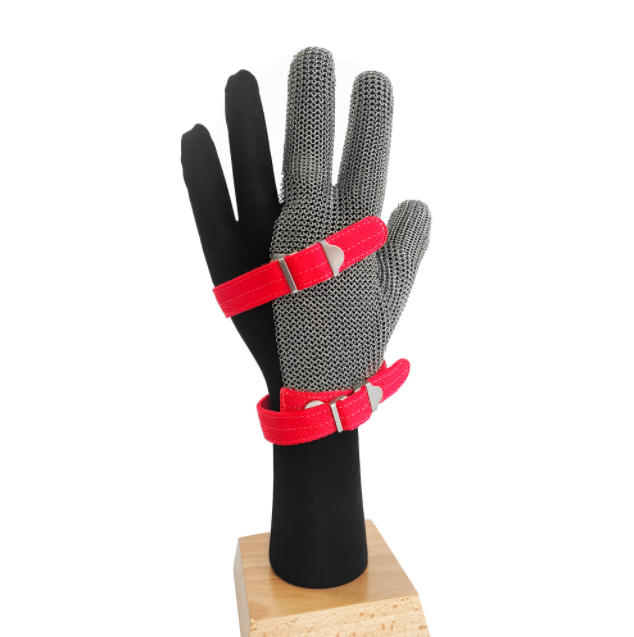
Metal mesh glove suppliers in China offer a range of products with various specifications to meet different application requirements. The primary materials used are stainless steel grades 304 and 316L. Grade 304 provides standard corrosion resistance and strength for general applications. Grade 316L offers superior corrosion resistance, particularly against chlorides and acids, making it suitable for seafood processing and other environments with salt or chemical exposure. Some suppliers also offer titanium metal mesh gloves as a lightweight alternative, though these are less common due to higher material costs.
The quality of ring construction is a critical factor in glove performance. Welded rings are essential for industrial chainmail gloves, as they prevent ring separation under the forces encountered during cutting operations. Micro-welding technology ensures each ring is securely closed, maintaining the glove's protective properties even after repeated impact and cutting forces. Butted rings, which are simply closed without welding, are generally not suitable for industrial applications.
Ring gauge affects both protection level and glove weight. Thicker wire provides higher cut resistance but increases weight. Standard wire diameters range from 0.50 to 0.53 millimeters in some supplier ranges to 0.8 millimeters in heavier-duty products. The 0.53 millimeter wire diameter is the most common standard for meat processing applications, balancing protection with flexibility. Ring diameter typically ranges from 3.8 to 4.2 millimeters, with smaller rings providing a denser weave and greater protection against pointed objects.
Suppliers offer various glove configurations, including five-finger gloves for full-hand protection, three-finger gloves where the thumb, index finger, and middle finger are protected, and long cuff gloves for extended wrist and forearm protection. Each configuration serves different applications, with five-finger gloves being the most common for meat processing and three-finger gloves preferred for tasks requiring maximum dexterity, such as garment cutting.
Customization capabilities vary among suppliers. Many suppliers can customize ring size, wire gauge, glove size, cuff length, and closure type to meet specific buyer requirements. Some suppliers also offer custom packaging, private labeling, and specific certification documentation. The extent of customization capabilities is an important consideration for buyers with unique requirements.
Product certifications are essential for market access. EN 1082-1 certification is the primary standard for chainmail gloves protecting against cuts and stabs from hand knives. This standard applies to protective chain mail gloves and to metal and plastics arm guards for use with hand knives. US FDA certification is required for food contact applications, while LFGB certification is the German food safety standard also recognized internationally. Suppliers holding these certifications can serve markets in Europe, North America, and other regions with regulatory requirements.
Quality control is a critical aspect of metal mesh glove manufacturing that reputable Chinese suppliers prioritize. The production process includes multiple inspection points from raw material verification to final product testing. Incoming material inspection confirms wire diameter and grade, checking for any surface defects that could affect ring integrity. In-process inspection during production includes checking ring diameter, wire tension, and weld integrity at statistically defined intervals to ensure consistent quality throughout the production run.
Final inspection before packaging includes dimensional verification to confirm the glove meets size specifications and visual defect review to identify any broken rings, weak welds, or assembly errors. Some suppliers also perform metal detection on finished gloves to rule out loose ring fragments that could present a hazard. These quality control procedures help ensure that gloves consistently meet certification requirements.
Testing according to recognized standards is essential for product certification. EN 1082-1 testing includes dimensional assessment to verify ring size and wire gauge meet specifications, impact cut testing to evaluate cut resistance using a knife blade mounted on a weight dropped onto the sample, and tensile strength testing on individual rings to verify adequate strength. The EN 388 standard provides ratings for mechanical protection including cut resistance, abrasion resistance, tear resistance, and puncture resistance.
Third-party certification provides independent verification of a supplier's product quality. SGS, TUV, and other recognized testing laboratories can certify that gloves meet EN 1082-1 and other applicable standards. Suppliers who use third-party testing demonstrate a commitment to quality that gives buyers confidence in their products. Buyers should request certification documentation and confirm that the testing laboratory is recognized in the target market.
Shipping and logistics are important considerations when sourcing metal mesh gloves from China. Suppliers typically offer both sea freight and air freight options depending on order urgency. Sea freight is more economical for larger orders but requires longer transit time. Air freight is faster but more expensive. Buyers should consider their delivery requirements and order quantities when selecting shipping methods.
Lead times vary by supplier and order size. Most suppliers maintain some inventory of standard glove sizes and configurations, allowing faster shipment for smaller orders. Custom orders typically require longer lead times for production. Buyers should confirm lead times with suppliers before placing orders and factor them into procurement planning.
Minimum order quantities (MOQs) are a common requirement for factory-direct purchases. Many suppliers require MOQs of 50 or more pairs for standard orders and higher quantities for custom configurations. Some suppliers accept smaller orders for sample evaluation or trial orders. Buyers should confirm MOQ requirements before engaging with a supplier.
Payment terms are typically negotiated between buyer and supplier. Common terms include T/T bank transfer with a deposit before production and balance before shipment, and L/C at sight for larger orders. Buyers should establish clear payment terms that provide protection for both parties and are documented in the purchase agreement.
Import duties and tariffs are the responsibility of the buyer and should be factored into landed cost calculations. Buyers should check the tariff classification for metal mesh gloves in their country and calculate any applicable duties or taxes. Some countries have preferential trade agreements with China that may reduce or eliminate tariffs on certain products.
When selecting a metal mesh glove supplier in China, buyers should evaluate several key criteria. A supplier's quality management systems should be assessed, including ISO certification and the presence of dedicated quality control staff. The supplier should have documented processes for verifying product quality at each stage of production.
Product certification and test reports should be reviewed to verify that gloves meet the required safety standards. The supplier should provide EN 1082-1 certification for chainmail gloves and test reports from certified laboratories. For food processing applications, FDA and LFGB certifications are important. Buyers should request certification documentation and confirm its validity.
Material quality affects both the glove's protective properties and its service life. The grade of stainless steel used is important, with 316L offering better corrosion resistance than 304. The supplier should provide material specifications, including ring diameter and wire gauge. For buyers requiring specific material grades, suppliers should be able to confirm material composition and provide material test reports.
Manufacturing capabilities affect the supplier's ability to meet order requirements and quality standards. Larger manufacturers with automated production lines can typically offer more consistent quality and faster delivery times than smaller operations. The use of automated welding and assembly equipment is an indicator of production quality. Suppliers with vertically integrated operations may offer better quality control and more competitive pricing.
Supplier experience and reputation should be considered. Suppliers with a long history in the industry and established customer relationships are generally more reliable than newer, less established suppliers. Customer references and testimonials can provide evidence of the supplier's reliability and product quality. Online reviews and industry reputation are also useful indicators.
Production capacity affects the supplier's ability to meet order deadlines. Suppliers with sufficient capacity to handle both regular orders and unexpected demand surges are better equipped to maintain consistent supply. The supplier should be able to demonstrate that they have the resources to meet the buyer's order requirements. For large volume buyers, factory visits may be appropriate to assess production capacity.
Communication and responsiveness are important for successful supplier relationships. Suppliers who respond promptly to inquiries, provide clear information, and maintain regular communication are more likely to deliver a positive buying experience. Language barriers should be considered, and suppliers with English-speaking staff or sales representatives are preferred for international buyers.
Hebei Linchuan Safety Protective Equipment Co., LTD is a manufacturer and supplier of metal mesh gloves based in Shijiazhuang, Hebei Province, China. The company specializes in stainless steel chainmail gloves for meat processing, food service, and industrial cutting applications. Products are manufactured with ring specifications of inner diameter 2.75 millimeters, outer diameter 3.81 millimeters, and wire diameter 0.53 millimeters.
The company's chainmail gloves are available in five-finger, three-finger, short cuff, and long cuff configurations to suit different applications. The gloves are ambidextrous, allowing them to be worn on either hand. Color-coded strap identification helps ensure correct sizing, with sizes available from XXS to XL. Strap options include textile straps, plastic straps with press-button buckles, hook straps, and spring straps with self-adjusting tension systems.
Hebei Linchuan's gloves are certified to EN 1082-1 standards for protective clothing against cuts and stabs from hand knives. They also hold US FDA certification for food contact safety and LFGB approval. The company's quality management systems are SGS-certified, and factory audits can be arranged for buyers requiring verification.
The company offers a factory repair program for damaged gloves, extending the service life of products. Each glove is given a unique serial number enabling traceability, individual glove allocation, and record keeping. This program supports the company's commitment to long-term customer relationships and sustainable PPE solutions.
China is the primary sourcing destination for metal mesh gloves, with Hebei Province, particularly Anping County, serving as the global manufacturing hub. The concentration of suppliers in the region creates advantages in raw material access, specialized labor, and production efficiency. Suppliers offer metal mesh gloves in various configurations, with stainless steel grades 304 and 316L, welded ring construction, and EN 1082-1 certification.
When selecting a metal mesh glove supplier in China, buyers should evaluate quality management systems, product certification, material specifications, manufacturing capabilities, experience and reputation, production capacity, and communication. Suppliers holding EN 1082-1, FDA, and LFGB certifications can serve regulated markets in Europe, North America, and other regions. Quality control procedures and third-party testing provide assurance of product consistency.
Hebei Linchuan Safety Protective Equipment Co., LTD is a manufacturer and supplier of metal mesh gloves based in Hebei Province, producing gloves certified to EN 1082-1 standards and holding FDA and LFGB approvals. The company offers five-finger, three-finger, short cuff, and long cuff configurations in sizes from XXS to XL with various strap options, serving meat processing, food service, and industrial cutting applications.