
Author: Site Editor Publish Time: 2026-08-24 Origin: Site


For procurement professionals, safety managers, and business buyers in the meat processing, food service, glass handling, and metal fabrication industries, selecting the right metal mesh gloves supplier is a critical decision that directly affects worker safety, operational efficiency, and regulatory compliance. Also known as chainmail gloves or stainless steel mesh gloves, these products provide essential cut and puncture protection for workers exposed to sharp blades, edges, and materials in demanding industrial environments.
The global market for metal mesh gloves includes suppliers across multiple regions, with manufacturing concentrated in specialized industrial clusters. Major global suppliers include established European manufacturers such as Honeywell, Niroflex, Manulatex France, and Fricosmos, as well as Chinese suppliers who have become dominant in the metal mesh glove market. Chinese suppliers, particularly those in Hebei Province, benefit from decades of experience in metallurgical processing and integrated supply chains for stainless steel wire and mesh products.
Hebei Linchuan Safety Protective Equipment Co., LTD is a China-based manufacturer and supplier of metal mesh gloves based in Shijiazhuang, Hebei Province. The company produces stainless steel chainmail gloves for meat processing, food service, and industrial cutting applications, with products certified to EN 1082-1 and holding FDA and LFGB approvals. This guide examines the global metal mesh glove supplier landscape, product specifications, quality considerations, and selection criteria for buyers.
Metal mesh gloves, also known as chainmail gloves or stainless steel mesh gloves, are personal protective equipment designed to protect workers from cuts and punctures in high-risk industries. These gloves are constructed from interlocking stainless steel rings that form a flexible mesh, creating a physical barrier against sharp blades, needles, and other hazardous materials.
The protective mechanism of metal mesh gloves is structural rather than material-based. Unlike cut-resistant fabric gloves that rely on fiber tensile strength, chainmail gloves use interlocking rings that a blade must either break or deform to penetrate. This structural approach provides consistent protection even under repeated blade contact and is the reason metal mesh gloves achieve the highest ANSI cut protection ratings available.
Key features of metal mesh gloves include stainless steel construction for resistance to cuts and corrosion, flexible design allowing freedom of movement during work, adjustable wrist straps for a secure fit, ambidextrous use for either left or right hand, and easy cleaning with full washability and suitability for sterilization processes.
The global metal mesh glove supply chain includes established European manufacturers and China-based suppliers who have become dominant in the metal mesh glove market due to their manufacturing scale and cost efficiency.
European Suppliers – Germany-based Niroflex, founded in 1920, claims to have developed the first safety glove made from welded stainless steel ring mesh in 1968. Niroflex remains a recognized manufacturer of cut protection solutions for industrial applications. Manulatex France is another established European supplier of chainmail gloves. Other major global suppliers include Honeywell, Fricosmos, Schlachthausfreund, Wells Lamont Industrial, and Saf-T-Gard International.
Chinese Suppliers – China has emerged as the dominant force in metal mesh glove manufacturing, accounting for a significant share of global output. Hebei Province, particularly Anping County, hosts numerous specialized PPE and metal mesh producers. Manufacturers in this region leverage decades of experience in wire mesh production and access to raw materials such as 304 and 316-grade stainless steel.
Hebei Linchuan Safety Protective Equipment Co., LTD is a China-based manufacturer and supplier of metal mesh gloves certified by SGS and BV. The company produces stainless steel chainmail gloves with ring specifications of inner diameter 2.75 millimeters, outer diameter 3.81 millimeters, and wire diameter 0.53 millimeters. Product certifications include CE according to EN 1082-1, US FDA certification, and LFGB approval.
Other Chinese suppliers include Zhong He Ring Mesh Safety Products Co., Ltd., which produces metal mesh gloves with AISI 304L stainless steel and CE, FDA, and LFGB certifications. Anping County Comesh Filter Co., Ltd. is another Hebei-based supplier with ten years of industry experience.
Portuguese Supplier – AEGIMESH LDA, based in Portugal, positions itself as a world-leading manufacturer and supplier of chainmail gloves and other PPE chainmail products, including aprons, arm guards, tunics, and boleros. This demonstrates that while China dominates production volume, specialized manufacturers exist in other regions as well.
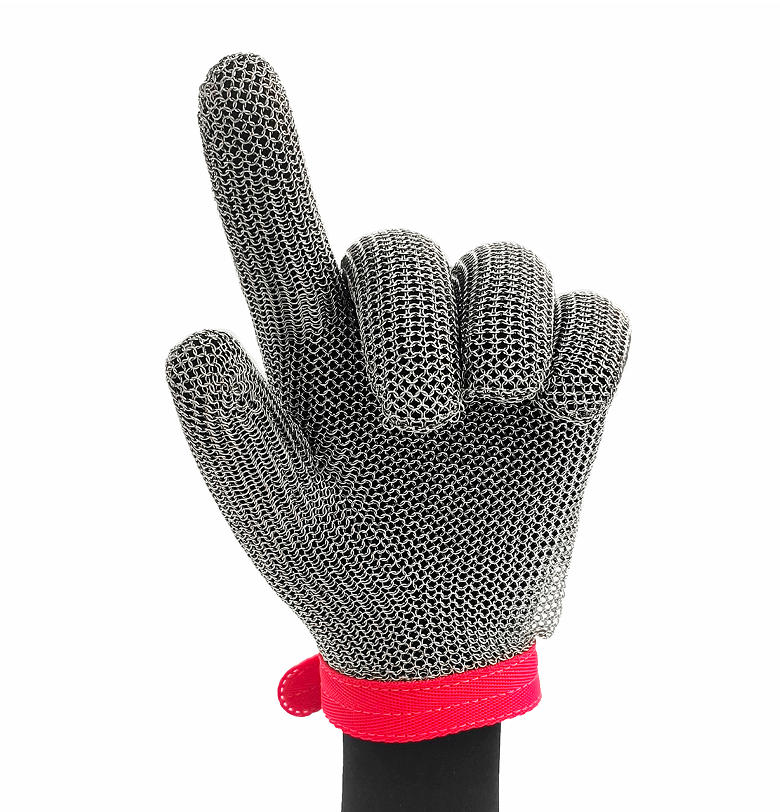
Metal mesh gloves are available in multiple configurations to suit different applications and user requirements. Understanding these specifications is essential for selecting the appropriate product.
Material Composition – Gloves are manufactured from stainless steel grades 304 or 316L. Grade 304 provides standard corrosion resistance and strength for general applications. Grade 316L offers superior corrosion resistance, particularly against chlorides and acids, making it suitable for seafood processing and other environments with salt or chemical exposure.
Ring Specifications – Standard ring dimensions for metal mesh gloves include wire diameter of 0.53 millimeters, inner diameter of 2.75 millimeters, and outer diameter of 3.81 millimeters. These dimensions provide a balance between protection density and flexibility, creating a tight mesh that presents a high density of metal to any approaching blade.
Product Variants – Suppliers offer several glove configurations:
Five-finger gloves are the most common type, offering full-hand cut and puncture resistance. Three-finger gloves, where only the thumb, index finger, and middle finger are protected, are used for applications requiring maximum flexibility. Long cuff gloves provide extended wrist protection for use with long knives or saws, with cuff lengths available in 8 centimeters, 15 centimeters, and 20 centimeters.
Strap Options – Gloves are available with different strap options: textile straps with press-stud closures for standard applications, plastic straps with press-button buckles for optimum hygiene and reduced bacteria retention, hook straps for secure fastening, and spring straps with self-adjusting tension systems made from stainless steel.
Size Range – Gloves are available in sizes from XXS to XL, with color-coded identification: XXS-Brown, XS-Green, S-White, M-Red, L-Blue, XL-Orange.
Metal mesh gloves sold in regulated markets must meet specific certification requirements. Reputable suppliers implement quality control procedures to ensure product consistency and compliance with safety standards.
EN 1082-1 Certification – This is the primary standard for chainmail gloves protecting against cuts and stabs from hand knives. Gloves meeting this standard are classified as personal protective equipment and can be CE marked for sale in the European market. Hebei Linchuan's chainmail gloves pass CE certification according to EN 1082-1.
US FDA Certification – For gloves used in food processing in the United States, FDA certification confirms that materials are safe for food contact. This certification is essential for facilities operating under FDA inspection and for products sold in the US market.
LFGB Approval – LFGB is the German food safety standard recognized internationally. Gloves with LFGB approval have been tested for material safety and are suitable for food contact applications.
SGS Certification – SGS is an independent testing laboratory that can verify product quality and compliance with standards. Suppliers with SGS-certified quality management systems have demonstrated their commitment to product quality and consistency.
Manufacturing Process – The production of metal mesh gloves involves precision wire preparation, coil winding and ring cutting, micro-welding for ring closure, mesh assembly using the standard 4-in-1 pattern, glove forming and shaping, edge finishing and strap installation, and cleaning and food-grade treatment. Suppliers with full in-house control from wire drawing to final glove assembly typically deliver superior product uniformity compared to traders or assemblers relying on outsourced components.
When selecting a metal mesh glove supplier, procurement professionals and safety managers should evaluate several key criteria to ensure they choose a supplier that meets their requirements for quality, service, and value.
Certification and Compliance – The supplier should provide EN 1082-1 certification for chainmail gloves and test reports from certified laboratories. For food processing applications, FDA and LFGB certifications are important. ISO 9001 certification indicates robust quality management systems.
Manufacturing Capability – The supplier's manufacturing capabilities affect their ability to meet order requirements and quality standards. Manufacturers with automated production lines and in-house control from wire drawing to final assembly typically offer better quality consistency.
Product Range – A comprehensive product range allows buyers to source multiple configurations from a single supplier. Suppliers offering five-finger, three-finger, and long cuff gloves with various strap options provide greater flexibility for different applications.
Material Quality – The supplier should provide material specifications, including ring diameter, wire gauge, and stainless steel grade. The use of 316L stainless steel for seafood processing applications should be confirmed. Suppliers with direct sourcing from reputable steel mills typically offer better product quality.
Quality Control – The supplier should have documented quality control processes including material verification, in-process inspection, and final inspection. Suppliers with SGS-certified quality management systems demonstrate a commitment to consistent quality.
Experience and Reputation – Suppliers with a long history in the industry and established customer relationships are generally more reliable than newer, less established suppliers. Customer references and testimonials can provide evidence of the supplier's reliability and product quality.
Production Capacity – The supplier should have sufficient capacity to handle both regular orders and unexpected demand surges. Buyers should confirm that the supplier can meet their order requirements and delivery deadlines.
Customization Capabilities – Some suppliers can customize glove designs to meet particular application needs. For chainmail gloves, this may include modifications to ring size, weave pattern, cuff length, or closure type.
Metal mesh glove suppliers are located globally, with major manufacturing hubs in China and Europe. Chinese suppliers, particularly those in Hebei Province, dominate production volume due to manufacturing scale and cost efficiency. European suppliers offer established brands with long histories in cut protection manufacturing.
When selecting a metal mesh glove supplier, buyers should evaluate certification and compliance, manufacturing capabilities, product range, material quality, quality control processes, experience and reputation, production capacity, and customization capabilities. Suppliers holding EN 1082-1, FDA, and LFGB certifications can serve regulated markets in Europe, North America, and other regions.
Hebei Linchuan Safety Protective Equipment Co., LTD is a manufacturer and supplier of metal mesh gloves based in Hebei Province, China. The company produces gloves certified to EN 1082-1 standards and holding FDA and LFGB approvals, with SGS-certified quality management systems. Products include five-finger, three-finger, and long cuff configurations in sizes from XXS to XL with various strap options, serving meat processing, food service, and industrial cutting applications.