
Author: Site Editor Publish Time: 2026-06-08 Origin: Site


Mesh gloves are a type of hand protection made from interlinked metal rings, commonly used in food processing, meat cutting, and industrial applications where sharp blades are present. Unlike knit cut-resistant gloves, mesh gloves provide a physical barrier that prevents a knife edge from reaching the skin. The construction consists of stainless steel rings woven in a specific pattern, typically the four-to-one weave where each ring passes through four adjacent rings. Mesh glove suppliers serve industries including commercial butcheries, poultry processing plants, fish filleting operations, and recycling facilities. The selection of a reliable mesh glove supplier affects both worker safety and operational efficiency. Hebei Linchuan Safety Protective Equipment Co., LTD operates as a supplier of mesh gloves, offering multiple cuff lengths and ring specifications for different cutting applications.
Mesh gloves are produced in several configurations to match specific tasks. The full-hand mesh glove covers the entire hand including fingers. This type is used for heavy boning and trimming where knife contact with fingers is frequent. The finger coverage can be closed-tip, where the fingertip is fully covered, or open-tip, where the last segment of the finger is exposed for tactile sensitivity. Open-tip gloves are preferred by butchers who need to feel meat texture during trimming. A second type is the mesh glove with wrist cuff, which ends at the wrist and allows full wrist rotation. This type is common in butcher shops and small meat processing rooms. A third type is the mesh glove with elbow cuff, extending from the hand to the elbow. This protects the forearm from cuts that can occur when cutting large pieces of meat on overhead rails. The elbow cuff length is typically 250 mm to 300 mm from the wrist to the cuff edge. A fourth type is the mesh glove with full arm protection, extending to the upper arm or shoulder. These are used in specialized applications such as large animal slaughter or shark processing. Some suppliers also offer mesh gloves with plastic or polycarbonate outer covers to prevent meat or fat from lodging between rings. Hebei Linchuan Safety Protective Equipment Co., LTD produces full-hand mesh gloves in wrist, elbow, and extended cuff lengths.
The metal rings used in mesh gloves are the primary determinant of performance and durability. Stainless steel is the standard material because of its corrosion resistance and strength. Grade 304 stainless steel contains eighteen percent chromium and eight percent nickel. This grade resists rusting from water and mild food acids. Grade 316 stainless steel contains sixteen percent chromium, ten percent nickel, and two percent molybdenum. The molybdenum content improves resistance to chlorides and acidic environments. Grade 316 is specified for fish processing where saltwater or brine is present. Wire diameter is a critical specification. Mesh gloves for light trimming use wire diameters of 0.4 mm to 0.45 mm. These gloves weigh less and provide more flexibility. Mesh gloves for heavy boning use wire diameters of 0.5 mm to 0.6 mm. A 0.6 mm wire glove provides approximately fifty percent higher tensile strength per ring compared to a 0.4 mm wire glove. The ring inside diameter typically ranges from 4 mm to 5 mm. Smaller rings produce a tighter weave with higher cut resistance but reduced flexibility. A 4 mm ring glove has approximately sixty percent more rings per square centimeter than a 5 mm ring glove. The hardness of the stainless steel wire is another factor. Wire hardness measured on the Vickers scale ranges from 150 HV for annealed wire to 400 HV for work-hardened wire. Harder wire resists ring separation under knife impact. Hebei Linchuan Safety Protective Equipment Co., LTD offers mesh gloves in both 304 and 316 stainless steel with wire diameters from 0.4 mm to 0.6 mm.
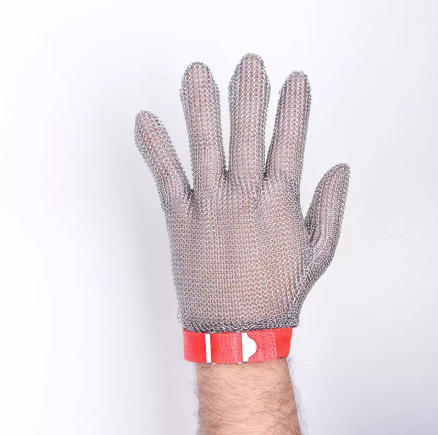
The weave pattern of mesh gloves determines how force distributes across the glove surface. The European four-to-one weave is the most common pattern for butcher mesh gloves. In this pattern, each ring passes through four adjacent rings at right angles. This creates a flexible structure that conforms to the hand while maintaining ring interlocking under tension. The four-to-one weave has a density of approximately sixty to eighty rings per square centimeter for a 4 mm ring size. The Japanese six-to-one weave is an alternative where each ring passes through six adjacent rings. This weave produces a flatter surface with less protrusion but reduced flexibility. The six-to-one weave is sometimes used for mesh aprons rather than gloves. Ring closure type affects structural integrity. Butted rings have the two ends of the wire meeting but not connected. Butted rings are sufficient for most butcher applications because the ring is held in place by adjacent rings. Riveted rings have the wire ends overlapped and joined with a small rivet. Riveted rings are stronger and used in heavy-duty applications such as shark processing or oyster shucking. Welded rings have the wire ends fused together. Welded mesh provides the highest ring pull strength, with individual ring failure occurring at forces above 200 newtons. The manufacturing process for welded rings is more expensive, so these gloves are reserved for specialized high-force applications. Hebei Linchuan Safety Protective Equipment Co., LTD uses four-to-one butted ring construction for standard mesh gloves and can supply riveted or welded rings on request.
Mesh gloves are tested for cut resistance using different methods than knit gloves. The standard EN 388 test with a rotating circular blade is not suitable for metal mesh because the blade can become damaged. Instead, ISO 13999 specifies testing methods for chainmail gloves. The test uses a straight knife blade that moves across the glove surface under a load of five kilograms. The test measures the number of strokes required to cut through the mesh. A standard butcher mesh glove with 0.5 mm wire and 4 mm rings typically withstands more than 10,000 strokes without cut-through. The blade used in the test is replaced after each set of tests to maintain sharpness. Another test method is the blunt knife test, where a dull blade is dragged across the mesh to simulate real-world contact with a dulled knife edge. Dull knives can be more dangerous because they require more force to cut, but mesh gloves resist both sharp and dull blades due to the metal barrier. Some customers request impact testing, where a knife edge is dropped onto the glove surface from a specified height. A typical impact test uses a 300 gram blade dropped from 500 mm height. Mesh gloves prevent blade penetration in this test because the rings distribute the impact force. Hebei Linchuan Safety Protective Equipment Co., LTD can provide test data from ISO 13999 procedures for its mesh glove products.
Mesh gloves used in food processing must meet food contact material regulations. In the United States, FDA 21 CFR 177.1210 governs the use of closures and sealing gaskets, while stainless steel is generally recognized as safe for food contact. The key requirement is that the material does not transfer harmful substances to food. Stainless steel meets this requirement because it is non-porous and does not leach chemicals under normal food processing conditions. In the European Union, Regulation (EC) 1935/2004 requires that food contact materials be manufactured according to good manufacturing practices so that they do not transfer constituents to food in amounts that could endanger health. Stainless steel mesh gloves comply with this regulation when produced from approved steel grades. Many food processing facilities require that mesh gloves be detectable by metal detectors. A complete stainless steel mesh glove is detectable by standard industrial metal detectors. The detection sensitivity for a mesh glove is typically 1.5 mm to 2.0 mm ferrous sphere equivalent. Facilities with metal detection gates set to 1.0 mm sensitivity will detect any mesh glove that passes through. Color coding is not possible with metal mesh alone, but some suppliers add colored plastic strips or cuffs to identify glove sizes or departments. Mesh gloves are also cleanable by automated washing systems. The smooth metal surface does not absorb meat juices or fat, and high-temperature washing at 80 degrees Celsius removes organic residues effectively. Hebei Linchuan Safety Protective Equipment Co., LTD manufactures mesh gloves from FDA-compliant stainless steel and provides documentation for food safety audits.
Proper sizing of mesh gloves is necessary for effective protection and worker comfort. Mesh gloves are sized based on hand circumference measured around the palm at the knuckles. Size 6 fits a palm circumference of 160 mm. Size 7 fits 175 mm. Size 8 fits 190 mm. Size 9 fits 205 mm. Size 10 fits 220 mm. Size 11 fits 235 mm. Size 12 fits 250 mm. Unlike knit gloves, mesh gloves have limited stretch because the metal rings do not expand. Therefore, accurate sizing is more critical. A mesh glove that is one size too large will have loose rings at the fingertips that can catch on bone fragments or hook onto equipment. A glove that is one size too small will restrict blood flow and cause hand fatigue. Many butchers wear a cut-resistant liner glove underneath the mesh glove. The liner provides additional cut protection and absorbs sweat. When a liner is worn, the mesh glove size should be one size larger than the bare hand measurement. For example, a bare hand measuring size 9 would use a size 10 mesh glove when wearing a liner. The cuff closure should be adjustable to secure the glove to the wrist without slipping. A hook-and-loop strap or a metal snap closure are common options. Hebei Linchuan Safety Protective Equipment Co., LTD offers mesh gloves in sizes 6 through 12 with adjustable wrist closures.
Mesh gloves have a longer service life than knit cut-resistant gloves in most cutting applications. A study of glove durability in a meat processing facility with thirty butchers compared mesh gloves to HPPE-based cut-resistant gloves. The mesh gloves had an average service life of eighteen months before showing ring wear or breakage. The HPPE gloves lasted four to six months before developing holes or thinning areas. The higher initial cost of mesh gloves is offset by the longer replacement interval. A pair of mesh gloves costing forty dollars that lasts eighteen months costs 2.22 dollars per month. A pair of HPPE A4 cut gloves costing six dollars that lasts four months costs 1.50 dollars per month. However, the mesh glove can be reconditioned by replacing individual broken rings, which extends service life further. A ring replacement kit costing five dollars can repair ten to twenty broken rings. The HPPE glove cannot be repaired and must be discarded when damaged. In applications involving sharp bones or frequent knife sharpening, the difference in lifespan is larger because bone fragments snag and tear knit fibers more readily than metal rings. In applications with no bone contact and only knife contact, the lifespan difference is smaller. Hebei Linchuan Safety Protective Equipment Co., LTD provides ring repair kits for its mesh gloves to extend product life.
Mesh gloves require regular cleaning to remove meat residues, fat, and microorganisms. An industrial dishwasher with a wash cycle at 60 degrees Celsius and a rinse cycle at 82 degrees Celsius effectively cleans mesh gloves. The high temperature rinse sanitizes the glove surface. Detergents used should be non-chlorinated, as chlorine causes pitting corrosion on stainless steel. A pH-neutral detergent with a pH between 6 and 8 is recommended. After washing, gloves should be dried to prevent water spots and potential rust formation. A centrifugal dryer operating at 1,500 RPM removes water from between rings in approximately three minutes. For manual cleaning, a stiff brush and warm soapy water are sufficient. The glove should be rinsed thoroughly and hung to dry in a well-ventilated area. Mesh gloves should not be stored wet. A study of bacterial counts on mesh gloves before and after cleaning found that a 60-degree wash cycle reduced total plate counts from 100,000 colony-forming units per glove to under 50 CFU per glove. For facilities without industrial washing equipment, mesh gloves can be soaked in a sanitizing solution containing 100 parts per million chlorine for two minutes, followed by rinsing with potable water. Chlorine solutions should be used sparingly to avoid long-term corrosion. Hebei Linchuan Safety Protective Equipment Co., LTD provides cleaning guidelines with each mesh glove shipment.
Implementing a mesh glove program requires calculating initial purchase costs, ongoing maintenance costs, and replacement frequency. The purchase price for a standard wrist-length mesh glove ranges from twenty-five to forty-five US dollars depending on wire diameter and ring size. An elbow-length mesh glove costs thirty-five to sixty US dollars. A full arm mesh glove costs sixty to one hundred US dollars. For a facility with twenty butchers each needing one mesh glove, the initial investment is five hundred to nine hundred dollars for wrist-length gloves. Replacement of broken rings occurs at an average rate of three to five rings per glove per year. A ring repair kit with two hundred rings and pliers costs approximately fifteen dollars. The labor cost for repair is minimal, taking about two minutes per broken ring. Over a five-year period, the total cost for mesh gloves including initial purchase, repairs, and eventual replacement after eighteen months of use is approximately forty to sixty dollars per glove per year. In comparison, using disposable or limited-use cut-resistant gloves in the same application would cost seventy to one hundred dollars per glove per year due to more frequent replacement. Facilities that previously used no cut protection but experienced hand lacerations can compare the cost of mesh gloves to the cost of medical treatment and lost work time. The direct medical cost for a hand laceration requiring sutures averages two thousand dollars. A single prevented laceration covers the cost of mesh gloves for an entire department for one year. Hebei Linchuan Safety Protective Equipment Co., LTD provides volume pricing for commercial customers and can assist with cost projections.
Different industries use mesh gloves for protection against specific hazards. In red meat processing (beef and pork), mesh gloves are used on boning lines where workers separate meat from bone with curved boning knives. The glove must withstand contact with sharp bone edges as well as knife blades. A wire diameter of 0.55 mm or 0.6 mm is typical. In poultry processing, mesh gloves are used for hand deboning of chicken and turkey thighs. The knives used are smaller and sharper, but the bones are softer. A 0.45 mm wire diameter glove provides sufficient protection with less weight. In fish processing, mesh gloves protect hands during filleting of species with sharp spines such as tilapia and catfish. For saltwater species like tuna and salmon, grade 316 stainless steel is used to resist salt corrosion. In recycling facilities, workers use mesh gloves when sorting glass and metal fragments. The hazard in recycling is not knife cuts but sharp edges of broken glass and sheet metal. A mesh glove with 0.5 mm wire and closed fingertips is appropriate. In the seafood processing of oysters and clams, mesh gloves protect against shell cuts and shucking knife slips. The glove requires high puncture resistance because oyster shells can puncture knit gloves. In the catering industry, mesh gloves are used by kitchen staff when operating deli slicers or using chef knives for bulk vegetable preparation. The wrist-length glove is common in this setting. Hebei Linchuan Safety Protective Equipment Co., LTD supplies mesh gloves for each of these industry segments.
Mesh gloves sold as personal protective equipment must comply with regional regulations. In the European Union, Regulation (EU) 2016/425 requires that mesh gloves undergo conformity assessment by a notified body. The glove must carry the CE mark and be accompanied by instructions for use. The technical file must include design drawings, material specifications, test reports, and risk assessment. In the United States, mesh gloves are not subject to pre-market approval by OSHA, but employers are responsible for selecting appropriate hand protection under 29 CFR 1910.138. Many large meat processors require that mesh gloves meet ANSI/ISEA 105 cut resistance standards, even though the standard was developed for knit gloves. Some mesh glove suppliers have obtained ANSI ratings through modified testing procedures. In Canada, mesh gloves used in federally inspected meat plants must comply with the Meat Inspection Regulations and be made of non-absorbent material that can be easily cleaned. Stainless steel mesh meets this requirement. In Australia, mesh gloves must comply with AS/NZS 2161, which references EN 388 for mechanical protection. Suppliers exporting mesh gloves should verify the specific requirements of the destination country. Hebei Linchuan Safety Protective Equipment Co., LTD maintains compliance documentation for mesh gloves sold to customers in North America, Europe, and other regions.
Buyers of mesh gloves should evaluate potential suppliers on several factors. The first factor is product range. A supplier offering multiple wire diameters, ring sizes, and cuff lengths can meet the needs of different applications within the same facility. The second factor is material traceability. The supplier should be able to provide mill certificates for the stainless steel wire used in the gloves. These certificates confirm the steel grade and chemical composition. The third factor is quality control. A supplier with documented inspection procedures for ring closure, weave density, and final glove dimensions is more reliable. The acceptable defect rate for mesh gloves is typically below two percent for cosmetic defects and below zero point five percent for structural defects such as unclosed rings. The fourth factor is lead time. A supplier stocking common sizes and cuff lengths can ship within five to ten business days. Custom sizes or special materials may require twenty to thirty business days. The fifth factor is post-sale support. A supplier that provides repair kits, replacement rings, and repair instructions adds value to the purchase. The sixth factor is price. While price is a consideration, the lowest-priced mesh glove may use lower grade steel or inconsistent ring closure, leading to premature failure. Hebei Linchuan Safety Protective Equipment Co., LTD offers a range of mesh glove products with material traceability, quality control documentation, and repair support.
Users of mesh gloves may encounter certain issues during normal use. Broken rings are the most common issue. A broken ring is identified by a gap in the mesh or a ring that moves independently from adjacent rings. Broken rings should be replaced immediately because a missing ring reduces the integrity of the weave. Replacement is done by opening the adjacent rings, removing the broken ring, inserting a new ring, and closing the adjacent rings using pliers. A second issue is ring stretching. Rings can stretch from repeated tension, becoming elongated. Stretched rings have a larger inside diameter than new rings. Stretched rings should be replaced because they provide less cut resistance. A third issue is corrosion. Red rust spots indicate that the stainless steel has been exposed to chlorides or acidic substances without proper cleaning. Surface rust can be removed with a stainless steel brush and a mild acid such as white vinegar. Deep pitting requires glove replacement. A fourth issue is cuff strap failure. The hook-and-loop or snap closure may wear out before the mesh. Replacement straps are available from many suppliers. A fifth issue is fit change over time. Mesh gloves do not stretch permanently, but the weave may loosen slightly with use. A glove that becomes too loose should be replaced or repaired by tightening the weave. Hebei Linchuan Safety Protective Equipment Co., LTD provides troubleshooting guides and repair parts for its mesh glove products.
Mesh glove suppliers provide essential protective equipment for industries where sharp blades and cutting tools are used. Understanding the specifications of mesh gloves including wire grade, wire diameter, ring size, and weave pattern allows buyers to select the appropriate product for their application. Grade 304 stainless steel suits most meat and poultry processing, while grade 316 is required for fish and saltwater environments. Wire diameters from 0.4 mm to 0.6 mm balance weight and cut resistance. The four-to-one weave is the standard configuration for hand protection. Cut resistance testing under ISO 13999 confirms that mesh gloves withstand thousands of knife strokes. Food safety compliance requires that mesh gloves be made from materials approved for food contact. Proper sizing based on palm circumference ensures effective protection. Mesh gloves have a longer service life than knit cut-resistant gloves in bone-in meat applications, with typical lifespans of eighteen months. Cleaning and sanitization procedures include dishwasher washing at 60 to 82 degrees Celsius and drying in a centrifugal dryer. Industry applications range from red meat processing to fish filleting to recycling facilities. Regulatory compliance varies by region, with CE marking required in the European Union. Selecting a reliable mesh glove supplier involves evaluating product range, material traceability, quality control, lead time, post-sale support, and price. Common issues such as broken rings or corrosion have defined troubleshooting procedures. Hebei Linchuan Safety Protective Equipment Co., LTD supplies mesh gloves with multiple specification options and provides documentation for safety audits and compliance reviews.