
Author: Site Editor Publish Time: 2026-03-26 Origin: Site


The chainmail vest represents one of the oldest forms of protective garment, with origins tracing back to ancient military applications. Today, this product category has expanded to serve diverse markets, including historical reenactment, industrial safety, and fashion accessories. Wholesale chainmail vest procurement requires understanding of material grades, construction techniques, and quality standards that determine product performance and durability. This article examines the technical specifications, manufacturing processes, and market segments for chainmail vests, with attention to the factors that distinguish quality wholesale products. Hebei Linchuan Safety Protective Equipment Co., LTD operates within this industry, providing chainmail products manufactured to meet both traditional and industrial specifications.
Mail armor, properly referred to simply as “mail” rather than “chainmail”—a term introduced by Sir Walter Scott in his 1822 novel “The Fortunes of Nigel”—has been used since at least the 3rd century BC . The earliest known examples were discovered in a Celtic chieftain’s burial in Romania, establishing the technology’s ancient origins . Throughout the Roman Empire and into the medieval period, mail remained a primary form of body defense until the development of fully articulated plate armor. The fundamental construction of mail has remained consistent for over two thousand years: small metal rings linked together in patterns to form a flexible mesh. The most common pattern, known as European 4-in-1 weave, connects each ring with four others, creating a structure that distributes force across multiple points while maintaining flexibility . Contemporary applications of chainmail extend far beyond historical reenactment. Modern uses include: Industrial protective clothing for meat processing and butchery Stab-resistant vests for security personnel Shark-resistant suits for marine researchers Fashion garments and accessories Architectural decorative elements The wholesale chainmail vest market encompasses all these applications, with product specifications varying significantly by intended use.
The material composition of a chainmail vest fundamentally determines its performance characteristics, including corrosion resistance, strength, weight, and durability. Wholesale buyers must specify material grade according to end-use requirements.
Stainless steel has become the dominant material for chainmail vests due to its corrosion resistance and strength-to-weight ratio. Two grades predominate in the industry: Grade 304 Stainless Steel contains approximately 18% chromium and 8% nickel. This alloy provides good corrosion resistance for indoor applications and environments without exposure to salt or harsh chemicals. For historical reenactment costumes, theatrical productions, and fashion applications, grade 304 offers an appropriate balance of performance and cost. Grade 316 Stainless Steel incorporates 2% to 3% molybdenum in addition to chromium and nickel. The molybdenum addition significantly improves resistance to pitting and crevice corrosion, particularly in chloride-rich environments. For industrial applications such as meat processing facilities, where the garment encounters moisture, blood, and cleaning chemicals, grade 316 is the standard specification. In marine environments or coastal installations, grade 316 provides extended service life compared to 304 .
Wire thickness is specified using gauge numbers, with lower numbers indicating thicker wire. Historical mail typically used wire ranging from 14 to 18 gauge, with thicknesses of 1.6 millimeters down to 1.2 millimeters respectively . The choice of gauge affects both protective capability and garment weight: Wire Gauge Thickness (mm) Typical Application 14 gauge 1.63 Heavy-duty industrial, high-impact protection 16 gauge 1.29 General purpose, balance of protection and weight 18 gauge 1.02 Lightweight applications, costumes, fashion A full chainmail vest in 16 gauge stainless steel typically weighs between 6 and 10 kilograms depending on size and coverage area. Industrial applications often specify heavier gauges for increased cut and puncture resistance, while costume applications may use lighter materials for wearer comfort .
Ring diameter affects both the density of the weave and the garment’s resistance to penetration. Smaller rings create a tighter weave that offers better protection against thin blades and sharp points. Common ring diameters in chainmail vests include: 6 mm: Fine weave, higher density, increased protection 8 mm: Standard weave, balanced protection and weight 10 mm: Open weave, reduced weight, suitable for decorative applications For industrial cut protection, smaller ring diameters and tighter weaves provide superior resistance to blade penetration. A study conducted at the Royal Armouries in Leeds concluded that properly constructed mail with appropriate ring specifications provides significant resistance to edged weapons, with the research noting that penetration is “almost impossible using any conventional medieval weapon”.
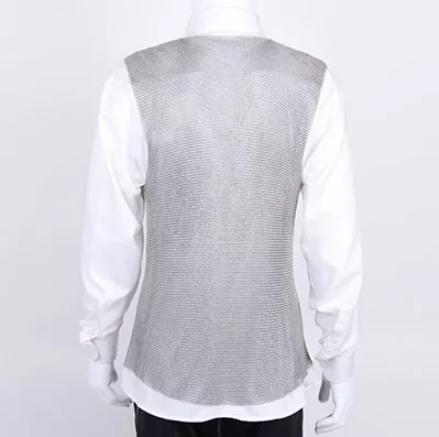
The method used to close individual rings significantly affects the structural integrity and protective capability of a chainmail vest. Three primary construction methods are used in wholesale chainmail manufacturing.
Butted mail is constructed by closing rings with the ends pressed together without welding or riveting. This method is the most common for costume and reenactment applications due to lower production costs. The rings are cut from wire, formed into shape, and the ends are simply butted together. Butted construction provides adequate integrity for decorative use and light reenactment where the garment will not be subjected to combat stress. However, butted rings can open under sustained impact or tension. For SCA heavy combat and full-contact reenactment, butted mail is generally considered insufficient, with recommended maximum wire thickness being 14 gauge for butted construction to provide adequate ring strength .
Riveted mail represents the historical standard for functional armor. Each ring is closed by overlapping the ends and driving a small rivet through the overlap. This creates a permanent closure that maintains integrity under impact and tension. Riveted construction requires significantly more labor than butted construction, increasing production costs by a factor of three to five times. For industrial protective applications and high-quality reenactment armor, riveted construction is the preferred specification due to its superior structural integrity .
Welded chainmail uses rings that are permanently joined through electrical resistance welding or other welding processes. This method creates the strongest possible ring closure, with each ring forming a continuous metal loop. Welded construction is standard for industrial protective applications, including meat processing gloves and vests. The welded ring eliminates any potential failure point at the closure, ensuring consistent protection across the entire garment. For applications requiring compliance with safety standards such as EN 388 (cut resistance), welded construction is typically specified .
Wholesale buyers of chainmail vests should verify product compliance with relevant safety and quality standards. Different end-use applications require certification to specific standards.
For industrial protective chainmail, the EN 388 standard governs cut resistance classification. This European standard tests protective gloves and garments against mechanical risks, including cut, puncture, and abrasion. The standard uses a numerical rating system from 1 to 5 for cut resistance, with Level 5 representing the highest protection . Chainmail vests used in meat processing and butchery typically achieve EN 388 Level 5 cut resistance, indicating the ability to withstand significant blade contact without penetration. Wholesale suppliers should provide documentation of test results for products intended for industrial safety applications.
Stainless steel chainmail vests should be accompanied by material certifications confirming the alloy grade. For food processing applications, grade 316 stainless steel is typically required to ensure corrosion resistance against acidic foods and cleaning chemicals. Certifications should verify the chromium, nickel, and molybdenum content of the material. For welded chainmail products, additional quality controls ensure that each welded ring meets strength specifications. Manufacturers typically perform tensile testing on sample rings to verify weld strength consistency across production batches.
The production of chainmail vests at wholesale scale involves specialized equipment and skilled labor. Understanding the manufacturing process helps buyers evaluate supplier capabilities.
The first stage of manufacturing produces the individual rings that will be assembled into the vest. Wire is wound into coils of the specified diameter, then cut into individual rings. Cutting methods affect ring quality: Saw cutting produces clean ends with minimal burrs but is slower and more expensive Shear cutting is faster but leaves angled ends that may require additional finishing Abrasive cutting using specialized wheels can process larger volumes but may generate heat that affects material properties For welded chainmail, rings are welded individually using resistance welding equipment that creates consistent, strong closures. Automated welding systems can process thousands of rings per hour with consistent quality.
Chainmail vests are assembled using the European 4-in-1 weave pattern as the foundation. In this pattern, each ring passes through four others, creating a flexible mesh that distributes forces across multiple connection points. Skilled craftspeople or specialized machinery link rings according to this pattern. Assembly labor requirements vary significantly by construction method. A hand-assembled riveted mail vest may require 50 to 100 hours of skilled labor, while machine-assembled butted or welded vests can be produced more efficiently. For historical accuracy and high-end reenactment products, hand assembly remains the standard .
Once the mail fabric is assembled, it is cut and shaped into vest form. This process requires careful attention to fit and coverage areas. Chainmail vests are typically constructed with: Full torso coverage extending from shoulders to waist Sleeve variations including short sleeves, half sleeves, or full sleeves Neck openings designed for comfort and protection Adjustable closures using buckles, straps, or laces For industrial protective vests, ergonomic design considerations include weight distribution, range of motion, and compatibility with other protective equipment. A well-designed chainmail vest distributes its weight across the shoulders and torso to minimize fatigue during extended wear .
The wholesale chainmail vest market serves multiple distinct segments, each with specific product requirements.
This segment includes participants in Society for Creative Anachronism (SCA) combat, Living History demonstrations, and Renaissance fairs. Reenactors typically specify riveted stainless steel or mild steel mail that accurately represents historical construction while providing protection for combat activities. Products for this segment require attention to historical accuracy in addition to structural integrity. Custom sizing, period-appropriate patterns, and specific ring specifications are common wholesale requirements. Manufacturers serving this segment often maintain inventory of multiple sizes and configurations to support reenactment groups purchasing for multiple members [citation:11].
The industrial safety segment represents a significant portion of the wholesale chainmail market. Meat processing facilities, butcheries, and commercial kitchens use chainmail vests, aprons, and gloves to protect workers from cutting injuries. Products for this segment require: Welded or riveted construction for maximum durability Grade 316 stainless steel for corrosion resistance Compliance with EN 388 and other applicable safety standards Ergonomic design for extended wear Compatibility with food safety requirements Wholesale buyers in this segment often require consistent product specifications for uniform implementation across facilities. Volume purchasing is common, with large processing plants requiring dozens or hundreds of units.
Chainmail vests designed for security applications offer stab and slash resistance for personnel in correctional facilities, border patrol, and private security. These vests combine chainmail construction with additional protective layers to meet ballistic and stab resistance standards. The security segment typically requires products certified to national standards such as NIJ (National Institute of Justice) levels for stab resistance. Chainmail may be integrated into composite vests that combine metal rings with textile-based ballistic protection .
The fashion segment has embraced chainmail as a distinctive material for garments, accessories, and costume pieces. Fashion chainmail vests range from lightweight butted constructions to custom-designed pieces using colored or anodized rings. Wholesale buyers in this segment prioritize aesthetic qualities including ring finish, pattern variations, and design flexibility. Stainless steel remains the primary material, with some designers specifying aluminum for reduced weight or copper and brass for visual effect. Production quantities vary from small-batch custom orders to larger runs for retail distribution [citation:12].
Selecting a reliable wholesale supplier for chainmail vests requires evaluation of technical capabilities, quality control systems, and production capacity.
Suppliers should demonstrate capability to produce the specific ring type, gauge, and construction method required for the target market. For industrial products, welded ring manufacturing capability is essential. For reenactment products, riveted construction capability distinguishes suppliers serving the high-end segment. Hebei Linchuan Safety Protective Equipment Co., LTD maintains manufacturing capabilities across multiple construction methods, with particular expertise in welded stainless steel products for industrial applications. The company’s production facility includes specialized equipment for ring production, weave assembly, and quality testing .
Wholesale buyers should verify that suppliers maintain documented quality assurance systems. For industrial products, ISO 9001 certification or similar quality management systems provide assurance of consistent production standards. For safety products, test reports from accredited laboratories confirm compliance with applicable standards. Key quality indicators for chainmail vests include: Consistent ring dimensions and gauge Uniform weave pattern without gaps or irregularities Secure ring closures appropriate to construction type Finished garment dimensions matching specifications Surface finish quality without burrs or sharp edges
Wholesale purchasers require consistent product availability and reliable delivery schedules. Suppliers should demonstrate capacity to produce required volumes within specified timelines. For custom products, suppliers should provide clear lead times and communication throughout production.
The chainmail vest wholesale market encompasses diverse applications requiring specific material specifications, construction methods, and quality standards. Understanding the distinctions between butted, riveted, and welded construction, along with appropriate stainless steel grade selection, enables buyers to procure products suited to their end-use requirements. For industrial protective applications, welded stainless steel chainmail vests meeting EN 388 cut resistance standards provide reliable worker protection in meat processing and other high-risk environments. For historical reenactment and medieval combat, riveted construction with appropriate ring specifications offers authentic appearance with structural integrity. For fashion and costume applications, butted chainmail provides visual impact with reduced weight and production cost. Hebei Linchuan Safety Protective Equipment Co., LTD supplies chainmail products across these market segments, with manufacturing capabilities spanning welded, riveted, and butted construction methods. The company’s quality assurance systems and technical expertise support the production of chainmail vests that meet applicable safety standards and customer specifications. As the chainmail market continues to evolve, suppliers who combine traditional craftsmanship with modern manufacturing capabilities remain best positioned to serve wholesale buyers across these diverse applications.