
Author: Site Editor Publish Time: 2026-08-12 Origin: Site


Chainmail short gloves are a specialized category of hand protection designed for tasks where dexterity and cut resistance are prioritized over full wrist coverage. These gloves, also known as short-cuff chainmail gloves, terminate at or just below the wrist, providing greater freedom of movement and compatibility with other personal protective equipment such as sleeves or aprons. Unlike long-cuff variants that extend up the forearm, short gloves provide coverage only for the hand itself, making them suitable for applications where the forearm is not exposed to cutting hazards.
Hebei Linchuan Safety Protective Equipment Co., LTD is a manufacturer of chainmail gloves based in Shijiazhuang, China. The company provides chainmail gloves in five-finger, three-finger, and short styles, with applications in abattoirs, food processing, and the fish and oyster industries. Our products are certified to CE EN1082-1 standards and are available in sizes from XXS through XXL.
This guide examines the technical specifications, sizing standards, applications, and maintenance requirements for chainmail short gloves to help safety managers and procurement professionals make informed purchasing decisions.
Chainmail short gloves are five-finger protective gloves constructed from interlocking stainless steel rings that terminate at the wrist. The primary advantage of this configuration is enhanced wrist mobility. Tasks requiring fine manipulation and frequent wrist articulation benefit from the reduced material mass and unrestricted movement that short gloves provide. The trade-off is the absence of forearm protection, making these gloves suitable for applications where the forearm is not exposed to cutting hazards.
The short cuff design typically ends at or just below the wrist, with cuff lengths around 115 millimeters for standard sizes. This length protects the lower arm without restricting the range of movement, making these gloves particularly suitable for tasks requiring frequent hand and wrist articulation.
Chainmail short gloves differ from long-cuff variants in both coverage and intended application. While long-sleeve gloves can extend up to 20 centimeters up the forearm, short gloves provide coverage only for the hand itself. This configuration is advantageous in environments where full-length gloves may impede movement or cause discomfort over long periods.
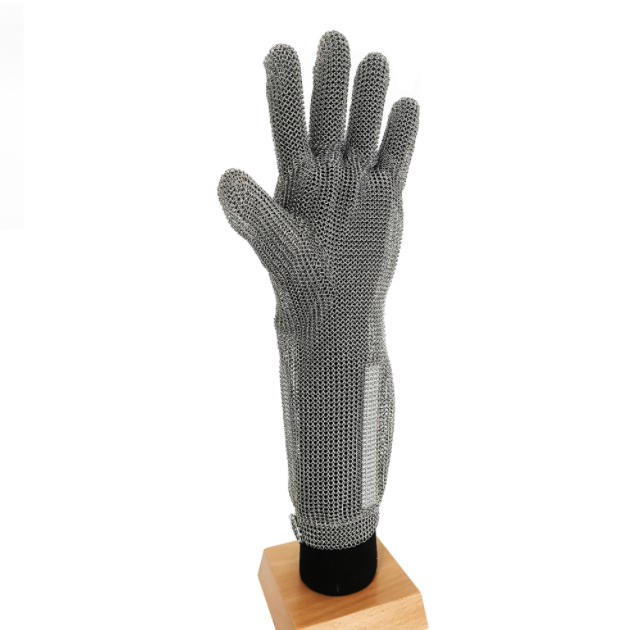
Chainmail short gloves are constructed from stainless steel, with grades such as AISI 304 and AISI 316L commonly used. The 316L grade offers better corrosion resistance than 304, making it particularly suitable for applications where the glove is exposed to salts, acids, or frequent washing. Some models incorporate a polymer coating on the palm area to enhance grip in wet or oily environments.
The quality of ring construction significantly affects the glove's durability and protective properties. Rings that are individually welded for maximum strength provide better durability and resistance to ring separation under stress. Products with welded connections maintain their protective properties even under repeated impact and cutting forces.
Standard chainmail short gloves incorporate specific ring dimensions optimized for hand protection. These gloves are constructed with a wire diameter of 0.53 millimeters. The rings have an inner diameter of 2.75 millimeters and an outer diameter of 3.81 millimeters. These dimensions represent a balance between protection density and flexibility. The relatively small ring inner diameter creates a tight mesh that presents a high density of metal to any approaching blade, reducing the likelihood of a knife point finding a gap between rings.
Glove weight varies by size and material. Stainless steel chainmail short gloves typically weigh between 200 and 315 grams depending on the size. A size medium short glove typically weighs approximately 200 grams, which is distributed across the hand and does not impose significant fatigue during extended wear periods. The weight of different sizes varies due to the additional material required for larger hand dimensions.
Proper sizing is essential for effective protection with chainmail short gloves. A glove that is too large can slip during use, creating gaps in protection. A glove that is too small may be uncomfortable and restrict circulation. Manufacturers provide detailed sizing tables based on palm perimeter and palm length.
A color-coded identification system is commonly used to indicate glove size. The color coding helps workers quickly identify correctly sized gloves and prevents mix-ups in processing environments. Standard size colors include XXS-Brown, XS-Green, S-White, M-Red, L-Blue, XL-Orange, and XXL-Dark Green.
Size is determined by two primary measurements: palm perimeter and palm length. The following size ranges are standard for chainmail short gloves:
XXS - Brown - Palm Perimeter 5-5.5 inches - Palm Length 190-200mm
XS - Green - Palm Perimeter 6-6.5 inches - Palm Length 200mm
S - White - Palm Perimeter 7-7.5 inches - Palm Length 215mm
M - Red - Palm Perimeter 8-8.5 inches - Palm Length 220-230mm
L - Blue - Palm Perimeter 9-9.5 inches - Palm Length 230-240mm
XL - Orange - Palm Perimeter 10-10.5 inches - Palm Length 240-250mm
The strap color system serves multiple practical functions. In processing environments where multiple workers share equipment or where gloves are issued to specific individuals, color coding allows immediate visual verification that the correct size has been selected. This reduces the risk of workers using improperly sized gloves that may compromise protection or comfort.
Users should measure the dominant hand at the widest point of the palm, excluding the thumb. The glove should feel snug but not tight. When the user makes a fist, the rings should not dig into the skin. The short cuff should sit at the wrist crease without gaping.
A defining feature of chainmail short gloves is their ambidextrous configuration. Unlike textile gloves that are molded specifically for right or left hands, chainmail gloves can be worn on either hand by simply turning them inside out. This design offers several operational advantages.
Inventory simplification is a key benefit. Facilities need only stock one glove model rather than separate right and left inventories. This reduces the number of SKUs that must be managed and simplifies ordering and storage processes. Even wear distribution is another advantage. Workers can alternate the glove between hands, distributing wear more evenly and extending service life. Replacement efficiency is improved as a single damaged glove can be replaced without discarding a matched pair.
The reversible design also means that the glove can be rotated to accommodate different workers or different tasks. In food processing environments where multiple workers may use the same glove type, the ambidextrous design simplifies glove allocation and reduces the number of gloves that must be kept in inventory.
Chainmail short gloves are available with different wrist closure types to suit different applications and preferences. The choice of closure affects fit, security, comfort, and hygiene.
Some gloves feature a steel spring wristband that adapts to the wrist shape due to its natural elasticity. This design promotes consistent wear time with no straps or press stud fastenings and may improve hygiene by eliminating fabric components that can harbor bacteria. The spring is made from stainless steel and will stand up to knife and blade damage, unlike a fabric strap.
Other gloves feature textile straps with press-stud closures that provide a secure, adjustable fit. Fully encased textile straps enhance cleanability and reduce bacteria retention. These straps allow the wearer to customize the fit and can be replaced when worn, extending the service life of the glove.
Some manufacturers also offer plastic straps as an alternative to textile, providing a different balance of hygiene and adjustability. The choice between closure types should consider the application requirements, with food processing environments typically favoring closures that minimize bacteria retention.
Chainmail short gloves intended for occupational protection must comply with applicable safety standards. The primary standard governing chainmail gloves is EN 1082-1, which specifies requirements for protective gloves against cuts and stabs from hand knives. This standard addresses design criteria, penetration resistance testing, ergonomic characteristics, and marking requirements. Compliance with EN 1082-1 requires that gloves undergo testing to verify that the mail construction prevents blade penetration under standardized test conditions.
EN 14328 is another relevant standard, addressing gloves protecting against cuts from powered knives. This standard applies to gloves used in applications where powered knives are used, such as slaughterhouses and meat processing facilities. Gloves meeting both EN 1082-1 and EN 14328 certification provide comprehensive protection for the range of cutting hazards present in meat processing environments.
For applications involving food handling, additional certifications are required. The LFGB certification is a German food safety standard that verifies materials are safe for contact with food. Some chainmail gloves are also FDA and CFIA-compliant for safe food handling. These certifications ensure that the glove material will not contaminate food products and can be safely used in food processing environments.
The EN 388 standard provides ratings for mechanical hazards including abrasion, cut, tear, and puncture resistance. Chainmail gloves are tested according to this standard with performance levels reported for each category. The cut resistance test, conducted according to EN ISO 13997, measures the force required to cut through the material and provides a rating on the standard scale.
Chainmail short gloves are used across a range of industries where cut hazards are present but full forearm protection is not required. The primary applications include meat processing, poultry processing, fish and shellfish processing, and food preparation.
In the meat processing industry, chainmail short gloves are used for tasks such as trimming, slicing, and deboning. Workers in slaughterhouses and cutting rooms wear these gloves to protect against knife slips during cutting operations. The short cuff design provides adequate protection for the hand without restricting wrist movement, which is essential for efficient cutting.
In seafood processing, chainmail short gloves protect against cuts from oyster shells, fish spines, and shellfish. Oyster shucking, fish descaling, and shellfish processing all involve sharp objects that can cause hand injuries. The puncture resistance of chainmail gloves is particularly valuable in these applications, as shell fragments and spines can penetrate fabric gloves.
Other applications for chainmail short gloves include cloth cutting in garment manufacturing, and wood, glass, plastic, and leather processing. The versatility of chainmail gloves makes them suitable for any environment where workers face cut hazards from sharp tools or materials.
Some chainmail short gloves are also used in security and public safety applications. The cut resistance of the gloves provides protection against edged weapons and sharp objects encountered in security operations.
Chainmail short gloves used in food processing must comply with food safety regulations. The metal construction provides a hygienic surface that can be thoroughly sanitized. The gloves are easily cleaned with hot water and soap and can be washed in industrial washing machines.
Recommended cleaning protocols include scrubbing at least once a day with hot soapy water at 50 degrees Celsius, rinsing at a minimum of 82 degrees Celsius, and disinfection with an approved product. The stainless steel mesh is resistant to processing fats and oils and cleans up simply with hot water and soap.
Gloves designed without straps or fabric components are particularly hygienic because they eliminate places where bacteria can accumulate. One hundred percent stainless steel construction guarantees a hypoallergenic glove with no contamination risk from a fastening strap. Each glove may be given a unique serial number enabling traceability, individual glove allocation, and record keeping.
For food processing environments, the ability to clean and sanitize gloves effectively is essential for maintaining hygiene standards and preventing cross-contamination. The stainless steel mesh is resistant to processing fats and oils and cleans up simply with hot water and soap.
One advantage of chainmail short gloves compared to textile alternatives is their repairability. When a ring breaks, it can be replaced, extending the service life of the glove. This repair capability significantly reduces the total cost of ownership over time, as the glove does not need to be replaced when minor damage occurs.
Factory repair programs are available from some manufacturers, providing professional repair services using original replacement rings and proper welding equipment. The repair restores the glove to its original condition and maintains compliance with safety standards. This service is particularly valuable for heavy-use applications where gloves experience occasional damage from blade contact.
For gloves used in food processing, regular cleaning and maintenance are essential for hygiene compliance. Cleaning protocols should be followed consistently to maintain both hygiene and the glove's protective properties. Proper storage in a dry, well-ventilated area after cleaning helps prevent corrosion and extends service life.
Chainmail short gloves should be compared with other available options to determine the most appropriate protection for each application. Textile cut-resistant gloves made from high-performance fibers such as high-density polyethylene or aramid are significantly lighter and offer better dexterity. However, they have a shorter service life in demanding applications and cannot be repaired. For tasks with lower cut hazards or where maximum dexterity is required, textile gloves may be the preferred option.
Long-cuff chainmail gloves provide additional protection for the forearm but reduce wrist mobility. For tasks where the forearm is exposed to cutting hazards, long-cuff gloves are recommended. For tasks where only hand protection is required, short gloves offer better flexibility.
Leather work gloves provide minimal cut protection and should not be relied upon for tasks involving sharp blades. While leather gloves may be suitable for general handling, they are not adequate for meat processing or other applications where blade contact is frequent.
When selecting between glove types, the assessment should consider the frequency and severity of cut hazards, the required dexterity, the duration of use, and the cleaning and maintenance requirements.
Chainmail short gloves provide cut protection with enhanced wrist mobility, making them suitable for tasks where hand protection is required but forearm coverage is unnecessary. The gloves are constructed from stainless steel with welded rings, available in sizes from XXS through XXL, and are certified to EN 1082-1 standards.
When selecting chainmail short gloves, safety managers should verify the material grade, ring gauge, and closure type. Stainless steel 316L is recommended for applications with salt exposure or frequent cleaning. The ambidextrous design simplifies inventory management. Color-coded sizing systems help ensure correct fit.
Proper maintenance extends the service life of chainmail short gloves. Regular cleaning, prompt repair of damaged rings, and proper storage contribute to the longevity of the gloves. Factory repair programs are recommended for maintaining compliance with safety standards.
Hebei Linchuan Safety Protective Equipment Co., LTD manufactures stainless steel chainmail short gloves for industrial and food processing applications. Our gloves meet EN 1082-1 certification requirements and are available in a range of sizes and closure types. We provide technical support and certification documentation for all products, helping customers select the appropriate protection for their specific applications.