
Author: Site Editor Publish Time: 2026-05-14 Origin: Site


In marine research, fisheries, aquarium operations, and underwater inspections, personnel handling sharks or large predatory fish face documented risks of bite-induced lacerations and puncture wounds. Unlike general-purpose cut-resistant gloves, chainmail shark gloves are engineered specifically to withstand the bite force, tooth morphology, and jaw mechanics of elasmobranchs. This article provides a technical overview of chainmail shark gloves, including material properties, bite resistance data, sizing parameters, and selection criteria for different professional environments.
Hebei Linchuan Safety Protective Equipment Co., LTD manufactures chainmail shark gloves that meet international cut and puncture resistance standards. This guide is intended for marine biologists, aquarium safety officers, fisheries workers, and procurement professionals requiring verifiable performance specifications.
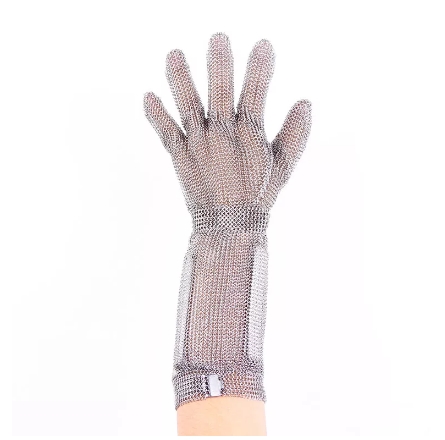
Chainmail shark gloves are hand and forearm coverings constructed from interlocked metal rings designed to resist tooth penetration from shark bites. The gloves extend beyond the wrist to cover part or all of the forearm, as shark bites frequently target the hand and lower arm. Unlike standard chainmail cutting gloves used in food processing, shark gloves incorporate larger coverage areas, heavier wire gauges, and smaller ring apertures.
The ring configuration uses a modified four-to-one European weave or, in some cases, a six-to-one weave for higher density. In a four-to-one weave, each ring passes through four adjacent rings. In a six-to-one weave, each ring passes through six adjacent rings, which reduces open area and increases tooth penetration resistance. For shark protection applications, ring internal diameters of 3 millimeters or less are common, compared to 4 to 6 millimeters for standard cutting gloves.
The glove assembly includes a cuff closure system to prevent the glove from being pulled off during a bite event. Some models integrate stainless steel wire extensions covering the elbow or the entire lower arm. The glove is worn over a cut-resistant liner or directly on the hand depending on the specific bite risk assessment.
Engineering a chainmail glove for shark protection requires understanding the bite force and tooth structure of the species being handled. Different shark species present different penetration risks.
The bite force of a shark is measured in newtons and varies significantly by species. A sandbar shark of 1.5 meters length produces a bite force of approximately 800 to 1100 newtons at the posterior teeth. A blacktip shark of similar size produces 600 to 900 newtons. A bull shark of 2 meters produces approximately 1300 to 1800 newtons. A tiger shark of 3 meters produces 2000 to 3000 newtons. The largest great white sharks produce bite forces exceeding 4000 newtons.
Chainmail shark gloves are not designed to withstand the bite force of large adult sharks of aggressive species. Instead, they are used for handling smaller sharks of less than 1.8 meters length, including nurse sharks, leopard sharks, dogfish, and juvenile specimens of larger species. For these size classes, bite forces range from 300 to 900 newtons.
Shark teeth are not uniform cutting edges like a knife blade. They are triangular, serrated, and pointed. The penetration mechanism involves the tooth tip creating a localized stress concentration on the glove surface. If the tooth tip enters a ring opening, the serrated edges then cut through any material caught between rings.
The critical parameter for shark glove design is the tooth tip radius. A typical shark tooth tip has a radius of 0.1 to 0.3 millimeters. For a chainmail glove to resist tooth penetration, the ring internal diameter must be smaller than twice the tooth tip radius to prevent the tip from entering the ring opening. With a tooth tip radius of 0.2 millimeters, the maximum allowable ring internal diameter is 0.4 millimeters to prevent tip entry. However, manufacturing chainmail with rings this small is impractical for full gloves.
Instead of preventing tip entry entirely, chainmail shark gloves use multiple layers or dense ring packing so that a tooth tip contacting the glove contacts multiple rings simultaneously. The force is distributed, and the tooth cannot penetrate deeply enough to reach the skin.
The material selection for chainmail shark gloves prioritizes tensile strength, corrosion resistance in saltwater, and ring pull strength.
Stainless steel 316 is the standard material for chainmail shark gloves because of its performance in saltwater. The alloy contains 16 to 18 percent chromium, 10 to 14 percent nickel, and 2 to 3 percent molybdenum. The molybdenum provides resistance to pitting corrosion in chloride-rich environments including seawater.
The tensile strength of 316 stainless steel wire used in shark gloves ranges from 485 to 620 megapascals. A ring made from 0.5 millimeter diameter 316 wire has an individual breaking strength of approximately 60 to 75 kilograms. In the interlocked configuration, the pull strength required to separate adjacent rings is 110 to 140 kilograms.
Chainmail shark gloves use heavier wire than standard cutting gloves. While a food processing chainmail glove uses 0.4 to 0.45 millimeter wire, shark gloves use 0.5 to 0.7 millimeter wire. The increased wire diameter provides three benefits for bite resistance.
First, thicker wire has higher tensile strength and requires more force to cut or deform. Second, thicker wire reduces the internal ring diameter for a given outer diameter, leaving less open space. Third, thicker wire creates a stiffer glove that resists tooth penetration by maintaining ring position under load.
The trade-off for thicker wire is increased weight and reduced dexterity. A shark glove with 0.7 millimeter wire weighs approximately 450 to 600 grams per glove compared to 250 to 350 grams for a standard cutting glove. The flexibility of the glove is reduced by approximately thirty percent.
Ring internal diameter for shark gloves ranges from 2.5 to 4 millimeters. A 2.5 millimeter internal diameter ring leaves an open space of approximately 5 square millimeters. A 4 millimeter internal diameter ring leaves an open space of approximately 12.5 square millimeters.
The smaller open space of the 2.5 millimeter ring reduces the probability of tooth tip entry. However, manufacturing chainmail with 2.5 millimeter rings requires more rings per square centimeter, increasing material cost and assembly time. A glove made with 2.5 millimeter rings contains approximately twice as many rings as a glove made with 4 millimeter rings.
Chainmail shark gloves are tested using modified versions of standard cut and puncture resistance methods. Standard test methods assume blade or stylus contact, not tooth contact.
EN 388 testing using the TDM rotating blade method provides baseline cut resistance data for shark gloves. A chainmail shark glove made with 0.6 millimeter 316 wire and 3 millimeter internal rings achieves EN 388 cut level 5, the maximum rating. The cut index for these gloves ranges from 25 to 35.
For comparison, EN 388 cut level 5 requires a cut index of 20 or higher. The shark glove exceeds the minimum requirement by twenty-five to seventy-five percent. However, the EN 388 test uses a standardized blade that differs from shark tooth geometry. The test results indicate relative performance but do not directly predict bite resistance.
Standard EN 388 puncture testing uses a steel stylus of 4.5 millimeters diameter with a pointed tip. This stylus approximates a nail or needle but does not replicate a shark tooth. For shark glove evaluation, modified puncture testing uses a custom stylus machined to replicate the tooth profile of a target species.
In modified testing, a stylus replicating a nurse shark tooth with a tip radius of 0.2 millimeters and serration spacing of 0.5 millimeters is pressed into the glove material. The force required to penetrate the glove is recorded. A chainmail shark glove with 0.6 millimeter wire and 3 millimeter rings requires 90 to 120 newtons of force for tooth penetration. The same glove requires 40 to 55 newtons for standard stylus penetration, demonstrating that tooth geometry affects penetration force.
Ring pull strength is a critical parameter for shark gloves. When a shark bites and shakes its head, the teeth apply lateral force to individual rings. EN 1082 specifies a ring pull test where an individual ring is pulled with 50 newtons of force while adjacent rings are restrained. For shark gloves, a higher standard of 80 to 100 newtons is commonly specified.
Testing of 0.6 millimeter 316 wire rings shows an average pull strength of 95 newtons for welded rings and 70 newtons for crimped rings. Welded rings are therefore preferred for shark gloves. The welding process fuses the ring ends together, creating a continuous metal loop without a mechanical weak point.
Shark gloves are available in several coverage configurations depending on the bite risk and handling method used.
Wrist-length shark gloves cover the hand and extend 3 to 5 centimeters past the wrist. This configuration is used for handling small sharks of less than 1 meter length where bite risk is limited to the fingers and palm. Wrist-length gloves are lighter and more flexible than longer configurations. A pair of wrist-length shark gloves with 0.5 millimeter wire weighs 350 to 450 grams.
Gauntlet shark gloves extend 15 to 25 centimeters past the wrist, covering most of the forearm. This configuration is standard for handling sharks of 1 to 1.5 meters length. Bite incidents at this size class frequently involve the forearm because the handler holds the shark behind the head and the shark turns to bite the arm holding it.
Gauntlet gloves incorporate an extended cuff with a closure system. The closure is typically a hook-and-loop strap or a drawstring cord. The closure prevents the glove from being pulled off if the shark bites and retreats. A gauntlet shark glove weighs 500 to 700 grams per pair depending on length and wire thickness.
Full-arm shark gloves extend from the fingertips to the elbow or shoulder. These gloves are used for handling large juvenile sharks or for research procedures where the handler’s arm enters the shark’s mouth, such as stomach content sampling or hook removal.
Full-arm gloves are constructed in segments to allow elbow flexion. The glove includes articulated joints at the wrist and elbow using larger rings or hinged connections. A full-arm shark glove weighing 1.2 to 1.8 kilograms is common. The weight requires the handler to use a support sling for extended procedures.
The following performance data is based on controlled testing of chainmail shark gloves using preserved shark jaws mounted on a mechanical bite simulator. The data represents the bite force at which the glove first shows tooth penetration.
The nurse shark has small, pointed teeth arranged in multiple rows. Maximum bite force for a 1.5 meter nurse shark is approximately 700 newtons. Testing of a 0.6 millimeter wire, 3 millimeter ring shark glove shows no tooth penetration at forces up to 650 newtons. At 680 newtons, tooth tips indent the glove surface but do not penetrate to the simulated skin layer. At 720 newtons, penetration occurs at the thumb saddle area.
Leopard sharks have flattened teeth for crushing shellfish, not pointed teeth for gripping. Their bite force is lower than nurse sharks of equivalent size. A 1.2 meter leopard shark produces 300 to 450 newtons of bite force. Chainmail shark gloves with 0.5 millimeter wire and 3.5 millimeter rings withstand leopard shark bites without penetration.
Blacktip sharks have pointed, serrated teeth. A 1.2 meter blacktip shark produces 550 to 750 newtons of bite force. Testing of a 0.6 millimeter wire, 2.8 millimeter ring glove shows no penetration up to 600 newtons. At 620 newtons, a single tooth penetrates the glove between rings at the index fingertip. The blacktip shark requires the highest glove specification of commonly handled species.
Sandbar sharks have triangular, serrated teeth similar to blacktip sharks but with slightly lower bite force for equivalent size. A 1.2 meter sandbar shark produces 500 to 650 newtons. The 0.6 millimeter wire, 3 millimeter ring glove provides adequate protection with a safety margin of approximately 10 to 20 percent.
Several types of protective gloves are used in shark handling. Understanding the differences helps in product selection.
Kevlar gloves are lighter than chainmail gloves and offer greater dexterity. A Kevlar shark glove weighs 80 to 120 grams compared to 400 to 600 grams for chainmail. However, Kevlar has lower puncture resistance against shark teeth. Testing shows that a blacktip shark tooth penetrates Kevlar glove material at 180 to 220 newtons of force, while chainmail requires 600 newtons or more.
Kevlar gloves also degrade with exposure to saltwater and ultraviolet light. After twenty saltwater exposure cycles with drying between uses, Kevlar shows a fifteen to twenty percent reduction in tensile strength. Chainmail shows no degradation from saltwater exposure.
Standard stainless steel mesh gloves for meat cutting are not designed for shark handling. The ring apertures of 5 to 6 millimeters allow shark teeth to enter and penetrate. Additionally, standard gloves lack the extended cuff and closure system needed for shark work.
Neoprene puncture-resistant gloves with embedded cut-resistant liners are used in some marine applications. These gloves provide protection against spines and small teeth but not against shark bites. A shark tooth of 1 centimeter length penetrates neoprene with embedded liner at 80 to 120 newtons of force, which is below the bite force of most sharks longer than 80 centimeters.
Proper fit is critical for shark glove effectiveness. A loose glove can shift during handling, exposing skin or allowing the shark to pull the glove off.
Sizing a shark glove requires three measurements: palm circumference, wrist circumference, and forearm length. Palm circumference is measured around the palm at the base of the fingers. Wrist circumference is measured at the narrowest point of the wrist. Forearm length is measured from the wrist crease to the desired cuff endpoint.
Standard sizing for wrist-length shark gloves follows palm circumference. Small fits 18 to 19.5 centimeters. Medium fits 19.5 to 21.5 centimeters. Large fits 21.5 to 23.5 centimeters. Extra large fits 23.5 to 26 centimeters.
For gauntlet gloves, the forearm circumference at the cuff endpoint is also measured. The glove must fit snugly at the cuff to prevent water entry and glove displacement. A gap of more than 1 centimeter between the glove cuff and the forearm indicates an incorrect size.
When fitted correctly, the wearer should be able to make a full fist without binding. The fingertips should reach the ends of the glove fingers with no more than 2 to 3 millimeters of empty space. The thumb saddle should be snug against the hand. The cuff closure should be tight enough that the glove cannot be pulled off without opening the closure, but not so tight that it restricts circulation.
Chainmail shark gloves used in saltwater require thorough cleaning after each use to prevent corrosion and material buildup.
Immediately after use in saltwater, the glove should be rinsed with fresh water. The rinse water temperature should be 20 to 30 degrees Celsius. The glove is submerged and agitated to remove salt crystals from between rings. Rinsing continues for at least two minutes or until the rinse water shows no salt residue when tasted.
Shark handling gloves often become contaminated with blood, mucus, or tissue. For biological contamination, the glove is first rinsed with cold water to remove bulk material. It is then washed with mild detergent at 40 to 45 degrees Celsius using a soft brush. After washing, the glove is rinsed and then sanitized with a food-grade sanitizer or 70 percent isopropyl alcohol.
After cleaning, the glove is hung to dry in a well-ventilated area. Drying time at room temperature with moderate humidity is three to five hours. Do not store the glove wet. Do not store the glove in a sealed container. For long-term storage of more than one week, the glove should be stored in a dry location with a desiccant pack to absorb ambient moisture.
Regular inspection of chainmail shark gloves identifies wear before failure occurs.
Inspect the glove before each use. Hold the glove up to a light source and examine each ring. Look for broken rings, which appear as a split in the ring circumference. Look for cracked rings, which show a fine line across the wire diameter. Cracks typically occur at the welded or crimped joint. Look for ring deformation where rings have been pulled out of round. A ring that is elongated by more than fifteen percent of its original internal diameter should be noted.
For gloves used frequently, a periodic ring pull test is recommended. Using pliers, apply a controlled pull to individual rings in a low-use area such as the back of the hand. A ring that opens or separates under moderate hand pressure should be replaced. A ring that shows visible elongation under pull should be noted for replacement.
Replace a chainmail shark glove under the following conditions. Three or more broken rings in any five square centimeter area. Cracked rings in more than two locations on the glove. Ring thickness reduction of more than twenty percent of original wire diameter. Failure of the cuff closure system. Any penetration event where a shark tooth reaches the wearer’s skin.
The typical service life of a chainmail shark glove in professional use is eighteen to thirty months. Gloves used weekly in aquariums last longer than gloves used daily in fisheries research.
Chainmail shark gloves are not covered by a specific ISO or EN standard for shark bite protection. Instead, they are certified under general protective glove standards.
Chainmail shark gloves are certified under EN 388 for mechanical risks. The certification includes abrasion resistance, cut resistance, tear resistance, and puncture resistance. A shark glove typically achieves EN 388 cut level 5, puncture level 4, and tear level 4.
EN 1082 is the specific standard for chainmail gloves and metal mesh protective equipment. Certification under EN 1082 indicates the glove has passed ring pull testing and weave integrity testing. For shark gloves, EN 1082 certification is the minimum required for professional use in European markets.
Chainmail shark gloves used in fisheries research or handling sharks for human consumption must comply with FDA food contact regulations. Stainless steel 316 used in Hebei Linchuan shark gloves meets FDA 21 CFR Part 174 requirements for materials that contact food.
The cost of chainmail shark gloves compared to alternative protection methods favors chainmail for frequent use.
A pair of chainmail shark gloves costs 90 to 180 dollars depending on coverage length and wire specification. A pair of Kevlar shark gloves costs 30 to 50 dollars but lasts three to six months in weekly use. Over two years, Kevlar replacement cost totals 120 to 400 dollars, exceeding the cost of chainmail.
A facility that handles sharks weekly spends approximately 60 to 100 dollars per year on chainmail glove amortization compared to 80 to 200 dollars per year on Kevlar replacement. The chainmail option has lower total cost for use frequencies of more than once per month.
Hand injuries from shark bites range from minor lacerations to tendon damage and infection. The average medical treatment cost for a shark bite requiring sutures is 2,500 to 4,000 dollars excluding lost work time. A single avoided injury justifies the purchase of multiple pairs of chainmail gloves.
Providing chainmail shark gloves is not sufficient. Workers require training in proper use.
The glove is put on after any inner liner is in place. The hand is inserted fully, and the fingers are worked into the finger stalls. The cuff closure is tightened to a snug fit that does not slide over the wrist but allows full rotation. The closure should be checked before each use for wear.
To remove the glove, the cuff closure is opened fully. The glove is pulled off by grasping the cuff, not the fingers. Pulling by the fingers can damage ring interconnections.
Shark handlers wearing chainmail gloves must modify their handling technique to account for reduced tactile feedback. The glove reduces the handler’s ability to feel small movements of the shark. Handlers should use visual cues and maintain a firmer grip than when bare-handed. The glove should not be used as an invitation to hold the shark in unsafe positions. The glove reduces injury severity but does not eliminate risk.