
Author: Site Editor Publish Time: 2026-03-26 Origin: Site


Chainmail mesh curtains represent a specialized category within architectural metalwork, combining the structural integrity of interlocking metal rings with the fluid drape characteristics of textile curtains. These products have gained significant traction in commercial and residential design as architects and interior designers seek materials that offer both aesthetic appeal and functional performance. Understanding the manufacturing landscape for chainmail mesh curtains requires examination of material specifications, production methods, quality standards, and the technical capabilities that distinguish manufacturers in this field. This article provides a comprehensive analysis of chainmail mesh curtain manufacturing, covering material options, ring specifications, construction methods, and the factors that buyers should evaluate when selecting manufacturing partners. Hebei Linchuan Safety Protective Equipment Co., LTD operates within this manufacturing sector, producing chainmail mesh curtains for architectural and decorative applications.
Chainmail mesh curtains, also known as ring mesh curtains or metal mesh drapery, consist of thousands of individual metal rings linked together to form a flexible, continuous mesh sheet . This construction creates a material that combines the durability of metal with the drape and movement characteristics of fabric, enabling applications that require both structural integrity and aesthetic fluidity. The product category encompasses several configurations. Flat ring types form uniform mesh sheets with consistent ring orientation. Circle-type ring curtains use rounded ring profiles that create distinct visual patterns. Combination designs incorporate rings of varying sizes or materials to achieve specific aesthetic effects . Applications for chainmail mesh curtains span multiple sectors. In commercial architecture, these products serve as room dividers, facade treatments, and feature wall installations for hotels, restaurants, office buildings, and retail spaces . In residential settings, they function as window treatments, fireplace screens, and decorative partitions . Specialized applications include security barriers, exhibition design elements, and staircase wall treatments . The material’s unique combination of properties explains its growing adoption. Chainmail mesh curtains offer fire resistance with melting points substantially higher than textile curtains, stability without shrinkage or stretching, mildew resistance in humid conditions, and UV resistance that maintains appearance under direct sunlight . These characteristics address limitations of traditional fabric curtains in demanding environments.
The choice of metal alloy for chainmail mesh curtains significantly affects corrosion resistance, appearance, weight, cost, and service life. Manufacturers typically offer multiple material options to accommodate different application requirements.
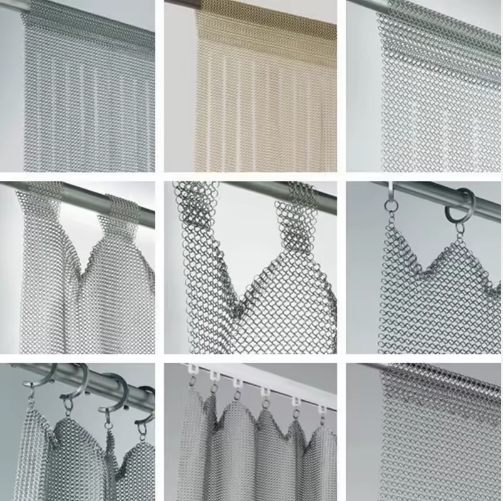
Stainless steel represents the most commonly specified material for chainmail mesh curtains due to its balance of corrosion resistance, strength, and cost-effectiveness . Within stainless steel, two grades predominate. Grade 304 stainless steel contains approximately 18% chromium and 8% nickel. This alloy provides good corrosion resistance for indoor applications and environments without exposure to salt or aggressive chemicals. For standard commercial and residential interior installations, grade 304 offers appropriate performance at a moderate cost point . Grade 316 stainless steel incorporates molybdenum in addition to chromium and nickel. This composition enhances resistance to pitting and crevice corrosion, particularly in chloride-rich environments . For coastal installations, outdoor applications exposed to marine conditions, or environments with chemical exposure, grade 316 is the preferred specification. The corrosion resistance difference between these grades has measurable performance implications. Grade 316 stainless steel demonstrates significantly lower corrosion rates in salt spray testing compared to grade 304, making it the standard specification for applications within several kilometers of coastlines or in industrial areas with atmospheric pollutants.
Copper, brass, and bronze alloys offer distinct aesthetic qualities that stainless steel cannot replicate. These materials provide warm metallic colors that develop natural patinas over time, creating visual interest that evolves with the installation . Copper chainmail mesh curtains present a reddish-orange metallic color that gradually oxidizes to a characteristic green patina when exposed to outdoor conditions. Brass alloys, composed of copper and zinc, produce bright gold tones suitable for interior applications seeking warm metallic accents. Bronze offers deeper, darker metallic appearances with enhanced corrosion resistance compared to copper or brass. The selection of non-ferrous metals involves trade-offs. These materials typically cost more than stainless steel and may require more frequent maintenance to preserve desired appearances. However, for applications where aesthetic qualities justify the additional investment, copper, brass, and bronze provide unique visual characteristics that stainless steel cannot match.
Carbon steel represents the lowest-cost material option for chainmail mesh curtains . However, carbon steel lacks the inherent corrosion resistance of stainless steel and requires protective coatings to prevent rust formation. Manufacturers may apply powder coating, galvanizing, or other surface treatments to carbon steel products to extend service life . For buyers considering carbon steel, the trade-off between initial cost and long-term durability requires evaluation. In protected indoor environments with controlled humidity, coated carbon steel may provide adequate service life. In demanding environments, the additional cost of stainless steel typically returns value through extended product longevity and reduced maintenance requirements.
The dimensional specifications of individual rings determine both the aesthetic appearance and functional performance of chainmail mesh curtains. Manufacturers offer ranges of ring sizes and wire gauges to accommodate different design requirements.
Ring diameter refers to the internal opening of each ring, while aperture describes the visible opening in the assembled mesh. These dimensions affect light transmission, visibility through the curtain, and the overall visual density of the installation. Common ring diameters in chainmail mesh curtains include : Ring Diameter Wire Gauge Range Typical Characteristics 3.8 mm 0.5 - 0.6 mm Fine weave, high density, reduced visibility 6 mm - 8 mm 0.8 - 1.0 mm Standard commercial specification, balanced visibility 10 mm - 12 mm 1.0 - 1.2 mm Open weave, higher light transmission 15 mm - 20 mm 1.2 - 2.0 mm Architectural statement, maximum visibility 24 mm - 35 mm 2.0 - 3.0 mm Large-scale installations, bold aesthetic Smaller ring diameters create tighter weaves that offer greater privacy and more controlled light diffusion. Larger rings produce more open, transparent installations that maintain visual connection between spaces while providing spatial definition.
Wire gauge, or the thickness of metal used to form rings, affects both structural strength and overall weight. Thicker wire provides greater durability and resistance to deformation but increases the curtain’s weight per square meter. Typical wire gauge ranges span from 0.5 millimeters to 3.0 millimeters . The selection of wire gauge should align with installation requirements. For suspended ceiling installations, lighter gauges reduce structural load requirements. For high-traffic areas where curtains may experience contact or manipulation, heavier gauges provide enhanced durability. Weight per square meter varies significantly with material and gauge selection. Stainless steel chainmail curtains typically weigh between 3.5 and 7 kilograms per square meter . This weight range enables installation on standard structural supports while providing sufficient mass for stable drape and movement resistance.
The method used to close individual rings represents a critical quality differentiator among chainmail mesh curtain manufacturers. Two primary construction types exist. Welded ring construction involves permanently joining ring ends through electrical resistance welding or other welding processes . Each ring forms a continuous metal loop with consistent strength around its entire circumference. Welded rings provide superior structural integrity, maintaining closure under tension without risk of separation. For applications requiring maximum durability—such as security barriers, high-traffic areas, or installations where safety considerations apply—welded construction is the preferred specification . Non-welded construction, sometimes called butted construction, closes rings by pressing ends together without welding. This method reduces manufacturing costs and lead times but creates potential failure points where ring ends meet. Under sustained tension or impact, non-welded rings may separate, compromising the integrity of the mesh . The cost difference between welded and non-welded construction is substantial, with welded products typically requiring significantly more labor and specialized equipment. For decorative applications where structural demands are minimal, non-welded construction may provide adequate performance at lower cost. For safety-critical applications or installations with high durability requirements, welded construction is the appropriate specification.
Chainmail mesh curtain manufacturers offer various surface finishing options that affect appearance, corrosion resistance, and maintenance requirements.
Natural metallic finishes preserve the inherent appearance of the base material. Stainless steel can be supplied in polished, matte, or satin finishes that affect reflectivity and visual character . Polished stainless steel produces mirror-like reflectivity that creates dynamic visual effects as lighting conditions change. Matte finishes offer more subdued reflectivity with reduced glare. Copper, brass, and bronze alloys are commonly supplied in their natural metallic states, allowing the materials to develop patinas over time. This natural aging process creates evolving visual character that some designers specifically specify.
Manufacturers may apply surface treatments to achieve specific colors or enhance corrosion resistance. Anodizing creates a protective oxide layer on aluminum components, with coating thickness typically reaching 25 micrometers for enhanced durability . Titanizing and chroming processes deposit thin metal layers that alter appearance while providing additional corrosion protection . Powder coating and PVDF (polyvinylidene fluoride) coating applications provide color options across the RAL color spectrum . These applied coatings allow chainmail mesh curtains to match architectural color schemes while providing additional protection against corrosion and UV degradation. For outdoor applications, the durability of applied coatings should be verified. Anodized and PVDF coatings typically offer extended service life compared to standard powder coatings, with better resistance to UV fading and environmental exposure.
The production of chainmail mesh curtains involves specialized processes that vary by manufacturer capability. Understanding these processes helps buyers evaluate manufacturing partners.
Ring production begins with wire that is formed into coils of specified diameter and then cut into individual rings. Cutting methods affect ring quality, with saw cutting producing cleaner ends than shear cutting. For welded construction, rings undergo resistance welding that creates consistent, strong closures. Automated welding systems can process rings efficiently while maintaining quality standards. For non-welded construction, rings are closed mechanically without joining. Assembly of rings into mesh sheets involves linking rings according to the European 4-in-1 weave pattern or other specified patterns. This assembly may be performed manually or using specialized machinery, depending on ring specifications and production volume . Manual assembly allows greater flexibility for custom specifications but increases labor costs and production lead times.
Quality manufacturers maintain dimensional tolerances that ensure consistent product performance. Ring diameter tolerances of ±0.1 to 0.3 millimeters and wire gauge tolerances of ±0.05 millimeters represent industry standards for quality production . Aperture consistency affects both appearance and functional performance. High-quality chainmail mesh curtains achieve aperture consistency of 98% or better, ensuring uniform light transmission and visibility across the installation . Quality management systems provide assurance of consistent production. Manufacturers may hold ISO 9001 certification, indicating documented quality management processes . For products exported to regulated markets, CE certification and RoHS compliance may be required .
Chainmail mesh curtains can be manufactured in custom dimensions to fit specific installation requirements. Width capabilities vary by manufacturer, with some producers offering widths up to 9.6 meters . Length capabilities extend to 15 meters or more for continuous curtain panels. Height limitations may apply based on structural considerations. Manufacturers typically advise that curtain heights exceeding 6 meters increase weight and may create structural challenges requiring specialized engineering . Customization options extend beyond dimensions to include ring patterns, color combinations, and integrated mounting systems. Bicolor designs combining stainless steel with copper or brass rings create distinctive visual patterns . Manufacturers may also provide integrated frame systems that simplify installation.
Chainmail mesh curtains intended for commercial or safety-critical applications should meet relevant industry standards.
The fire performance of chainmail mesh curtains is governed by material properties rather than applied treatments. Stainless steel and other metal alloys have melting points substantially above those of textile curtains, providing inherent fire resistance . For installations requiring specific fire ratings, manufacturers should provide material specifications documenting flame spread and smoke development characteristics.
RoHS (Restriction of Hazardous Substances) certification ensures that products do not contain restricted hazardous materials, which is relevant for installations in regulated markets . CE marking indicates compliance with European Union safety standards. For industrial or safety-related applications, manufacturers may provide additional certifications specific to end-use requirements. Buyers should verify that products meet applicable standards for their intended installations.
Selecting a chainmail mesh curtain manufacturer requires evaluation of technical capabilities, quality systems, and service capabilities.
Manufacturers should demonstrate capability to produce the specific ring type, gauge, and construction method required for the project. For welded construction requirements, manufacturers must have appropriate welding equipment and quality control processes. For custom colors or finishes, manufacturers should have in-house finishing capabilities or established partnerships with finishing providers.
Quality management system certification, such as ISO 9001, provides evidence of documented quality processes . For projects requiring specific performance characteristics, manufacturers should be able to provide material certifications and test reports.
Manufacturer production capacity should align with project requirements. Minimum order quantities vary by manufacturer, with some offering low minimums suitable for custom residential projects and others requiring larger volumes for wholesale distribution . Lead times for custom chainmail mesh curtains typically range from 7 to 30 days depending on specification complexity and production volume. Manufacturers should provide clear delivery schedules and maintain communication throughout production.
Reputable manufacturers provide samples for evaluation before order placement. Sample policies vary, with many manufacturers offering free samples with freight charges applied . Sample evaluation allows verification of material quality, finish appearance, and construction quality.
Chainmail mesh curtain manufacturing encompasses a range of material options, construction methods, and quality standards that produce products with distinctly different characteristics suitable for different applications. The selection of appropriate manufacturers requires understanding of these technical specifications and their implications for product performance. Stainless steel remains the dominant material choice, with grade 304 serving interior applications and grade 316 specified for coastal and demanding environments. Non-ferrous metals including copper, brass, and bronze provide unique aesthetic qualities at higher cost points. The choice between welded and non-welded ring construction significantly affects durability and should align with application requirements. Quality manufacturers maintain dimensional tolerances, quality management systems, and certification that provide assurance of consistent product performance. Size capabilities, lead times, and sample availability vary among manufacturers and should be evaluated based on project requirements. Hebei Linchuan Safety Protective Equipment Co., LTD manufactures chainmail mesh curtains with capabilities spanning material selection, ring specifications, and surface finishing options. The company’s manufacturing processes accommodate custom specifications while maintaining quality standards appropriate for architectural and decorative applications. Buyers selecting chainmail mesh curtain manufacturers should evaluate technical capabilities against their specific project requirements to ensure appropriate product selection.