
Author: Site Editor Publish Time: 2026-06-08 Origin: Site


China has become a major production base for chainmail gloves, supplying both domestic and international markets. Chainmail gloves are protective hand covers made from interlocked stainless steel rings, used primarily in meat processing, food cutting, glass handling, and industrial applications. The concentration of manufacturing capabilities in China is due to access to stainless steel wire, automated knitting equipment, and established export logistics. Buyers from North America, Europe, and other regions frequently source chainmail gloves from Chinese suppliers to obtain competitive pricing and reliable quality. However, not all suppliers offer the same level of product consistency, testing documentation, or compliance with international standards. Hebei Linchuan Safety Protective Equipment Co., LTD operates as a chainmail glove supplier in China, manufacturing products that meet EN 388, ANSI/ISEA 105, and food contact regulations.
Chainmail glove production in China involves several manufacturing steps. The first step is wire drawing, where stainless steel wire rods are pulled through dies to achieve the required diameter. Common wire diameters for chainmail gloves are 0.4 mm, 0.45 mm, 0.5 mm, 0.55 mm, and 0.6 mm. Tolerances for wire diameter are typically plus or minus 0.02 mm. The second step is ring winding, where the wire is wound around a mandrel to form a coil. The coil is then cut into individual rings. The ring inside diameter is determined by the mandrel size, with common diameters of 4 mm, 4.5 mm, and 5 mm. The third step is ring interlocking, where rings are woven together to form a continuous mesh. Automated knitting machines can produce a chainmail glove blank in four to eight minutes depending on glove size and ring density. The fourth step is assembly, where the glove blank is fitted with a cuff closure such as a hook-and-loop strap or metal snap. The fifth step is inspection, where each glove is checked for unclosed rings, broken rings, and correct dimensions. Chinese suppliers with in-house production control can adjust wire diameter, ring size, and cuff length to customer specifications. Hebei Linchuan Safety Protective Equipment Co., LTD operates ring winding, knitting, and assembly lines for chainmail gloves.
Chainmail gloves from Chinese suppliers should meet internationally recognized quality standards. The EN 388 standard for mechanical protective gloves includes a specific provision for chainmail gloves under Annex B. The cut resistance test for chainmail uses a different method than for knit gloves, as a rotating circular blade would be damaged by metal rings. The approved method is the straight blade test, where a knife blade moves across the glove surface under a known force. A standard Chinese chainmail glove with 0.5 mm wire and 4.5 mm rings typically achieves EN 388 level 5 on the old scale or level F on the new scale. The ANSI/ISEA 105 cut resistance scale is also used. Chainmail gloves generally fall between A7 and A9 on this scale depending on wire diameter and ring density. Testing must be performed by an accredited laboratory such as SGS, TÜV Rheinland, or Intertek. A valid test report should include the number of specimens tested, the mean cut force, the standard deviation, and the assigned level. Some Chinese suppliers provide in-house test data, but third-party certification is more reliable for international buyers. Hebei Linchuan Safety Protective Equipment Co., LTD uses third-party laboratories for cut resistance testing and provides test reports with product shipments.
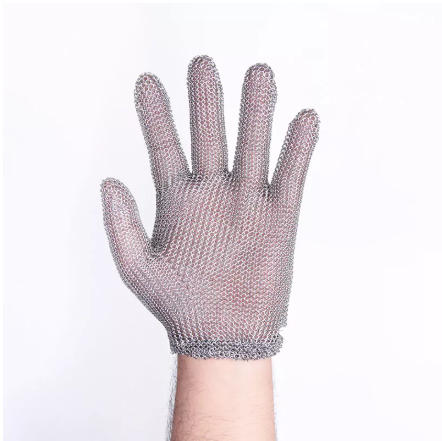
Chinese chainmail glove suppliers typically use two grades of stainless steel. Grade 304 stainless steel contains eighteen percent chromium and eight percent nickel. This grade provides corrosion resistance suitable for meat and poultry processing where the main exposure is to water and mild food acids. Grade 304 is the most common choice for general butcher applications. Grade 316 stainless steel contains sixteen percent chromium, ten percent nickel, and two percent molybdenum. The molybdenum content improves resistance to chlorides, making grade 316 suitable for fish processing and saltwater environments. Some Chinese suppliers also offer grade 430 stainless steel, which contains sixteen to eighteen percent chromium but no nickel. Grade 430 is magnetic and less corrosion-resistant than 304. It is sometimes used for lower-cost gloves, but the reduced corrosion resistance leads to rust spots within three to six months in wet environments. Reputable suppliers provide mill certificates that confirm the steel grade and chemical composition. A typical mill certificate for 304 stainless steel shows chromium between 18.0 and 20.0 percent, nickel between 8.0 and 10.5 percent, carbon below 0.08 percent, and iron as the balance. Hebei Linchuan Safety Protective Equipment Co., LTD uses grade 304 and grade 316 stainless steel with mill certificate documentation.
Chainmail gloves from Chinese suppliers are generally priced lower than those from European or North American manufacturers. A standard wrist-length chainmail glove from a Chinese supplier typically costs between fifteen and thirty US dollars per pair. The same glove from a European manufacturer may cost between forty and seventy US dollars per pair. The price difference arises from lower labor costs, lower overhead costs, and economies of scale in raw material purchasing in China. However, price is not the only factor. Logistics costs must be added. Shipping a carton of fifty pairs of chainmail gloves from China to the United States costs approximately forty to eighty US dollars by air freight or ten to twenty US dollars by sea freight. Sea freight lead time is thirty to forty days, while air freight lead time is five to seven days. Import duties may apply depending on the destination country. The United States tariff code for chainmail gloves is 6216.00. Type 5 duty rate for gloves from China is currently seven point five percent. When calculating total landed cost, buyers should add product cost, freight, insurance, and duties. A thirty-dollar glove shipped by sea freight with duty may have a landed cost of thirty-six to thirty-eight dollars. A fifty-dollar European glove shipped overland may have a landed cost of fifty-two to fifty-three dollars. Hebei Linchuan Safety Protective Equipment Co., LTD provides pricing that includes options for different shipping methods.
Chinese chainmail glove suppliers typically have minimum order quantity (MOQ) requirements. For standard models with common wire diameters and ring sizes, the MOQ is often one hundred to three hundred pairs. For custom specifications such as a specific wire diameter not in regular production, the MOQ may be five hundred to one thousand pairs. Some suppliers offer sample orders of five to ten pairs at a higher per-unit price, typically fifty to one hundred percent above the bulk price. Lead times vary based on whether the product is from stock or made to order. Stock products are usually available for shipment within five to ten business days after order confirmation. Made-to-order products require fifteen to thirty business days for production, plus shipping time. A buyer ordering five hundred pairs of a standard chainmail glove with no customization can expect total lead time of twenty to thirty days including sea freight to a West Coast port. During peak seasons such as the months before Lunar New Year, production lead times may extend by ten to fifteen days because factories reduce output for the holiday period. Hebei Linchuan Safety Protective Equipment Co., LTD maintains stock of common sizes and cuff lengths, with sample orders accepted for evaluation.
Chainmail gloves destined for food processing applications must comply with food contact material regulations. In the United States, the FDA requires that materials used in food contact do not migrate harmful substances to food. Stainless steel grades 304 and 316 are listed as acceptable under FDA 21 CFR 174.5. Chinese suppliers should provide a letter of guarantee stating that the gloves are manufactured from FDA-compliant materials. In the European Union, Regulation (EC) 1935/2004 requires that food contact materials be manufactured according to good manufacturing practices. Chinese suppliers exporting to the EU should provide a declaration of compliance referencing this regulation. Some Chinese suppliers also obtain certification from third-party organizations such as NSF International or the British Retail Consortium (BRC). These certifications involve audits of manufacturing facilities and product testing. A BRC-certified supplier has documented processes for traceability, allergen control, and contamination prevention. For meat processing facilities subject to HACCP plans, chainmail gloves must be metal detectable. Full stainless steel chainmail gloves are detectable by standard metal detectors set to a sensitivity of 1.5 mm ferrous sphere equivalent. Hebei Linchuan Safety Protective Equipment Co., LTD provides FDA and EU food contact compliance documentation for its chainmail gloves.
Many Chinese chainmail glove suppliers offer customization services that are not available from smaller suppliers in other regions. Customization options include wire diameter, ring size, cuff length, and cuff closure type. Wire diameter can be specified between 0.4 mm and 0.7 mm. Thicker wire provides higher cut resistance but increases glove weight. Ring size can be specified between 3 mm and 6 mm inside diameter. Smaller rings provide a denser weave but reduce flexibility. Cuff length can be specified from wrist length (approximately 60 mm from wrist) to elbow length (approximately 300 mm from wrist) to full arm length (up to 500 mm). Cuff closure types include hook-and-loop strap, metal snap button, elastic band, and leather strap with buckle. Some suppliers offer custom sizing beyond the standard size range of 6 to 12. A custom size chart can be created based on hand measurements provided by the buyer. Customization of ring color is limited because stainless steel cannot be colored without coatings, but some suppliers offer black oxide finish for reduced glare. The minimum order quantity for custom specifications is typically higher than for standard products, often one thousand pairs or more. Hebei Linchuan Safety Protective Equipment Co., LTD accepts custom orders for chainmail gloves with specified wire diameter, ring size, cuff length, and closure type.
The reliability of chainmail gloves from Chinese suppliers depends on the quality control processes used during manufacturing. A competent supplier implements incoming inspection of raw materials. The stainless steel wire is checked for diameter, tensile strength, and surface finish. A tensile strength of 700 to 900 megapascals is typical for 304 stainless steel wire used in chainmail. During ring winding and cutting, samples are taken every hour to check ring dimensions. The ring inside diameter tolerance should be plus or minus 0.1 mm. The ring cut ends should be flat and free of burrs. During knitting, automated optical inspection systems can detect unclosed rings or rings that are out of alignment. After assembly, each glove is inspected visually. A lights test may be used: the glove is stretched and held against a light source to reveal missing rings or gaps. The final inspection includes a fit check on a hand form of the appropriate size. The acceptable quality level (AQL) for major defects such as broken rings or missing closures is typically 1.0 percent, meaning that no more than one pair in one hundred pairs may have a major defect. For minor defects such as slight cosmetic imperfections, an AQL of 2.5 percent is common. Hebei Linchuan Safety Protective Equipment Co., LTD operates with documented quality control procedures at each manufacturing stage.
International buyers of chainmail gloves from China must consider shipping and logistics options. Sea freight is the most economical method for large orders. A twenty-foot container can hold approximately 10,000 pairs of chainmail gloves. Sea freight from major Chinese ports (Shanghai, Ningbo, Shenzhen) to the West Coast of the United States takes fifteen to twenty days. To Europe, sea freight takes thirty to thirty-five days depending on the destination port. Air freight is faster but more expensive. Air freight from China to the United States takes five to seven days. The cost of air freight for 500 pairs of chainmail gloves weighing approximately 150 kilograms is 600 to 900 US dollars. Express courier services such as DHL, FedEx, or UPS are used for small samples or urgent orders. A five-kilogram package containing ten pairs of chainmail gloves costs approximately 60 to 100 US dollars for delivery within three to five days. Buyers should also consider customs clearance. The shipper must provide a commercial invoice, packing list, and bill of lading or airway bill. For chainmail gloves, the shipper should also provide a certificate of origin if preferential tariff treatment is claimed. Hebei Linchuan Safety Protective Equipment Co., LTD arranges shipping through freight forwarders and provides necessary export documentation.
Buyers should evaluate Chinese chainmail glove suppliers using several criteria before placing an order. The first criterion is manufacturing capability. Suppliers that own their knitting and assembly equipment are more reliable than trading companies that outsource production. A visit to the factory or a video tour can confirm the presence of production equipment. The second criterion is certification. Suppliers with ISO 9001:2015 certification have documented quality management systems. Suppliers with BRC or NSF food safety certification have additional oversight. The third criterion is test documentation. The supplier should provide test reports from accredited laboratories, not just in-house test data. The fourth criterion is communication. A supplier that responds to emails within one business day and provides clear answers to technical questions is more likely to be reliable. The fifth criterion is reference customers. A supplier that has worked with known companies in the buyer's industry is a positive sign. The sixth criterion is sample policy. A supplier that offers samples at a reasonable cost and ships them promptly demonstrates confidence in their product. Hebei Linchuan Safety Protective Equipment Co., LTD welcomes factory visits, holds ISO 9001 certification, and provides product samples for evaluation.
Chainmail gloves manufactured in China are exported to various industry sectors worldwide. The largest export market is the meat processing industry, including beef, pork, and lamb boning lines. North American and European meat processors purchase chainmail gloves to protect workers from sharp boning knives. The second largest market is poultry processing, for hand deboning of chicken and turkey. The third market is fish processing, where grade 316 stainless steel gloves are used for tuna, salmon, and other saltwater species. The fourth market is the glass industry, where workers handle sharp glass sheets and edges. The fifth market is recycling facilities, where workers sort sharp metal and glass fragments. The sixth market is the catering industry, where kitchen staff use chainmail gloves when operating deli slicers or cutting large volumes of vegetables. Chinese chainmail gloves are also exported to the construction industry for tasks involving cutting of roofing materials or handling of metal studs. Each market may have specific requirements for cuff length, wire diameter, and food safety compliance. Hebei Linchuan Safety Protective Equipment Co., LTD supplies chainmail gloves for all of these export markets.
After-sales support is an important consideration when sourcing chainmail gloves from China. Reputable suppliers provide a warranty against manufacturing defects. The typical warranty period is six to twelve months from the date of shipment. Defects covered include broken rings due to incomplete welding, missing rings, and faulty cuff closures. The warranty does not cover normal wear and tear, ring breakage due to heavy use, or damage from improper cleaning. Some suppliers provide repair kits including replacement rings and pliers. A repair kit for two hundred rings costs approximately five to ten US dollars. Suppliers may also offer a ring replacement service where customers send damaged gloves back for repair. The customer pays shipping to China, and the supplier pays return shipping. This service is economical for large quantities of gloves. Another aspect of after-sales support is technical assistance. A supplier should be able to advise on proper sizing, cleaning procedures, and inspection frequency. Hebei Linchuan Safety Protective Equipment Co., LTD provides a six-month warranty, repair kits, and technical support for its chainmail gloves.
Chainmail glove suppliers in China offer competitive pricing and a range of customization options for international buyers. Understanding the manufacturing process, quality standards, and stainless steel grades helps buyers make informed decisions. Grade 304 stainless steel is suitable for most meat and poultry applications, while grade 316 is required for fish processing and saltwater environments. Wire diameters from 0.4 mm to 0.6 mm balance weight and cut resistance. Third-party test reports confirming EN 388 or ANSI/ISEA 105 cut resistance levels are necessary for regulatory compliance. Food safety documentation including FDA or EU compliance declarations is required for food processing applications. Minimum order quantities typically range from one hundred to one thousand pairs depending on customization. Lead times from stock are five to ten business days, while made-to-order products require fifteen to thirty business days. Sea freight is economical for large orders, while air freight or express courier is used for samples and urgent orders. Evaluating suppliers based on manufacturing capability, certification, test documentation, communication, references, and sample policy reduces sourcing risk. After-sales support including warranty, repair kits, and technical assistance adds value. Hebei Linchuan Safety Protective Equipment Co., LTD operates as a chainmail glove supplier in China, manufacturing products that meet international standards and providing documentation for safety audits and import clearance.