
Author: Site Editor Publish Time: 2026-03-02 Origin: Site


Chainmail fingerless gloves represent a specialized category of personal protective equipment (PPE) designed to protect hands from cut and puncture hazards while maintaining maximum dexterity and tactile sensitivity. Unlike fully enclosed protective gloves, fingerless variants allow the wearer"s fingertips to remain free, enabling precise manual tasks that would be difficult or impossible with covered fingers.
The history of chainmail protection dates back centuries, but modern manufacturing techniques have transformed these products from handcrafted armor into precision-engineered safety equipment. Today, chainmail fingerless gloves serve critical roles in food processing, manufacturing, and various industrial applications where cut hazards exist but fingertip sensitivity is essential.
Hebei Linchuan Safety Protective Equipment Co., LTD, a certified supplier with SGS and BV profile verification, manufactures stainless steel chainmail gloves that comply with international safety standards including CE EN1082-1:1996 and FDA requirements. This guide provides comprehensive information about chainmail fingerless gloves, their technical specifications, applicable safety standards, and selection criteria for procurement professionals and safety officers.
Chainmail fingerless gloves are protective hand coverings constructed from interlinked metal rings that form a flexible mesh. The "fingerless" designation indicates that the glove covers the palm, back of the hand, and portions of the fingers while leaving the fingertips exposed. This design allows wearers to perform tasks requiring fine tactile feedback while maintaining cut protection for the majority of the hand.
The construction typically involves individual stainless steel rings, each welded closed to ensure structural integrity. The rings interlock in a pattern that allows flexibility and movement while maintaining continuous coverage. Standard ring dimensions for industrial chainmail gloves include an inner diameter of 2.75mm, outer diameter of 3.81mm, and wire diameter of 0.53mm.
Chainmail fingerless gloves serve diverse industries where cut hazards exist but fingertip dexterity is required:
Food Processing Industry: Workers in meat processing, fish and shellfish preparation, and poultry processing use these gloves on the non-knife hand during cutting operations . The fingerless design allows workers to grip and manipulate product while the protected hand remains safe from accidental cuts.
Garment and Textile Manufacturing: In cloth cutting operations, particularly those using sewing cutters or manual cutting tools, fingerless chainmail gloves protect the guiding hand while allowing fabric manipulation.
Leather Processing: Similar to textile applications, leather cutting requires hand protection without sacrificing the ability to feel material texture and thickness.
Oyster and Shellfish Processing: The sharp edges of shells present significant cut hazards, and fingerless gloves provide protection while allowing the manual dexterity needed for shucking operations.
Glass Handling: Workers handling cut glass or sharp-edged glass products benefit from cut protection while maintaining grip sensitivity.
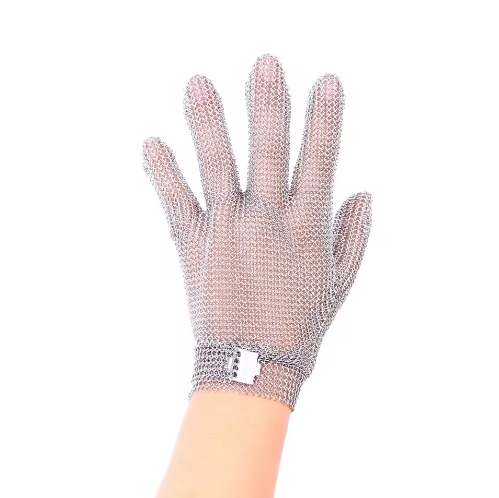
The majority of industrial chainmail fingerless gloves are manufactured from stainless steel, with Type 316 being the most common specification. Type 316 stainless steel offers excellent corrosion resistance, making it suitable for food processing environments where frequent washing and exposure to fats, oils, and cleaning agents occur.
Stainless steel provides several advantages for protective gloves:
Corrosion resistance in wet environments
Compatibility with food processing requirements
Durability through repeated use and cleaning cycles
Non-magnetic properties (depending on specific alloy)
Resistance to cleaning and disinfectant products
The protective performance of chainmail gloves depends significantly on ring construction. Individual rings must be welded closed rather than simply butted together. Welded rings maintain their structural integrity under stress, preventing the glove from separating when caught on sharp edges or during impact.
Ring dimensions directly affect glove performance characteristics. Smaller diameter rings typically provide better cut resistance but may reduce flexibility. The standard configuration of 2.75mm inner diameter with 0.53mm wire diameter represents an established balance between protection and wearer comfort.
Traditional chainmail gloves present weight challenges for workers who wear them for extended periods. The weight of stainless steel chainmail varies based on ring size, wire gauge, and coverage area. Manufacturers have responded to ergonomic concerns by optimizing ring configurations to reduce weight while maintaining protective performance.
A significant advancement in cut protection technology involves knitted stainless steel yarns, which offer lighter weight alternatives to traditional chainmail construction. These hybrid products combine fine stainless steel filaments with textile fibers to create cut-resistant gloves with improved comfort and flexibility. While not technically chainmail, these products serve similar protective functions with reduced weight penalties.
The primary European standard for chainmail gloves is EN 1082-1:1996, which specifies requirements for protective clothing designed to protect against cuts and stabs from hand knives. This standard applies specifically to chain-mail gloves and arm guards.
EN 1082-1 testing evaluates:
Penetration resistance
Ergonomic characteristics
Strap strength and security
Material specifications
Marking and instructions for use
Products certified to this standard have undergone testing to verify their ability to resist cutting and stabbing hazards encountered in meat processing and similar applications.
ISO 13999-1:1999 provides international specifications for protective clothing, gloves, and arm guards protecting against cuts and stabs by hand knives. Part 1 specifically addresses chain-mail gloves and arm guards.
This standard establishes requirements for:
Design and construction
Penetration resistance
Ergonomic performance
Strap systems
Weight limitations
Material specifications
Marking and instructional content
For food processing applications, chainmail gloves must comply with food contact material regulations. The U.S. Food and Drug Administration (FDA) certification confirms that materials are suitable for incidental food contact. Similarly, LFGB (German Food and Feed Code) certification demonstrates compliance with European food contact requirements.
These certifications are essential for gloves used in meat processing, poultry processing, fish preparation, and other food handling operations where the glove may contact food products.
Depending on specific applications and regional requirements, chainmail fingerless gloves may also comply with:
EN 14328 (Protective clothing against cutting and stabbing by power knives)
EN 1811 (Reference test method for release of nickel from products intended to come into direct and prolonged contact with the skin)
Proper fit is essential for both safety and comfort. The sizing of chainmail fingerless gloves typically considers two primary hand measurements: palm perimeter and palm length.
Palm perimeter is measured around the widest part of the hand, excluding the thumb. Palm length is measured from the wrist crease to the tip of the middle finger.
Manufacturers typically offer chainmail fingerless gloves in sizes ranging from XX-Small to XX-Large. Color-coded sizing systems facilitate quick identification, particularly important in processing environments where multiple workers may share glove inventories.
| Size | Color Code | Palm Perimeter | Palm Length |
|---|---|---|---|
| XXS | Brown | 5-5.5 inches | 200mm |
| XS | Green | 6-6.5 inches | 200mm |
| S | White | 7-7.5 inches | 215mm |
| M | Red | 8-8.5 inches | 220mm |
| L | Blue | 9-9.5 inches | 230mm |
| XL | Orange | 10-10.5 inches | 240mm |
Source: Hebei Linchuan Safety Protective Equipment Co., LTD product specifications
Most chainmail fingerless gloves feature ambidextrous design, meaning they can be worn on either hand. This is achieved through symmetrical construction and is particularly useful in applications where workers may need to switch the glove between hands or when the glove requires turning inside out to accommodate the opposite hand.
Ambidextrous design offers several advantages:
Simplified inventory management
Extended glove life through balanced wear
Flexibility in work assignments
Reduced training requirements for donning
Chainmail fingerless gloves utilize various closure systems to secure the glove to the wearer"s hand. The choice of strap system affects fit security, ease of donning and doffing, and suitability for specific environments.
Textile Straps: Fabric straps with hook-and-loop or buckle closures provide adjustable fit and easy donning. Color-coded textile straps often incorporate size identification directly into the strap system.
Plastic Straps: Molded plastic straps with buckle closures offer enhanced hygiene properties due to reduced bacteria retention compared to textile alternatives. These are particularly suitable for food processing environments.
Metal Claw Straps: Spring-loaded metal closure systems provide secure retention and long service life. These may include colored labels for size identification -2.
Spring Straps: Self-adjusting tension spring systems made of stainless steel provide automatic fit adjustment and eliminate the need for manual closure. These systems are particularly useful in applications requiring frequent glove changes.
In food processing applications, strap selection significantly impacts sanitation. Straps can harbor bacteria if not properly designed and maintained. Some manufacturers offer strapless chainmail gloves specifically designed to eliminate bacteria retention concerns. These gloves rely on the spring tension of the chainmail construction itself for retention.
For strapped gloves, plastic closure systems typically offer better hygiene characteristics than textile alternatives, as non-porous surfaces resist bacterial colonization and clean more effectively.
Chainmail fingerless gloves protect through a combination of material properties and structural design. When a knife edge contacts the stainless steel rings, the metal distributes the cutting force across multiple rings and resists penetration through material hardness.
The welded ring construction ensures that individual rings cannot separate under load, maintaining the continuous protective barrier. This distinguishes quality chainmail from decorative or costume products, which may use butted rings that can separate under stress.
Chainmail fingerless gloves are designed specifically for cut protection against hand knives and similar cutting tools. They are not intended to protect against:
Puncture from pointed objects (though some resistance is inherent)
Impact injuries
Crush hazards
Chemical exposure
Thermal hazards
Powered cutting equipment such as band saws or circular blades
The EN 1082-1 standard specifically addresses protection against hand knives, and users should select gloves based on the specific hazards present in their workplace.
Chainmail fingerless gloves represent a significant initial investment compared to textile cut-resistant gloves. However, their durability and reusability often provide favorable long-term economics in appropriate applications.
Industrial chainmail gloves are typically priced from approximately $28 to $30 per unit for standard five-finger wrist gloves. Extended coverage versions with arm protection command higher prices. Replacement parts, including straps and tensioners, are available to extend glove service life.
Many manufacturers, including Hebei Linchuan Safety Protective Equipment Co., LTD, offer factory repair programs for chainmail gloves. These programs allow damaged gloves to be professionally repaired rather than replaced, reducing long-term costs and waste.
Common repairable issues include:
Broken rings (individual ring replacement)
Strap damage (strap replacement)
Edge wear (re-knitting or reinforcement)
When evaluating chainmail fingerless gloves, procurement professionals should consider:
Initial purchase price
Expected service life under normal use
Repair frequency and costs
Replacement strap costs
Cleaning and maintenance requirements
Worker productivity impacts (comfort, dexterity, weight)
Chainmail fingerless gloves require regular cleaning, particularly in food processing applications. Stainless steel construction allows robust cleaning methods without material degradation.
Standard cleaning procedures include:
Rinsing with hot water to remove organic material
Washing with food-safe detergents
Sanitizing with approved disinfectants
Thorough drying to prevent water spots
Stainless steel resists damage from cleaning and disinfectant products, unlike some alternative materials.
Regular inspection ensures chainmail gloves maintain their protective properties. Inspection should include:
Visual examination for broken or damaged rings
Strap integrity and closure function
Edge condition (particularly at finger openings)
General flexibility and ring mobility
Corrosion signs (unusual for Type 316 stainless steel but possible in aggressive environments)
Gloves with damaged rings should be removed from service and either repaired or replaced. A single broken ring can compromise the integrity of the surrounding area and reduce cut resistance.
In slaughterhouses and processing facilities, chainmail fingerless gloves protect workers during boning and cutting operations. The glove is typically worn on the non-knife hand, which holds the meat while the knife hand performs cutting.
The fingerless design allows workers to maintain tactile feedback necessary for:
Feeling bone fragments
Gripping slippery meat surfaces
Detecting textural changes during trimming
Performing precise manual manipulations
Fish and shellfish processing presents unique cut hazards from sharp fins, shells, and processing tools. Chainmail fingerless gloves provide protection while allowing the finger sensitivity needed for tasks such as:
Shucking oysters and other bivalves
Filleting fish
Removing shells from cooked product
Sorting and grading seafood
In garment and leather production, workers use sharp cutting tools to shape materials. Chainmail fingerless gloves protect the hand that guides material during cutting operations. The fingerless design is particularly valuable when workers need to:
Feel fabric texture and thickness
Manipulate small pieces
Perform detailed cutting operations
Maintain precision in pattern following
Beyond food and textile processing, chainmail fingerless gloves serve various industrial roles:
Plastic processing (removing flash from molded parts)
Paper manufacturing (handling cut edges)
Glass handling (protecting against sharp edges)
Warehouse operations (cutting shrink wrap and banding)
Recycling operations (sorting materials with sharp edges)
The first step in glove selection is comprehensive hazard assessment. Safety officers should evaluate:
Types of cutting tools used (hand knives, utility knives, scissors)
Frequency and duration of cut hazard exposure
Other hazards present (wet conditions, temperature, chemicals)
Required dexterity levels for tasks
Cleaning and sanitation requirements
Fingerless gloves are appropriate when tasks require fingertip sensitivity, but some applications may benefit from different coverage levels:
Standard Wrist-Length Glove: Suitable for most hand protection applications where forearm protection is unnecessary.
Gauntlet-Style with Sleeve: Provides extended protection for forearm when work involves overhead cutting or when arms are exposed to cut hazards. Available with sleeve extensions of 8cm, 15cm, or 20cm.
Three-Finger Design: Offers protection for thumb, index, and middle fingers while leaving ring and little fingers free. Popular in garment manufacturing where these fingers guide material.
Proper sizing is critical for both safety and comfort. Gloves that are too large may shift during use, creating gaps in protection or interfering with grip. Gloves that are too small restrict movement and cause worker fatigue.
Workers should measure their hands according to manufacturer specifications and select sizes based on the larger measurement if between sizes. Color-coded sizing systems facilitate proper glove assignment and help workers quickly identify their size.
Chainmail fingerless gloves represent a specialized but essential category of personal protective equipment for industries ranging from food processing to manufacturing. Their unique combination of cut resistance and fingertip dexterity makes them irreplaceable for applications requiring both safety and precision.
When selecting chainmail fingerless gloves, procurement professionals and safety officers should consider multiple factors: applicable safety standards (EN 1082-1, ISO 13999-1), material specifications (Type 316 stainless steel), sizing and fit requirements, closure systems appropriate for the work environment, and total cost of ownership including repair programs.
Hebei Linchuan Safety Protective Equipment Co., LTD manufactures stainless steel chainmail gloves that meet international standards and are suitable for meat processing, seafood preparation, textile manufacturing, and various industrial applications. With proper selection, maintenance, and worker training, chainmail fingerless gloves provide reliable protection that justifies their investment through injury prevention and extended service life.
The ongoing evolution of cut protection technology, including knitted stainless steel alternatives, continues to expand options for workers requiring hand protection. However, traditional chainmail construction remains the established standard for applications requiring the combination of cut resistance, cleanability, and durability that only welded stainless steel rings can provide.