
Author: Hebei Linchuan Publish Time: 2026-11-06 Origin: Site


Hand injuries are the second most common type of workplace injury worldwide, accounting for approximately 23% of all nonfatal occupational injuries according to the International Labour Organization. Among these, lacerations and cuts represent the leading cause, responsible for 40-50% of hand injury incidents in industrial settings. The direct cost of a single laceration injury averages $24,000 according to the National Safety Council, with severe cases requiring surgical nerve repair exceeding $100,000. Chainmail cut resistant gloves represent the most advanced personal protective equipment available for preventing these devastating injuries in high-cut-risk environments. This comprehensive guide examines the technology, standards, applications, and economics of chainmail cut resistant gloves, providing safety professionals and procurement managers with the knowledge needed to make informed protection decisions.
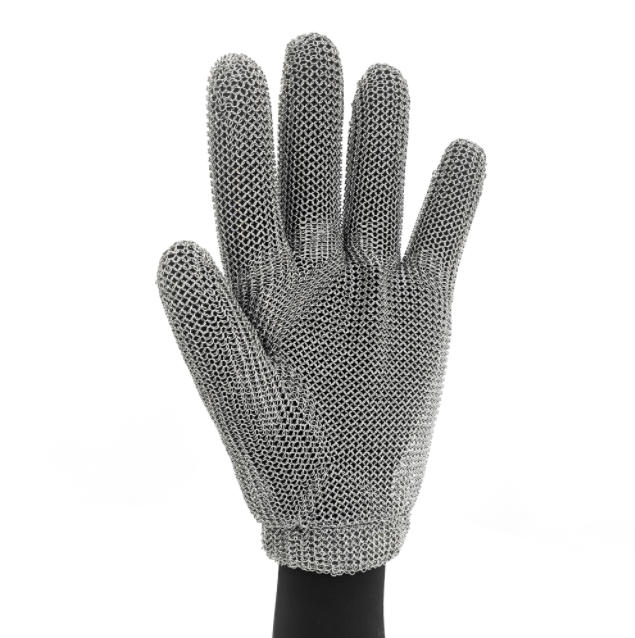
Chainmail cut resistant gloves are protective handwear constructed from precision-engineered interlocked metal rings, forming a continuous mesh that provides exceptional resistance to cutting, slicing, and puncturing forces. The technology, evolved from medieval armor, has been refined through decades of industrial engineering to meet the demands of modern high-hazard workplaces. Unlike synthetic cut-resistant gloves that rely on high-performance fibers (HPPE, Kevlar, Dyneema), chainmail gloves achieve their protective properties through the inherent physical hardness of stainless steel.
The construction of a chainmail cut resistant glove involves several precisely controlled manufacturing steps:
Wire Drawing: Stainless steel wire is drawn to precise diameters, typically 1.2mm, 1.5mm, or 2.0mm, depending on the target application. The wire drawing process controls the mechanical properties of the steel, including tensile strength (minimum 520 MPa for AISI 304), elongation, and surface finish. Hebei Linchuan Safety Protective Equipment Co., LTD sources wire from certified mills that produce to ASTM A580 specifications, with material certificates providing full traceability.
Ring Formation: The drawn wire is coiled into helical springs of precise diameter (typically 4-6mm internal diameter), then individually cut to form rings. Each ring's dimensional accuracy directly affects the mesh's protective properties — rings that are too large create gaps that fine blades can exploit, while rings that are too small increase glove weight and reduce flexibility without proportional protection improvement.
Ring Welding: Each ring's opening is welded closed using precision micro-welding technology. This is the most critical manufacturing step: an incomplete or weak weld creates a failure point that can allow a ring to open under cutting force, compromising the entire mesh. Hebei Linchuan employs computer-controlled resistance welding with parameters (current, pressure, duration) optimized for each steel grade and wire diameter, producing welds with tensile strength exceeding the parent material's minimum specification.
Mesh Assembly: Welded rings are assembled into mesh panels using the European 4-in-1 pattern, where each ring interconnects with four neighboring rings. This pattern provides the optimal balance of flexibility, protection, and manufacturing efficiency. Alternative patterns include European 6-in-1 (denser, heavier, used for maximum protection applications) and 8-in-1 (used for specialized high-risk applications).
Glove Shaping: Mesh panels are shaped into glove form using specialized forms and additional ring joining. Contoured finger sections, thumb opposability, and wrist tapering are achieved through skilled assembly work. The final glove shape must match human hand ergonomics while maintaining continuous ring coverage across all protected surfaces.
Finishing: The completed glove undergoes tumbling to smooth ring edges and remove welding burrs, ultrasonic cleaning to remove manufacturing residues, and final inspection. The wrist strap — typically nylon webbing with a plastic side-release buckle — is attached, and the glove is sized, labeled, and packaged.
The result is a protective garment that provides Level 5/F cut resistance (EN388:2016) or A8-A9 (ANSI/ISEA 105-2016) — the highest available ratings under both standards. This level of protection cannot be achieved by any fiber-based technology, making chainmail gloves the only viable option for environments where cutting forces are severe and continuous.
Two primary international standards govern the rating and classification of cut resistant gloves: the European EN388:2016 and the American ANSI/ISEA 105-2016. Both standards provide quantified, laboratory-tested performance ratings that enable buyers to compare glove protection levels objectively. Understanding these standards in detail is essential for selecting gloves that meet both regulatory requirements and the actual hazard profile of the workplace.
EN388:2016 — European Standard
EN388 is the European standard for "Protective gloves against mechanical risks," maintained by CEN (European Committee for Standardization). The 2016 revision introduced significant changes from the 2003 version, most notably the addition of the TDM-100 test (ISO 13997) as a mandatory secondary cut test for materials where blade dulling is detected during the Coupe test.
The standard tests five mechanical properties:
Property | Test Method | Rating Scale | Chainmail Glove Performance |
|---|---|---|---|
Abrasion Resistance | Rotating abrasion wheel | 1-4 | 4 (maximum) |
Cut Resistance (Coupe) | Rotating circular blade under fixed load | 1-5 | 5 (maximum, index >20) |
Tear Resistance | Tensile tear test | 1-4 | 4 (maximum, >60N) |
Puncture Resistance | Standard puncture probe | 1-4 | 4 (maximum, >100N) |
Cut Resistance (TDM) | ISO 13997 straight blade test | A-F | E or F (15-30N+) |
A chainmail glove from Hebei Linchuan Safety Protective Equipment Co., LTD typically carries the marking: 4 5 4 4 E or 4 5 4 4 F, indicating maximum performance across all test categories. This marking is accompanied by the CE mark and the four-digit Notified Body number, required for Category III PPE (protection against irreversible risks).
The Coupe Test Dulling Effect: A critical consideration for chainmail gloves is the interaction between the rotating circular blade and the hardened steel rings. In the Coupe test, the blade can become dull from contact with the steel, causing it to require more cycles to cut through — artificially inflating the cut index. EN388:2016 addresses this by requiring that if the dulling ratio (ratio of reference material cut cycles before and after glove testing) exceeds 3.0, the TDM-100 test must be performed and the letter rating (A-F) takes precedence over the Coupe index for classification purposes. For chainmail gloves, the TDM rating is always the more reliable indicator of actual cut performance.
ANSI/ISEA 105-2016 — American Standard
The ANSI/ISEA 105 standard, maintained by the International Safety Equipment Association, uses only the TDM-100 test (ASTM F2992) for cut resistance classification. The 2016 revision expanded the rating scale from A1-A5 (pre-2016) to A1-A9, providing finer differentiation at high cut levels:
ANSI Level | Grams of Force to Cut | Typical Glove Type |
|---|---|---|
A1 | 200-499 | Basic cotton/leather |
A2 | 500-999 | Light-duty synthetic |
A3 | 1,000-1,499 | Standard HPPE |
A4 | 1,500-2,249 | Reinforced HPPE |
A5 | 2,250-2,999 | Heavy HPPE/Kevlar |
A6 | 3,000-3,499 | Engineered composite |
A7 | 3,500-4,499 | High-performance composite |
A8 | 4,500-5,499 | Chainmail (typical) |
A9 | 5,500-6,000+ | Chainmail (heavy-duty) |
Chainmail cut resistant gloves from Hebei Linchuan consistently achieve ANSI A8 or A9 ratings, requiring 4,500-6,000+ grams of force to produce cut-through. For comparison, a typical heavy-duty Kevlar glove achieves A4-A5 (1,500-3,000 grams), meaning chainmail provides approximately 2-4 times greater cut resistance.
Selecting the Right Standard: For European markets, EN388 compliance is mandatory (CE marking required). For U.S. markets, ANSI/ISEA 105 is the recognized standard, though OSHA accepts EN388 as an alternative. Many international buyers request both ratings to serve multiple markets. Hebei Linchuan provides both EN388 and ANSI/ISEA 105 test certificates for all chainmail glove models.
Chainmail cut resistant gloves find application across a remarkably broad spectrum of industries where workers face severe cutting hazards. While the food processing sector (meat, poultry, seafood) is the most visible user, accounting for approximately 55% of global chainmail glove demand, the remaining 45% is distributed across multiple industrial sectors that face equally serious cut risks. Understanding the full range of applications helps safety professionals identify opportunities to improve protection in their own operations.
1. Meat, Poultry, and Seafood Processing (55% of market)
The dominant application for chainmail gloves. Workers in slaughterhouses, deboning lines, and cutting rooms face continuous exposure to sharp knives and bone fragments. The Bureau of Labor Statistics reports that meat processing has a hand injury rate of 9.8 per 100 workers — nearly double the all-industry average. Chainmail gloves reduce laceration injuries by 70-86% when properly implemented (Journal of Safety Research). Both AISI 304 (general meat processing) and AISI 316L (seafood, high-salt environments) grades are used.
2. Metal Fabrication and Manufacturing (15% of market)
Sheet metal handling, metal stamping, press operations, deburring, and grinding all involve contact with razor-sharp metal edges. OSHA reports that fabricated metal product manufacturing has a hand injury rate of 7.2 per 100 workers. Chainmail gloves protect against cuts from sheet metal edges (which can be sharper than surgical blades) and punctures from metal burrs and stamping remnants. Unlike synthetic gloves, which can be cut through by sharp metal edges, chainmail provides permanent, non-degrading protection.
3. Glass and Ceramics Industry (8% of market)
Glass manufacturing, cutting, and handling involves contact with extremely sharp glass edges and shards. The glass industry reports some of the highest laceration rates in manufacturing. Chainmail gloves protect against both cuts from glass edges and punctures from glass fragments, which synthetic gloves cannot reliably prevent. AISI 316L is preferred due to potential chemical exposure in glass treatment processes.
4. Plastics and Textile Industry (7% of market)
Workers operating industrial cutting knives, plastic sheet slitters, and textile cutting equipment face continuous blade contact. Chainmail gloves are typically worn on the non-cutting hand during manual cutting operations and during blade changes on automated cutting equipment, where accidental contact with sharp blades is a significant risk.
5. Waste Management and Recycling (5% of market)
Workers sorting waste and recyclable materials encounter broken glass, metal shards, needles, and other sharp objects. Chainmail gloves provide protection against the diverse and unpredictable sharp hazards present in waste streams. The durability of chainmail is particularly valuable in this environment, where synthetic gloves would require frequent replacement.
6. Forestry and Wood Processing (4% of market)
Logging operations, sawmill work, and wood processing involve sharp tools (axes, saws, knives) and sharp wood splinters. Chainmail gloves protect hands during blade handling, blade changes, and material handling in sawmill operations.
7. Laboratory and Research (3% of market)
certain laboratory settings — particularly those handling sharp instruments, glass preparation, or animal processing — chainmail gloves provide protection against cuts from scalpels, broken glassware, and animal bone/teeth. Autoclave compatibility is essential in these applications.
8. Craft and Artisanal Applications (3% of market)
Professional chefs, oyster/shellfish openers, and artisanal craftspeople (leather working, chainmail art) use chainmail gloves for personal protection during precision cutting tasks. While a smaller market segment, these users demand the same EN388 Level 5 protection as industrial users.
Grand View Research estimates the global cut-resistant gloves market at $1.92 billion in 2023, projected to grow at 6.8% CAGR through 2030. Chainmail gloves represent approximately 15% of this market by value but offer the highest cut protection level available, making them irreplaceable in the most hazardous applications.
The choice between chainmail cut resistant gloves and high-performance synthetic alternatives — primarily HPPE (High-Performance Polyethylene, including Dyneema and Spectra brands), Kevlar (aramid fiber), and composite knit gloves — is one of the most consequential decisions in safety equipment procurement. Each technology has fundamentally different protective mechanisms, performance characteristics, and economic profiles. A thorough comparison enables safety professionals to match the right technology to each application's specific hazard profile.
Protective Mechanism Comparison:
Chainmail gloves achieve cut resistance through the physical hardness of stainless steel rings. When a blade contacts the ring surface, the steel's hardness (Rockwell B 70-85 for AISI 304) exceeds the blade's ability to penetrate. The cutting force is distributed across the ring's curved surface, preventing the blade edge from reaching the skin underneath. This mechanism is permanent — the steel does not degrade, weaken, or fatigue with repeated cutting contact.
HPPE and Kevlar gloves achieve cut resistance through fiber engineering. HPPE fibers (including Dyneema) have extremely high tensile strength-to-weight ratios — Dyneema SK99 fiber has a tenacity of 42 cN/dtex, approximately 15 times stronger than steel on a weight-for-weight basis. The fibers resist cutting by absorbing and distributing the blade's energy along their length. However, fibers can be severed by sufficiently sharp or forceful cuts, and repeated cutting in the same area progressively weakens the glove.
Performance Comparison:
Parameter | Chainmail (Steel) | HPPE (Dyneema) | Kevlar (Aramid) | Composite |
|---|---|---|---|---|
EN388 Coupe Rating | 5 (max) | 3-5 | 3-4 | 4-5 |
EN388 TDM Rating | E-F (max) | C-E | B-D | D-F |
ANSI Cut Level | A8-A9 | A4-A7 | A3-A5 | A5-A8 |
Weight per glove | 180-280g | 50-100g | 60-110g | 80-150g |
Dexterity | Moderate | High | High | Moderate-High |
Service life (industrial) | 3-5+ years | 2-4 months | 1-3 months | 3-6 months |
Puncture resistance | Excellent | Low-Moderate | Low-Moderate | Moderate |
Performance degradation with use | None | Progressive | Progressive | Progressive |
Washable/Autoclavable | Yes (134°C) | Limited (<80°C) | Limited (<80°C) | Limited |
When to Choose Chainmail:
Continuous, forceful knife contact (meat processing, deboning)
Puncture hazards from bone, metal, or glass
Wet environments where synthetic fibers absorb fluids
Applications requiring autoclave sterilization
Long-term cost optimization (high replacement frequency for synthetics)
When to Choose Synthetic Alternatives:
Tasks requiring maximum dexterity (electronics assembly, precision handling)
Moderate cut risk where chainmail weight would cause fatigue
Applications where metal contamination must be avoided
Short-term or occasional use where investment in chainmail is not justified
Tasks where impact or vibration protection is also needed (composite gloves)
Hybrid Strategy: Many operations achieve optimal safety and economics by deploying both technologies: chainmail gloves for the highest-risk positions (deboners, slaughter workers, metal stampers) and HPPE/composite gloves for moderate-risk positions (packaging, material handling, quality inspection). This tiered approach ensures that each worker has appropriate protection without over- or under-equipping any position.
Proper sizing of chainmail cut resistant gloves is a critical factor that directly impacts both safety performance and worker acceptance. Research published in the journal Ergonomics demonstrates that improperly fitted gloves can reduce grip strength by up to 30%, increase task completion time by 15-20%, and significantly increase the likelihood that workers will remove gloves during work — the single most dangerous outcome in any mandatory glove program. A well-fitted chainmail glove, by contrast, becomes an unobtrusive extension of the hand that workers naturally incorporate into their work technique.
Measurement Protocol:
Accurate sizing begins with proper hand measurement. Workers should be measured at the beginning of their employment and periodically thereafter, as hand dimensions can change with weight fluctuations, aging, and certain medical conditions. Two measurements are required:
Hand Circumference: Using a flexible measuring tape, measure around the widest part of the hand — across the knuckles at the base of the fingers, excluding the thumb. The hand should be relaxed and flat, fingers extended. Record the measurement in millimeters.
Hand Length: Measure from the wrist crease (the point where the hand meets the forearm, identifiable by asking the worker to flex their wrist) to the tip of the middle finger. Record in millimeters.
Use the larger of the two measurements to determine glove size. If the measurement falls on the boundary between two sizes, select the larger size — a slightly loose glove can be tightened with the wrist strap, while a tight glove cannot be made larger.
Size Chart (Hebei Linchuan Standard):
Size Code | Numeric Size | Hand Circumference (mm) | Hand Length (mm) | Typical Application |
|---|---|---|---|---|
XS | 7 | 165-178 | 160-165 | Precision tasks, small hands |
S | 8 | 178-190 | 165-175 | General deboning, poultry |
M | 9 | 190-203 | 175-185 | Universal, most popular |
L | 10 | 203-216 | 185-195 | Heavy processing, large hands |
XL | 11 | 216-229 | 195-205 | Slaughter, metal fabrication |
XXL | 12 | 229-242 | 205+ | Extra large hands |
Fit Verification Checklist:
After donning the glove and tightening the wrist strap, the worker should verify the following:
Fingertip space: 5-10mm of space should remain between the worker's fingertip and the glove's fingertip. This allows the wrist strap to pull the mesh snug against the fingers.
Full fist closure: The worker should be able to close their hand into a complete fist without the ring mesh binding, pinching, or creating pressure points. Ring mesh should follow the hand's flexion smoothly.
Finger independence: Each finger should be able to move independently, particularly the thumb and index finger for pinch grip tasks.
Wrist strap security: With the strap tightened and buckled, the worker should shake their hand vigorously — the glove must remain securely in place without shifting or rotating.
Wrist coverage: The glove's wrist edge should cover the wrist crease, with no gap between the glove edge and the forearm. The wrist strap should sit flat against the wrist without bunching.
Range of motion: The worker should simulate their actual work movements — reaching, gripping, cutting motions — and confirm that the glove does not impede necessary actions.
Comfort assessment: The worker should rate the glove's comfort on a simple scale. Discomfort at initial fitting will only worsen with extended wear and may lead to glove removal.
Break-In Period: New chainmail gloves require 2-5 shifts to conform to the individual worker's hand. During break-in, the ring mesh settles into optimal positions and the wrist strap molds to the wrist shape. Workers should be informed that initial stiffness is normal. Assigning dedicated personal gloves to each worker — rather than sharing — ensures proper break-in and ongoing fit.
The extended service life of chainmail cut resistant gloves — typically 3-5+ years — is one of their most significant economic advantages over synthetic alternatives. However, this lifespan is only achievable with proper maintenance and cleaning protocols. Neglected chainmail gloves can develop corrosion, ring joint fatigue, or bacterial contamination that compromises both safety and hygiene. A structured maintenance program protects the investment and ensures consistent protective performance throughout the glove's service life.
Cleaning Protocols by Application:
General Industrial Use (metal fabrication, glass, recycling):
Daily: Wipe gloves with a clean, dry cloth to remove dust and metal particles. Inspect for ring damage.
Weekly: Wash with warm water (40°C) and mild detergent. Rinse thoroughly and air dry.
Monthly: Apply a light coat of food-grade mineral oil to ring joints to prevent corrosion and maintain smooth ring articulation.
Food Processing (meat, poultry, seafood):
End of shift: Rinse under warm water (40-50°C) to remove organic matter. Wash with alkaline detergent (pH 9-11) using a soft brush. Rinse. Sanitize with peracetic acid (100-200ppm, 60-second contact) or chlorine (200ppm). Air dry.
Weekly: Ultrasonic bath with enzymatic cleaner (15-20 minutes) to deep-clean ring joints. Inspect under magnification for weld integrity.
Monthly: Autoclave sterilization (121°C, 30 minutes) for sterile-zone applications. Bacterial swab testing to verify sanitation effectiveness.
Chemical/Corrosive Environments:
End of shift: Rinse with clean water to remove chemical residues. Neutralize if appropriate (acid exposure: rinse with dilute sodium bicarbonate solution; alkali exposure: rinse with dilute citric acid solution).
Daily: Inspect for pitting corrosion, especially in AISI 304 gloves. Any pitting indicates the need for AISI 316L replacement.
Weekly: Deep wash, thorough drying, and application of corrosion inhibitor.
Inspection and Maintenance Schedule:
Inspection Item | Frequency | Acceptance Criteria | Action if Failed |
|---|---|---|---|
Ring integrity | Before each use | No broken, missing, or deformed rings | Remove from service; repair or replace |
Weld joint quality | Before each use | No visible cracks, gaps, or discoloration | Remove from service; repair |
Wrist strap | Daily | Strap intact, buckle functional, no fraying | Replace strap |
Corrosion | Weekly | No rust spots, pitting, or discoloration | Deep clean; if persistent, replace |
Flexibility/articulation | Monthly | Rings move freely; no stiffness or binding | Lubricate with mineral oil; if persistent, replace |
Sizing/fit | Quarterly | Glove fits as originally issued | Re-measure; replace if needed |
Bacterial swab (food) | Monthly | Negative for target organisms | Review cleaning protocol; deep clean; re-test |
Comprehensive audit | Annually | All criteria met | Document; repair/replace as needed |
Maximizing Service Life:
Assign personal gloves — shared gloves wear faster and fit poorly
Never use a chainmail glove for purposes it was not designed for (hammering, prying, as a vise)
Store gloves dry, hung or laid flat — never stacked under heavy objects
Address minor damage immediately — a single broken ring is a 5-minute repair; waiting until multiple rings fail may require replacing the entire panel
Keep spare gloves available to allow rotation during cleaning/repair
Hebei Linchuan Safety Protective Equipment Co., LTD offers free ring repair during the warranty period (12-24 months depending on model). Our repair service restores gloves to full protective capability, extending service life well beyond the warranty period and maximizing return on investment.
The statistical impact of implementing chainmail cut resistant gloves in high-risk workplaces provides compelling evidence for their adoption. Decades of occupational safety research, compiled by agencies including OSHA, the U.S. Bureau of Labor Statistics, the UK Health and Safety Executive, and academic institutions, demonstrate that proper cut-resistant glove programs dramatically reduce both the frequency and severity of hand injuries. The following data provides a quantitative foundation for investment decisions.
Industry Injury Baselines:
Industry | Hand Injury Rate (per 100 workers) | Laceration % of Hand Injuries | Average Cost per Laceration |
|---|---|---|---|
Meat processing | 9.8 | 38% | $27,500 |
Metal fabrication | 7.2 | 45% | $22,000 |
Glass manufacturing | 6.8 | 52% | $19,500 |
Food manufacturing (general) | 5.5 | 35% | $18,000 |
All manufacturing | 4.3 | 40% | $16,500 |
All industries (average) | 3.2 | 35% | $14,000 |
Sources: U.S. Bureau of Labor Statistics (2022), National Safety Council Injury Facts, OSHA IMIS database
Impact of Chainmail Glove Implementation:
Multiple studies have quantified the injury reduction achieved by implementing chainmail cut resistant glove programs:
USDA FSIS study (meat processing): Facilities implementing mandatory chainmail glove programs saw laceration injury rates decrease by 70-86% within the first year, with the residual injuries primarily occurring on the unprotected (knife) hand or due to glove misuse.
UK HSE study (metal fabrication): Introduction of chainmail gloves for sheet metal handling reduced hand laceration incidents by 64% over an 18-month observation period, with zero severe (nerve/tendon damage) lacerations recorded among chainmail glove users.
Journal of Safety Research meta-analysis: Across 12 studies covering 8,500 workers in high-cut-risk industries, chainmail glove implementation reduced hand laceration rates by an average of 75.3% compared to pre-implementation baselines.
OSHA compliance data: Facilities cited for inadequate hand protection (general duty clause violations) that subsequently implemented EN388 Level 5 chainmail programs showed a 78% reduction in OSHA-recordable hand injuries within two years.
Economic Impact Analysis:
Beyond injury reduction, the economic impact of chainmail glove programs is substantial: