
Author: Site Editor Publish Time: 2026-03-09 Origin: Site


The meat processing industry remains one of the most hazardous sectors for hand injuries. Butchers and meat cutters face the constant threat of lacerations from boning knives, breaking saws, and sharp bone fragments. In this environment, the chainmail butcher glove is not an accessory but a primary safety device. This article examines the specific requirements, performance data, and safety standards governing chainmail gloves in professional butchery.
In slaughterhouses and meat processing plants, workers perform repetitive cutting motions at high speed. A laceration not only causes personal harm but also poses a contamination risk to the product. According to industry safety guidelines, the use of cut-resistant or chainmail gloves is mandatory when handling handsaw blades and sharp cutting tools.
Chainmail gloves are specifically designed to mitigate these risks. Unlike gloves that merely resist cutting, chainmail deflects and blunts the edge of a knife, often stopping the blade entirely within the mesh structure.
The primary standard governing chainmail gloves for butchery in Europe is EN 1082-1. This standard is specifically designed for garments protecting against cuts and stabs from hand knives. It is distinct from the EN 388 standard, which covers general mechanical risks for fabric gloves.
Compliance with EN 1082-1 involves testing the penetration resistance, design, and ergonomic characteristics of the glove. For a butcher, this certification ensures the glove provides adequate coverage and that the rings are constructed to a tolerance that prevents knife penetration. Hebei Linchuan Safety Protective Equipment Co., LTD produces gloves that comply with this directive, ensuring they meet the rigorous demands of European and international markets.
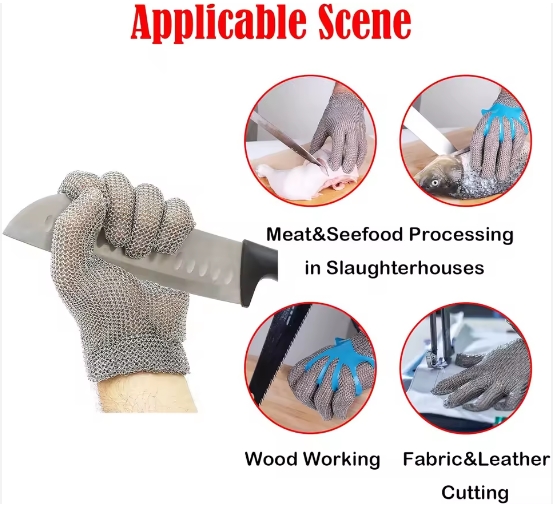
Not all butchery tasks are the same, and glove design varies accordingly. Data from product specifications reveals distinct categories:
This is the most common type for detailed butchery work, such as deboning and trimming. It allows for maximum dexterity. Specifications for a medium-sized five-finger glove from a standard manufacturer show a palm length of 220mm and a weight of approximately 200 grams, allowing for precise movement without excessive fatigue.
For tasks like evisceration or breaking down whole carcasses, protection must extend up the forearm. Gloves with extended cuffs of 8cm, 15cm, or 20cm are available. The weight penalty for this extra protection is significant; a size large glove with a 20cm cuff can weigh approximately 415 grams, which impacts the ergonomic load on the worker.
Some butchers prefer a three-finger design (where the thumb and index finger are free, and the remaining three are covered) for tasks requiring extreme tactile feedback. Data shows three-finger gloves are lighter, with a size medium weighing around 140 grams compared to 200 grams for a five-finger.
The closure mechanism is a critical point of design in butcher gloves. Traditional metal clasps, while durable, can harbor bacteria. Modern designs, such as those from Hebei Linchuan, incorporate fully encased plastic straps. These straps are smoother and have fewer crevices, making them easier to clean and sanitize between uses, thereby reducing the risk of bacterial retention in the processing environment. Options also include textile straps and spring-loaded metal claws, each offering different balances of security and ease of doffing.
For a butcher or processing plant, the total cost of ownership is a key factor. High-quality chainmail gloves are non-disposable and designed for long-term use. They are resistant to the corrosive effects of animal fats and can be sanitized repeatedly without losing integrity.
Many reputable manufacturers, including Hebei Linchuan, offer factory repair programs. Given that individual gloves can cost between $29 and $37 or more depending on specifications, the ability to repair a damaged glove rather than replace it offers significant economic advantages over disposable cut-resistant alternatives.
Using the correct size is essential for both protection and comfort. Glove sizing is typically based on palm perimeter and palm length. Standard sizing charts categorize sizes from XXS (5-5.5 inches palm perimeter) to XXL. A color-coding system on the strap (e.g., Red for Medium, Blue for Large, Orange for X-Large) allows for quick identification on the processing line, ensuring workers pick the correct size for their hand.
Chainmail gloves are a fundamental component of safety protocols in the meat processing industry. Governed by specific standards like EN 1082-1 and designed with task-specific variations in cuff length and closure type, they provide the necessary protection for the high-risk work of professional butchery. Hebei Linchuan Safety Protective Equipment Co., LTD exemplifies the manufacturing precision required to produce gloves that meet these stringent safety and durability demands.