
Author: Site Editor Publish Time: 2026-03-26 Origin: Site


Chainmail gloves serve critical protective functions across multiple industries, from meat processing and commercial fishing to historical reenactment and industrial manufacturing. A common question among buyers is whether all chainmail gloves offer comparable protection and performance. The technical answer is that chainmail gloves vary significantly in material composition, construction methods, ring specifications, and quality standards, resulting in products with distinctly different capabilities and suitable applications. This article provides a systematic comparison of chainmail glove types, examining the technical factors that differentiate products in the wholesale market. Understanding these distinctions enables buyers to select gloves appropriate for their specific protection requirements. Hebei Linchuan Safety Protective Equipment Co., LTD manufactures chainmail gloves across multiple specifications, offering products designed for various industrial and protective applications.
Every chainmail glove consists of three primary elements: the metal alloy used for rings, the wire gauge or thickness, and the method used to close individual rings. Variations in any of these elements produce gloves with different performance characteristics.
The metal from which rings are fabricated determines the glove’s corrosion resistance, strength, and weight. Two stainless steel grades dominate the chainmail glove market. Grade 304 stainless steel contains approximately 18% chromium and 8% nickel. This alloy provides adequate corrosion resistance for indoor applications, theatrical use, and environments without exposure to salt water or strong acids. For meat processing facilities where gloves contact blood and cleaning solutions, grade 304 offers baseline protection but may show surface corrosion over extended exposure to chlorinated cleaners. Grade 316 stainless steel incorporates 2% to 3% molybdenum in addition to chromium and nickel. The molybdenum addition creates superior resistance to pitting corrosion in chloride-rich environments. For commercial meat processing, seafood handling, and applications involving salt water or acidic foods, grade 316 provides extended service life. Testing indicates that grade 316 maintains structural integrity in marine environments with corrosion rates less than 0.002 millimeters per year, compared to higher rates for grade 304 under identical conditions. Some chainmail gloves use aluminum rings for lightweight applications such as costume or decorative use. Aluminum gloves weigh approximately one-third of stainless steel equivalents but offer significantly lower cut and puncture resistance, making them unsuitable for industrial protection.
Wire gauge refers to the thickness of metal wire used to form rings. Gauge numbers follow an inverse relationship: lower numbers indicate thicker wire. Gauge Thickness (mm) Typical Application 19 gauge 1.02 Light-duty, costume 16 gauge 1.29 General industrial 14 gauge 1.63 Heavy-duty protection Thicker wire provides greater resistance to cutting and penetration but increases glove weight. A full-size chainmail glove in 16 gauge weighs approximately 500 to 700 grams. The same glove in 14 gauge weighs 700 to 900 grams. For applications requiring extended wear, the weight difference affects worker fatigue and comfort. For cut protection in meat processing, 16 gauge represents the standard specification, providing balance between protection and usability. For applications involving particularly heavy cutting or larger blades, 14 gauge may be specified despite the additional weight.
Ring diameter affects both the flexibility of the glove and the size of openings in the chainmail fabric. Smaller rings create tighter weaves that offer better protection against thin blades and sharp points. Common ring diameters include: 6 mm: Fine weave, higher protection density 8 mm: Standard industrial weave 10 mm: Open weave, reduced weight A glove constructed with 6 mm rings has approximately 40% more rings per unit area than a glove with 8 mm rings, providing a more continuous protective surface. The trade-off is reduced flexibility and increased weight from the additional rings.
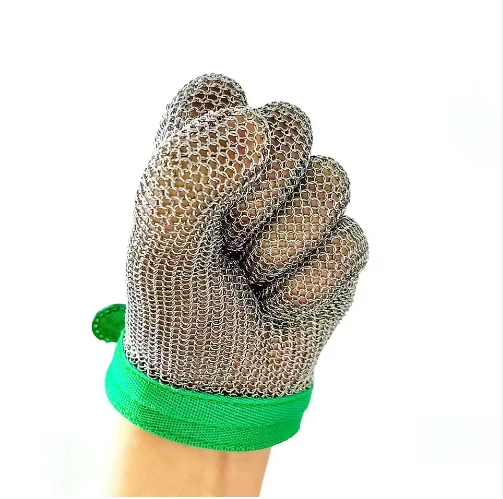
The method used to close individual rings represents one of the most significant technical differences between chainmail gloves. Three closure methods exist, each with distinct performance characteristics.
Butted rings are formed by cutting wire and closing the ends together without welding or riveting. The ends simply meet and are pressed together during assembly. Butted construction offers lower manufacturing costs, making it common for costume and light-duty applications. However, butted rings can separate under sustained tension or impact. When a butted ring opens, the integrity of the chainmail fabric is compromised, potentially creating a gap that exposes the wearer to cut hazards. For industrial protection applications, butted construction is generally not recommended. The force required to open a butted ring varies by wire gauge, with 16 gauge butted rings requiring approximately 20 to 30 kilograms of tensile force to separate. Under dynamic cutting motions or snagging conditions, this threshold can be exceeded.
Riveted rings are closed by overlapping the ends and driving a small rivet through the overlap. This creates a permanent mechanical lock that maintains integrity under tension and impact. Riveted construction represents the historical standard for functional armor and remains the preferred specification for high-quality protective chainmail. Each riveted ring requires multiple manufacturing steps, increasing production time by a factor of three to five compared to butted rings. The tensile strength of a riveted ring closure exceeds that of the wire itself in most cases. Testing indicates that riveted rings fail through wire breakage rather than closure separation when subjected to overload conditions. This characteristic ensures that protective integrity is maintained even under extreme conditions.
Welded rings are permanently joined through electrical resistance welding or other welding processes, creating a continuous metal loop with no mechanical closure point. Welded construction provides the highest level of ring integrity. Each ring forms a complete metal circle with consistent strength around its entire circumference. For industrial protective applications, welded chainmail gloves represent the standard specification. Welded rings maintain consistent tensile strength across the closure area, with typical failure occurring at 80% to 90% of the parent wire strength rather than at a reduced-capacity closure point. This consistency is particularly important for cut protection gloves, where ring failure could allow blade penetration.
Chainmail gloves are not all configured identically. Variations in coverage patterns affect both protection level and wearer dexterity.
Full-coverage chainmail gloves protect the entire hand, including all fingers and thumb. These are standard for meat processing and industrial applications where the entire hand is exposed to cutting hazards. Fingerless or half-coverage designs leave fingertips exposed for enhanced dexterity. These configurations are suitable for applications where fingertip protection is not required or where tactile sensitivity is prioritized over complete coverage. For historical reenactment and costume use, fingerless designs are common.
Wrist coverage length varies significantly between glove models. Standard wrist-length gloves cover the hand and extend approximately 5 to 8 centimeters past the wrist. Extended-cuff gloves provide 10 to 15 centimeters of forearm coverage, protecting the wrist and lower arm areas. Closure systems include: Hook-and-loop straps for adjustable fit Elastic cuffs for consistent tension Buckle closures for secure retention Gauntlet-style extensions for integration with arm protection The choice of closure affects how securely the glove remains positioned during use. For meat processing applications where gloves are frequently removed and replaced, hook-and-loop closures offer convenience. For applications requiring extended wear with consistent positioning, elastic or buckle closures may be preferred.
Chainmail gloves designed for industrial protection must meet specific safety standards. Not all chainmail gloves are certified to these standards, creating a significant distinction between products.
EN 388 is the European standard for protective gloves against mechanical risks. The standard evaluates cut resistance on a scale from Level 1 to Level 5, with Level 5 representing the highest protection. Industrial chainmail gloves typically achieve EN 388 Level 5 cut resistance, indicating the ability to withstand significant blade contact without penetration. Testing involves moving a rotating circular blade across the glove material under controlled pressure, measuring the number of cycles required to cut through. EN 388 also evaluates abrasion resistance, tear resistance, and puncture resistance. Certified gloves must meet minimum performance levels across all categories relevant to their intended use.
EN 1082 is the specific European standard for protective gloves made of chainmail. This standard addresses the unique characteristics of chainmail construction, including ring closure integrity, weave density, and coverage requirements. Gloves certified to EN 1082 undergo testing for: Ring tensile strength Ring closure integrity Cut resistance Puncture resistance Dimensional accuracy Products bearing EN 1082 certification have been independently tested and verified to meet the standard’s requirements. For buyers specifying chainmail gloves for industrial protection, EN 1082 certification provides assurance of product quality and performance.
Not all chainmail gloves sold in the wholesale market carry these certifications. Costume-grade gloves, light-duty products, and imports from non-certifying manufacturers may not have undergone independent testing. When comparing chainmail gloves, the presence or absence of certification represents a fundamental difference in product classification. Certified industrial gloves meet documented performance standards; uncertified products do not provide the same level of performance assurance.
Different industries require chainmail gloves with specifications tailored to their specific hazards and working conditions. A glove suitable for one application may be inadequate for another.
The meat processing industry is the largest user of industrial chainmail gloves. Facilities processing beef, pork, and poultry require gloves that protect workers using knives, saws, and other cutting equipment. Meat processing gloves typically feature: Grade 316 stainless steel for corrosion resistance Welded ring construction for maximum integrity 16 gauge wire for balanced protection and weight Full hand coverage with extended cuffs EN 1082 certification In large processing facilities, gloves are cleaned and sanitized multiple times daily. Corrosion resistance is essential, as frequent exposure to water, blood, and cleaning chemicals would degrade lesser materials.
Seafood processing presents distinct challenges due to salt water exposure and the presence of sharp shells, spines, and processing equipment. Chainmail gloves for seafood applications require: Grade 316 stainless steel for marine corrosion resistance Welded construction to prevent ring separation Fine weave with small ring diameters to resist thin spines Extended coverage for arm protection The combination of salt water and sharp marine hazards demands the highest levels of material and construction quality. Gloves designed for meat processing may not provide adequate corrosion resistance for continuous salt water exposure.
Reenactment chainmail gloves serve different requirements than industrial products. Protection remains important, but historical accuracy, appearance, and mobility receive greater emphasis. Reenactment gloves may use: Butted or riveted construction depending on quality level Grade 304 stainless steel or mild steel 14 or 16 gauge wire for combat applications Historical patterns and designs For heavy combat activities such as Society for Creative Anachronism (SCA) fighting, riveted construction is typically required. Butted rings may open under the impacts of simulated combat, compromising protection.
Costume chainmail gloves prioritize appearance, weight, and cost over industrial protection standards. These products are suitable for theatrical productions, cosplay, and decorative applications. Costume gloves typically feature: Butted aluminum or stainless steel rings Lighter gauges for reduced weight Open weaves for flexibility No safety certifications While these gloves provide visual authenticity, they do not offer the cut protection of industrial-grade products. Buyers should not substitute costume gloves for industrial protection applications.
Beyond specifications, observable quality indicators distinguish chainmail gloves of different quality levels.
High-quality chainmail gloves have rings of consistent diameter and wire gauge throughout. Variations in ring size create gaps in the weave that can compromise protection. Quality manufacturers maintain dimensional tolerances of ±0.1 millimeter for ring diameter and ±0.05 millimeter for wire gauge.
The European 4-in-1 weave pattern should be consistent across the entire glove. Each ring should pass through four adjacent rings in the correct pattern. Gaps, misaligned rings, or irregular patterns indicate quality issues that may affect protective performance.
For welded gloves, weld points should be clean and consistent without burn marks or excessive deformation. For riveted gloves, rivets should be fully seated without gaps between overlapped ring ends. For butted gloves, ring ends should be aligned without sharp protrusions that could snag or cause discomfort.
The edges of chainmail gloves—at the cuff, finger ends, and thumb gusset—should be finished cleanly without protruding ring ends or sharp edges that could cause discomfort or injury during wear.
Chainmail glove prices vary significantly based on the specifications and quality factors described above. Understanding cost drivers helps buyers evaluate whether higher-priced products offer appropriate value for their applications. Factor Lower Cost Impact Higher Cost Impact Material Grade 304 or aluminum Grade 316 Construction Butted rings Welded or riveted rings Certification Uncertified EN 1082 certified Wire gauge 19 gauge or lighter 16 gauge or heavier Ring diameter 10 mm or larger 8 mm or smaller A certified welded grade 316 glove with 16 gauge wire and 8 mm rings will typically cost three to five times more than a butted grade 304 costume glove. For industrial protection applications, the higher cost reflects the engineering and testing required to ensure reliable performance under demanding conditions.
Buyers evaluating chainmail gloves should match product specifications to application requirements rather than assuming all chainmail gloves offer comparable protection. For industrial meat and seafood processing, the appropriate specification includes: Grade 316 stainless steel Welded ring construction 16 gauge wire minimum 8 mm ring diameter or smaller EN 1082 certification Full hand coverage with extended cuff For historical reenactment combat, the appropriate specification includes: Grade 304 stainless steel or mild steel Riveted ring construction 16 gauge wire Historical pattern accuracy Sizing for wear with padded undergarments For costume and theatrical use, the appropriate specification may include: Butted aluminum or stainless steel rings Lighter wire gauges Open weaves for reduced weight Aesthetic appearance prioritized over certification
Chainmail gloves are not all the same. Technical differences in material composition, ring closure method, wire gauge, ring diameter, and certification status produce gloves with distinctly different performance characteristics suitable for different applications. For industrial protection applications, welded stainless steel gloves meeting EN 1082 standards provide the reliability required for worker safety. For historical reenactment, riveted construction offers structural integrity with historical authenticity. For costume use, butted aluminum or stainless steel gloves provide visual impact at lower cost and weight. Hebei Linchuan Safety Protective Equipment Co., LTD manufactures chainmail gloves across these specifications, with particular expertise in welded stainless steel products for industrial protection. The company’s products include grade 316 stainless steel chainmail gloves with welded ring construction, available with EN 1082 certification for applications requiring documented protection standards. Buyers selecting chainmail gloves should evaluate their specific requirements against the technical specifications described in this comparison to ensure appropriate product selection.